
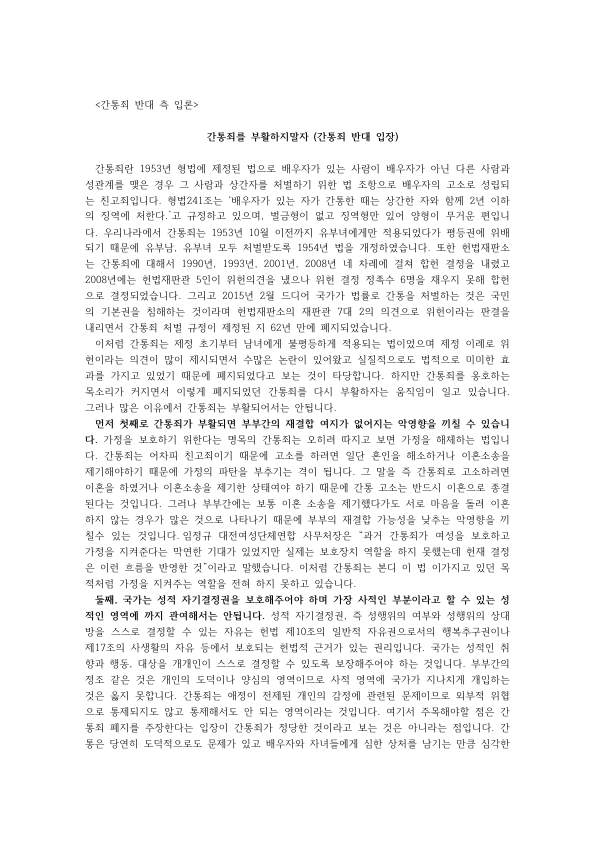
Page 1 is shown as is; from page 2 on, the preview is blurred. Buy it to download the complete original file right away (the file itself is written in Korean).
Packed with real examples and experience. Download it now and save time.
Save your valuable time
Buyer ratings
Fast, accurate and useful.
No ratings yet. Be the first to rate it.


Should Korea Bring Back the Adultery Crime? A Debate Brief Against Revival Based on Sexual Self-Determination
※ You can preview page 1 as is. Buy it to download the complete original file right away. The file itself is written in Korean.
■ Should Korea Bring Back the Adultery Crime? A Debate Brief Against Revival Based on Sexual Self-Determination — Overview
A 3-page Korean debate brief opposing the revival of Korea's former adultery crime (Criminal Act art. 241). It traces the Constitutional Court's four decisions upholding the law and its 7-2 ruling in February 2015 striking it down, argues that criminal punishment discouraged reconciliation and intruded on sexual self-determination and privacy, and rebuts three likely arguments for revival, proposing stronger civil remedies such as punitive damages instead.
■ Should Korea Bring Back the Adultery Crime? A Debate Brief Against Revival Based on Sexual Self-Determination — Excerpt from the original document (English translation)
Finally, the legal effectiveness of the crime of adultery is minimal, and its purported aim of protecting women is turning out to be practically meaningless. In fact, it is said that the rate of actual prison sentences, that is, actually being detained and serving a sentence, under the charge of adultery is less than 1%. To prove an adultery charge, one must prove the scene of intercourse together with the police or have evidence, and it is practically not easy for the injured spouse alone to go through such procedures and obtain a legal remedy. In addition, not only investigative agencies but also the judicial bodies handling trials recognize that adultery is a controversial and ambiguous area, so an atmosphere has formed in which the judiciary, too, tacitly hushes up the crime of adultery. Moreover, although the crime of adultery legally has the purported aim of protecting women, it cannot be seen as protecting them: when a woman, the economically weaker party, commits adultery, she is unlikely to be able to pay her husband consolation money and have him withdraw the complaint, whereas when a man, the economically stronger party, commits adultery, he is likely to pay a large amount of consolation money and avoid punishment for adultery. Furthermore, because there is greater social condemnation of women's adultery than men's and a more negative social view of divorced women than divorced men, the crime of adultery cannot be said to be for women. What matters is what role punishing adultery actually plays in providing relief to divorcing couples, and in reality divorcing without establishing the crime of adultery lets the victim obtain greater economic benefit. Since men still hold economic control in many households, what women need most upon divorce is economic independence. But when a guilty verdict is reached for adultery, the amount of consolation money tends to be lowered; and while the mental suffering caused by divorce and adultery is great, if economic power is seen as important when looking at the life of the female victim after divorce, it would be better to abolish the meaningless crime of adultery and substantially raise consolation money.
For reference, the crime of adultery punished both men and women from Article 241 of the Criminal Act as enacted in 1953. The original text's explanation that it was made to punish both parties by a 1954 amendment is not accurate, so correct it in your assignment. The provision lost effect through the decision of unconstitutionality on February 26, 2015 (2009Heonba17, etc.), and under the proviso to Article 47(3) of the Constitutional Court Act it lost effect retroactively only back to the day after October 30, 2008, the date of the previous decision upholding constitutionality. People whose convictions became final after that date could petition for retrial, and this standard was first introduced in the Constitutional Court Act as amended in 2014.
■ Should Korea Bring Back the Adultery Crime? A Debate Brief Against Revival Based on Sexual Self-Determination — Contents and key concepts
Is adultery a crime in Korea today?
✦ At a glance
- How Korea's adultery crime ended in 2015
- Structure: opening case → two arguments → three rebuttals
- Useful for criminal law, constitutional law and debate classes
☰ What the paper covers
- What the adultery crime required
- The Constitutional Court decisions
- Arguments against revival
- Civil remedies as an alternative
✎ Adultery and the Korean Constitutional Court
Korea punished adultery with up to two years in prison until 2015. The offense could be prosecuted only on the spouse's complaint, which required divorce proceedings first.
After upholding the law four times, the Constitutional Court struck it down 7-2 in February 2015, holding that it excessively restricted sexual self-determination and privacy. Most U.S. states have also repealed adultery laws, and the few that remain are rarely enforced.
Note: the paper itself is written in Korean and discusses Korean law. This page is general study information, not legal advice.
Related wiki: Sexual Autonomy and the Law
Take a break with a quick personality test?
Ranked by actual participation. Results in about a minute.
Loading…
Most-read content
Loading view counts…

Campusdown is a lifelong-learning community in Korea offering study materials, information on government support, student loans and scholarships, and more. Don't miss our free resources.
Go to the Campusdown home page →Refund policy
- Change of mind / refund requested after partial use / more than 7 days after purchase
◆ Exceptions
- File errors / cannot download or open the file
◆ How to request a refund: send a 1:1 inquiry via Customer Service at the top