
Page 1 is shown as is; from page 2 on, the preview is blurred. Buy it to download the complete original file right away (the file itself is written in Korean).
Packed with real examples and experience. Download it now and save time.
Save your valuable time
Buyer ratings
Fast, accurate and useful.
No ratings yet. Be the first to rate it.


Should Korea Adopt Day Fines? Income-Based Fines Versus Fixed-Sum Fines, the Emperor Labor Controversy and Equal Impact of Punishment
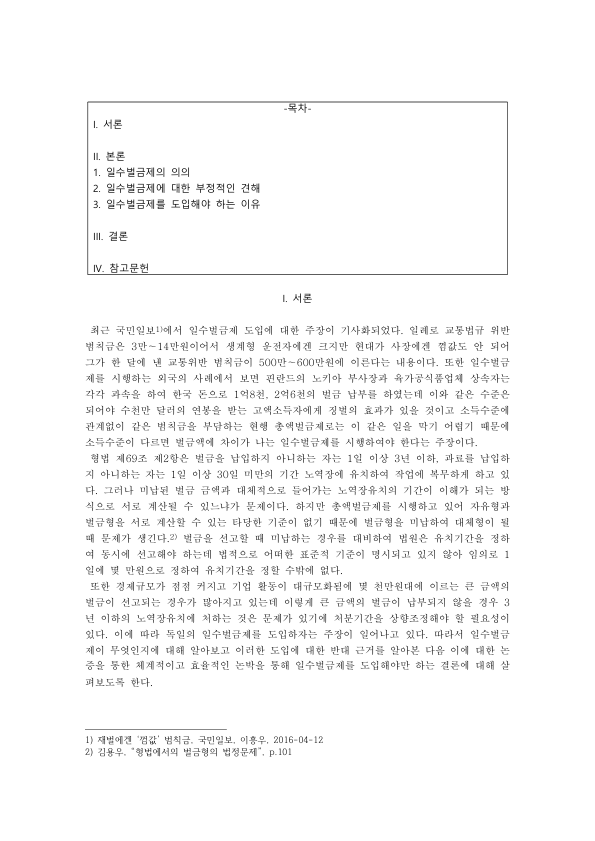
※ You can preview page 1 as is. Buy it to download the complete original file right away. The file itself is written in Korean.
■ Should Korea Adopt Day Fines? Income-Based Fines Versus Fixed-Sum Fines, the Emperor Labor Controversy and Equal Impact of Punishment — Overview
A 5-page Korean criminal policy paper on day fines. It explains how fixed-sum fines barely affect the rich, how day fines combine a number of days set by culpability with a daily rate set by income, the Korean Bar Association's objections, and the 2014 reform after a tycoon worked off a huge fine at 500 million won a day.
■ Should Korea Adopt Day Fines? Income-Based Fines Versus Fixed-Sum Fines, the Emperor Labor Controversy and Equal Impact of Punishment — Excerpt from the original document (English translation)
The day-fine system was first introduced in Finland in 1921 and then in Scandinavian countries such as Sweden in 1931 and Denmark in 1939, in Germany and Austria in 1975 and in France in 1988, and it has also been adopted in many other countries including Hungary, Norway, Poland, Switzerland and Portugal. Under a day-fine system, stating the number of fine days shows the offender's culpability outwardly, satisfying the culpability principle, and because the daily amount differs by grade according to the offender's financial situation, it can also satisfy the principle of equal sacrifice.
So, at least in theory, the day-fine system removes the drawbacks of the fixed-sum fine system, which either ignores the offender's financial situation or takes it into account only by guesswork at the judge's discretion, and achieves justice in fines by individualizing the penalty. Fines have a special character that sets them apart from other penalties. For other penalties, the length of punishment is proportionate to wrongdoing and culpability, so the 'principle of equal sacrifice,' the standard of fairness in punishment, and the 'culpability principle,' its basis of legitimacy, are automatically satisfied.
Even when life is forcibly taken or qualifications and liberty are forcibly taken away, the same length is regarded as the same suffering. With fines, however, even if people pay the same fine for acts of the same wrongdoing and culpability, their financial situations differ, so in reality people with less financial ability or property suffer more, departing from the principle of equal sacrifice. On the other hand, if fines for the same crime are graded according to financial circumstances, the amount of the fine no longer tracks the degree of wrongdoing or culpability, departing from the culpability principle.
If a fine reflects the offender's financial circumstances but is too large, it can strip away the person's economic foundation or turn into a substitute custodial sentence, losing the advantages of a fine, and if it is too small, it loses its punitive effect. The difficulty in running a fine system is how to reflect differences in offenders' financial situations, and the day-fine system was devised as a solution to this problem. The day-fine system reflects a shift in criminal justice ideology that places more weight on 'sentencing based on justice' than on 'the offender's return to society through correction.'
Running a day-fine system would make it easier for offenders to accept both a fine amount that meets the demand for equal sacrifice and the authority of the criminal justice system, because fines would be imposed according to each offender's financial condition. If courts used their broader discretion over fine amounts to widen the use of fines, custodial sentences would become a last resort. Compared with the fixed-sum fine system, which reflects the seriousness of the crime and the offender's finances without order or system, judgments would become more rational and precise, and the system would also cope more easily with inflation.
The term noblesse oblige is a French phrase meaning the moral responsibility and duty required of people of high status and rank.
To add: Article 70(2) of the Criminal Act, added in May 2014 after the emperor labor controversy, requires courts to set a detention period of at least 300 days for fines of 100 million won or more but under 500 million won, at least 500 days for fines of 500 million won or more but under 5 billion won, and at least 1,000 days for fines of 5 billion won or more. The cap on workhouse detention is still three years (Article 69(2)). As of 2026 Korea has not adopted day fines, and under the Special Act on the Execution of Community Service for Fine Defaulters, in force since 2009, people who cannot pay a fine can apply for community service instead of detention. France adopted day fines in 1983.
■ Should Korea Adopt Day Fines? Income-Based Fines Versus Fixed-Sum Fines, the Emperor Labor Controversy and Equal Impact of Punishment — Contents and key concepts
Should fines be scaled to the offender's income?
✦ At a glance
- The case for day fines in Korea
- Structure: problem → how day fines work → objections → arguments for
- Useful for criminal law and criminal policy courses
☰ What the paper covers
- Problems with fixed fines
- Three steps of day fines
- Objections from the bar
- The 2014 reform
- Adoption abroad
✎ Day fines in Korea and the U.S.
Korea still uses fixed-sum fines, though it raised minimum detention periods for unpaid large fines in 2014 after an emperor labor scandal.
In the U.S., the Supreme Court in Bearden v. Georgia (1983) barred jailing people solely for inability to pay, and some jurisdictions have piloted day fines.
Note: the paper itself is written in Korean and discusses Korean law. This page is general study information, not legal advice.
Related wiki: Theories of Punishment
■ Should Korea Adopt Day Fines? Income-Based Fines Versus Fixed-Sum Fines, the Emperor Labor Controversy and Equal Impact of Punishment References
- 企業犯罪의 統制方案에 관한 硏究, 안상욱, 명지대학교 대학원, 2010
- 조세범처벌법에 관한 연구 : 조세포탈을 중심으로, 조길태, 성균관대학교 일반대학원, 2012 行政刑罰과 行政秩序罰의 比較 硏究, 박찬명, 성균관대학교 일반대학원, 2012 商事法上 株式會社 關聯 刑事責任 硏究, 박성수, 高麗大學校 大學院, 2010
- 개인적 법익에 대한 죄의 법정형 정비방안, 김민희, 한양대학교 대학원, 2011 6.
- 벌금형제도의 문제점과 개선방안, 고요석, 서울대학교 대학원, 2014 7.
- 시민성 함양을 위한 고등학교 청소년의 나눔교육, 강현주, 한국교원대학교 대학원, 2009 1.
- 재벌에겐 ‘껌값’ 범칙금, 국민일보, 이흥우, 2016-04-12 2.
- 변협 "일수벌금제 도입 반대", 법률신문, 임순현, 2014-02-14 3.
- 억대 ‘황제 노역’ 사라졌지만…수천만원 ‘귀족 노역’ 여전, 한겨레, 정환봉, 2015-09-29
Take a break with a quick personality test?
Ranked by actual participation. Results in about a minute.
Loading…
Most-read content
Loading view counts…

Campusdown is a lifelong-learning community in Korea offering study materials, information on government support, student loans and scholarships, and more. Don't miss our free resources.
Go to the Campusdown home page →Refund policy
- Change of mind / refund requested after partial use / more than 7 days after purchase
◆ Exceptions
- File errors / cannot download or open the file
◆ How to request a refund: send a 1:1 inquiry via Customer Service at the top