
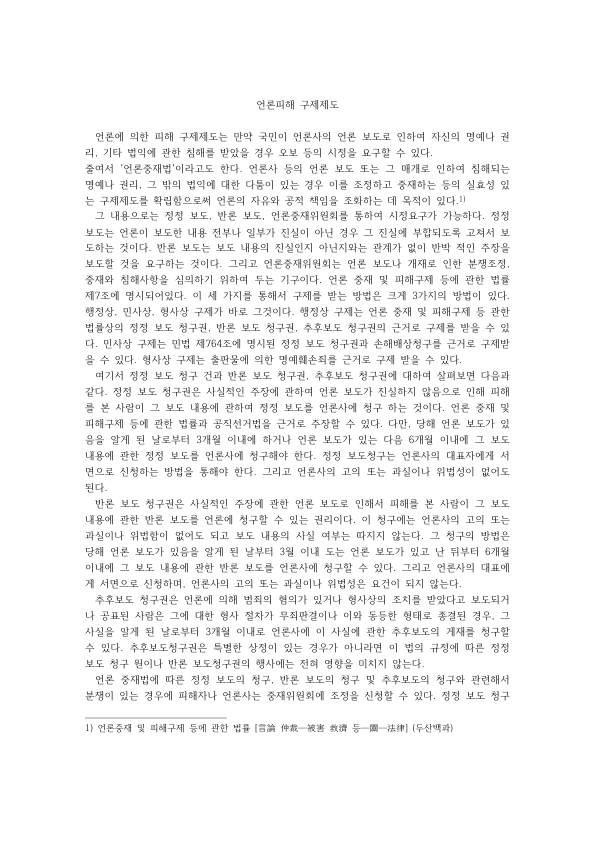
Page 1 is shown as is; from page 2 on, the preview is blurred. Buy it to download the complete original file right away (the file itself is written in Korean).
Packed with real examples and experience. Download it now and save time.
Save your valuable time
Buyer ratings
Fast, accurate and useful.
No ratings yet. Be the first to rate it.

Remedies for Press Harm in Korea: Correction, Reply and Follow-Up Reports under the Press Arbitration Act, Mediation and Lawsuits
※ You can preview page 1 as is. Buy it to download the complete original file right away. The file itself is written in Korean.
■ Remedies for Press Harm in Korea: Correction, Reply and Follow-Up Reports under the Press Arbitration Act, Mediation and Lawsuits — Overview
A 2-page Korean media law summary. It explains the Press Arbitration Act's right to demand a correction, a reply or a follow-up report, the three-month and six-month deadlines, mediation and arbitration by the Press Arbitration Commission and their legal effect, correction lawsuits that must be decided within three months, and the strict limits on pre-publication injunctions.
■ Remedies for Press Harm in Korea: Correction, Reply and Follow-Up Reports under the Press Arbitration Act, Mediation and Lawsuits — Excerpt from the original document (English translation)
The system of remedies for harm caused by the press lets citizens demand correction of false reports when a news report infringes their reputation, rights or other legal interests.
It is known for short as the Press Arbitration Act. Its purpose is to harmonize press freedom with the press's public responsibility by establishing effective remedies, such as mediation and arbitration, for disputes over reputation, rights or other legal interests infringed by press reports or their distribution.
Under it, people can seek correction through correction reports, reply reports and the Press Arbitration Commission. A correction report revises a report so that it matches the truth when all or part of it is untrue. A reply report is a demand that the outlet publish a rebuttal, regardless of whether the original report is true. The Press Arbitration Commission is the body that mediates and arbitrates disputes over reports and deliberates on infringements; it is provided for in Article 7 of the Act. Through these three, there are broadly three kinds of remedy: administrative, civil and criminal.
Note: The Press Arbitration Act was enacted on January 27, 2005 and took effect on July 28, 2005. Article 14 says a claim for a correction does not require intent, negligence or illegality on the part of the outlet, but under Supreme Court case law the person seeking the correction bears the burden of proving that the report was untrue. The correction, reply and follow-up claims the paper calls 'administrative remedies' are not administrative procedures but remedies created by the Press Arbitration Act, and Article 764 of the Civil Act provides for measures to restore reputation in defamation cases, not a right to a correction report.
■ Remedies for Press Harm in Korea: Correction, Reply and Follow-Up Reports under the Press Arbitration Act, Mediation and Lawsuits — Contents and key concepts
Three ways to fix a wrong news story
✦ At a glance
- How Korean law lets people correct harmful news reports
- Structure: purpose → remedies → three claims → mediation → courts
- Useful for media law and journalism courses
☰ What the paper covers
- Correction and reply
- Follow-up reports
- Deadlines
- Mediation and arbitration
- Injunctions
✎ Press corrections in Korea and the U.S.
Korea gives people a statutory right to demand corrections and replies, enforced through a press arbitration commission and the courts.
In the U.S., the Supreme Court struck down a right-of-reply law in Miami Herald v. Tornillo (1974), so remedies rely mainly on defamation suits and voluntary corrections.
Note: the paper itself is written in Korean and discusses Korean law. This page is general study information, not legal advice.
Related wiki: The First Amendment and Free Speech, Truth as a Defense to Defamation
Take a break with a quick personality test?
Ranked by actual participation. Results in about a minute.
Loading…
Most-read content
Loading view counts…

Campusdown is a lifelong-learning community in Korea offering study materials, information on government support, student loans and scholarships, and more. Don't miss our free resources.
Go to the Campusdown home page →Refund policy
- Change of mind / refund requested after partial use / more than 7 days after purchase
◆ Exceptions
- File errors / cannot download or open the file
◆ How to request a refund: send a 1:1 inquiry via Customer Service at the top