
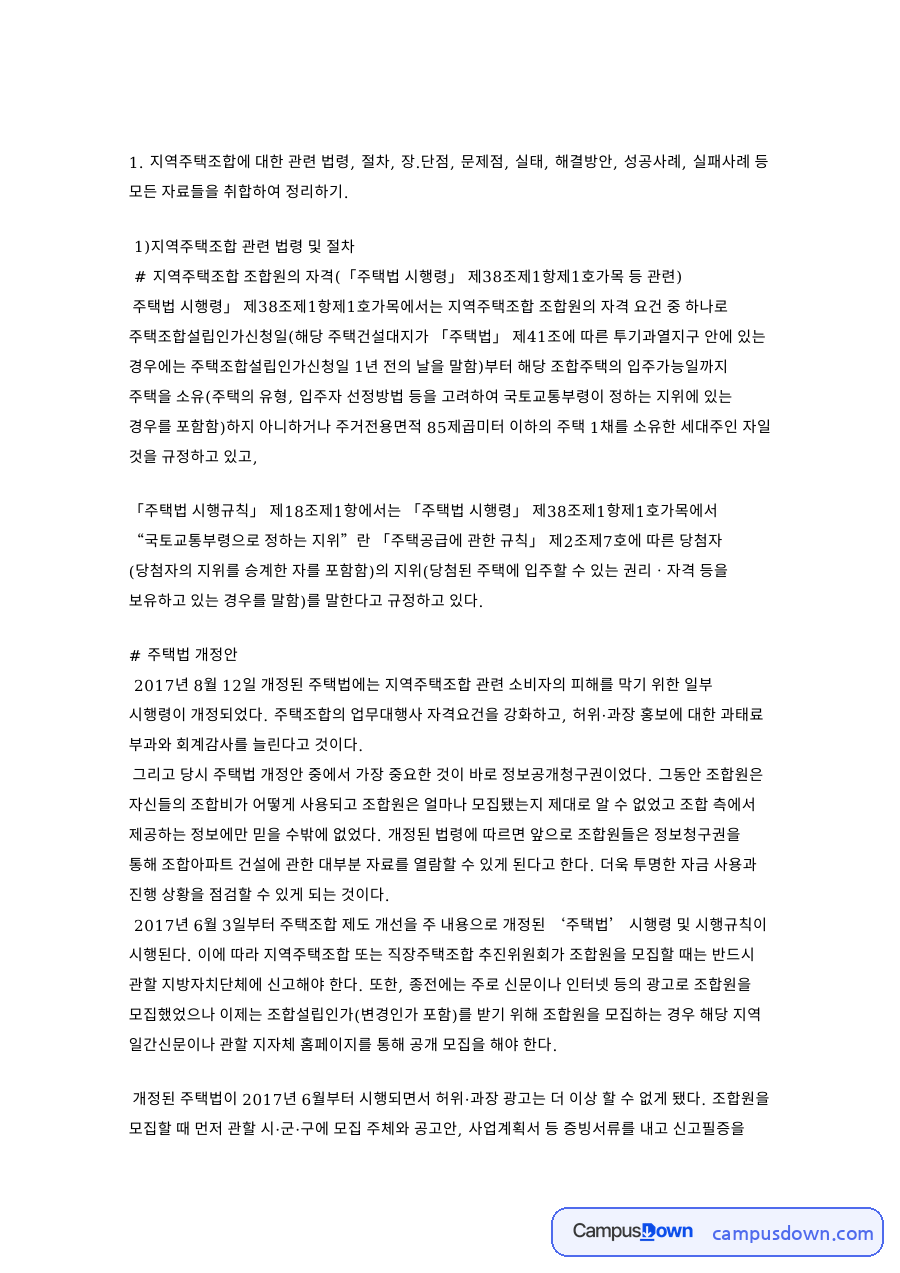
Page 1 is shown as is; from page 2 on, the preview is blurred. Buy it to download the complete original file right away (the file itself is written in Korean).
Packed with real examples and experience. Download it now and save time.
Save your valuable time
Buyer ratings
Fast, accurate and useful.
No ratings yet. Be the first to rate it.


1 / 10
좌우로 밀어서 페이지를 넘겨보세요
과제 개요
| 전체 페이지 수 | 10페이지 |
|---|---|
| 파일 형식 | 한글(HWP) |
| 등록일 | 2025.07.21 |
캠퍼스다운 도움말
해당 자료는 No AI 자료입니다. 인싸이트를 얻고 새롭게 가공해 보세요.
자료를 받아서 이용하면 품질이 확 올라갑니다.
- 지역주택조합
- 주택법
- 조합원 자격
- 조합원 모집 신고
- 토지 사용권원
- 업무대행사
- 내 집 마련
- 부동산법
Regional Housing Cooperatives in Korea: Laws and Procedures, Pros and Cons, Problems, Member Recruitment Rules and Solutions
※ You can preview page 1 as is. Buy it to download the complete original file right away. The file itself is written in Korean.
■ Regional Housing Cooperatives in Korea: Laws and Procedures, Pros and Cons, Problems, Member Recruitment Rules and Solutions — Overview
A 9-page Korean real estate law paper on regional housing cooperatives, where local households form a cooperative to buy land and build apartments themselves. It covers member eligibility under the Housing Act, amendments requiring reported and public recruitment, the cost advantages, risks such as land acquisition delays, extra charges and misleading ads, cases, and solutions.
■ Regional Housing Cooperatives in Korea: Laws and Procedures, Pros and Cons, Problems, Member Recruitment Rules and Solutions — Excerpt from the original document (English translation)
A regional housing cooperative is a cooperative formed to obtain one's own home: a system that supplies housing to heads of households who own no home or a small home (one home of 85 square meters or less of exclusive area, including winners of housing subscriptions and their successors), regardless of whether they hold a housing subscription account. It is meant to curb reckless real estate speculation and serve people who actually need a place to live.
Members are recruited to build an apartment complex together, and because the cooperative itself becomes the developer, buys the site, chooses the builder directly and runs the project, it has the advantage of speed. In particular, since the members are effectively the developer, the project puts the members' interests first and many benefits go to them. Because the builder handles only construction, margins can be cut, so apartments are supplied relatively below market price.
Other advantages are that the price is lower than nearby general-sale apartments, no housing subscription account is needed, and one can apply regardless of subscription priority.
In addition, units can be transferred freely after project approval without resale restrictions, and members get priority in unit allocation over general buyers. Groups of like-minded people or coworkers can also form a club, join the cooperative and move in together, which helps build a community network.
But cooperative apartments do not have only advantages. So when choosing one, it is necessary to consider fully the problems that may arise.
First, if fewer than 50 percent of members have been recruited, the project can be delayed, and the damage falls entirely on the members. Because the project proceeds with a guarantee from the Korea Housing Guarantee Corporation, if the builder goes bankrupt or the cooperative defaults, the members bear all the responsibility. Even if it is said that 100 percent of the land has been bought during recruitment, in some cases only part of the land is purchased and the rest proceeds with mere land-use consents, which carries risk.
Second, the members' price is initially set low, but if it does not include extra costs such as land purchases, design fees, supervision fees, permit costs and agency fees, the price may well rise. A bigger problem is that if the cooperative cannot be formed, the entire project can come to nothing.
Just the plan for a regional cooperative apartment leads local landowners to set compensation above market prices. Some nearby landowners even plant trees or put up temporary buildings. With such behavior slowing the project, extra charges arise, and the members' burden and internal conflict grow.
Third, if there are special facilities on the site, buying the land takes time, and the resulting delay becomes the members' burden.
Beyond that, if the cooperative's agent sells units twice and gets entangled in lawsuits, disputes can arise among members; if the location is poor and recruitment slows, or if securing a top-tier builder is difficult, the asset value may be undervalued because of the apartment's brand image. Delays due to the bankruptcy of the agent or the builder are another problem. The fundamental problem of regional housing cooperatives stems from recruiting members before land acquisition and the project plan are fixed, so that if land is hard to secure, members face extra charges and the project runs behind schedule. Problems such as spreading false information arise especially at the steering committee stage, when members are recruited before applying for incorporation approval, and there are currently no rules on this at all.
Note: The Housing Act amendment introducing reported recruitment and mandatory public recruitment was promulgated on December 2, 2016 and took effect on June 3, 2017; the paper's reference to an 'amendment of August 12, 2017' could not be confirmed. An amendment in force from July 24, 2020 then required land-use rights to at least 50 percent of the site when reporting recruitment, and at least 80 percent land-use rights plus 15 percent ownership for incorporation approval. Check the current law for provisions and requirements. The paper's statement that there are 'no rules at all' at the steering committee stage reflects the time it was written.
■ Regional Housing Cooperatives in Korea: Laws and Procedures, Pros and Cons, Problems, Member Recruitment Rules and Solutions — Contents and key concepts
Cheap and fast homeownership, and its price
✦ At a glance
- How Korea's regional housing cooperatives work and why they go wrong
- Structure: laws → advantages → problems → cases → solutions
- Useful for real estate law and housing policy courses
☰ What the paper covers
- Member eligibility
- Recruitment rules
- Land acquisition risk
- Extra charges
- Transparency
✎ Housing cooperatives in Korea and the U.S.
Korea tightened rules from 2017 and 2020, requiring reported public recruitment and minimum land-use rights before recruiting and incorporating.
In the U.S., housing cooperatives usually own existing buildings and sell shares to residents, and their offerings are regulated mainly under state law.
Note: the paper itself is written in Korean and discusses Korean law. This page is general study information, not legal advice.
Related wiki: Property Deeds and Recording
Keyword Prompt
전문가가 만들었어요과제를 직접 쓰는 데 도움이 되는 영어 프롬프트예요.
Tip! Prompt 에 자신의 생각을 추가해서 하면 훨씬 더 ✨ 좋습니다.
캠퍼스다운에서 레포트 받고 잘 쓰는 법 3가지, AI로 참고자료 제대로 재가공하기 →Prompt 1
I'm writing a university assignment on "지역주택조합의 법령과 절차, 장단점과 문제점: 조합원 자격, 주택법 개정과 모집 신고제, 피해 실태와 해결방안". Help me build an outline (introduction, 2-3 body sections, conclusion) that covers 지역주택조합, 주택법 and 조합원 자격. Don't write the paper for me - give me guiding questions for each section. My own perspective: [자신의 생각 넣는 곳] Please respond in Korean.
Prompt 2
Explain the key concepts "지역주택조합" and "주택법" in simple terms, then show how they connect to the topic "지역주택조합의 법령과 절차, 장단점과 문제점: 조합원 자격, 주택법 개정과 모집 신고제, 피해 실태와 해결방안". Point out common misunderstandings students have about them. My own perspective: [자신의 생각 넣는 곳] Please respond in Korean.
Prompt 3
Suggest 3 real-world cases or examples I could analyze in an assignment on "지역주택조합의 법령과 절차, 장단점과 문제점: 조합원 자격, 주택법 개정과 모집 신고제, 피해 실태와 해결방안", focusing on "조합원 자격". For each, tell me what I should look up and verify in official or academic sources. My own perspective: [자신의 생각 넣는 곳] Please respond in Korean.
Prompt 4
Review my draft paragraph on "지역주택조합의 법령과 절차, 장단점과 문제점: 조합원 자격, 주택법 개정과 모집 신고제, 피해 실태와 해결방안" (key idea: "조합원 모집 신고"). Give feedback on logic, evidence and clarity, and mark where I need a citation. My paragraph: [paste here] My own perspective: [자신의 생각 넣는 곳] Please respond in Korean.
Take a break with a quick personality test?
Ranked by actual participation. Results in about a minute.
Loading…
Most-read content
Loading view counts…

Campusdown is a lifelong-learning community in Korea offering study materials, information on government support, student loans and scholarships, and more. Don't miss our free resources.
Go to the Campusdown home page →Refund policy
- Change of mind / refund requested after partial use / more than 7 days after purchase
◆ Exceptions
- File errors / cannot download or open the file
◆ How to request a refund: send a 1:1 inquiry via Customer Service at the top