
Page 1 is shown as is; from page 2 on, the preview is blurred. Buy it to download the complete original file right away (the file itself is written in Korean).
Packed with real examples and experience. Download it now and save time.
Save your valuable time
Buyer ratings
Fast, accurate and useful.
No ratings yet. Be the first to rate it.


1 / 6
좌우로 밀어서 페이지를 넘겨보세요
과제 개요
| 전체 페이지 수 | 6페이지 |
|---|---|
| 파일 형식 | 한글(HWP) |
| 등록일 | 2025.07.17 |
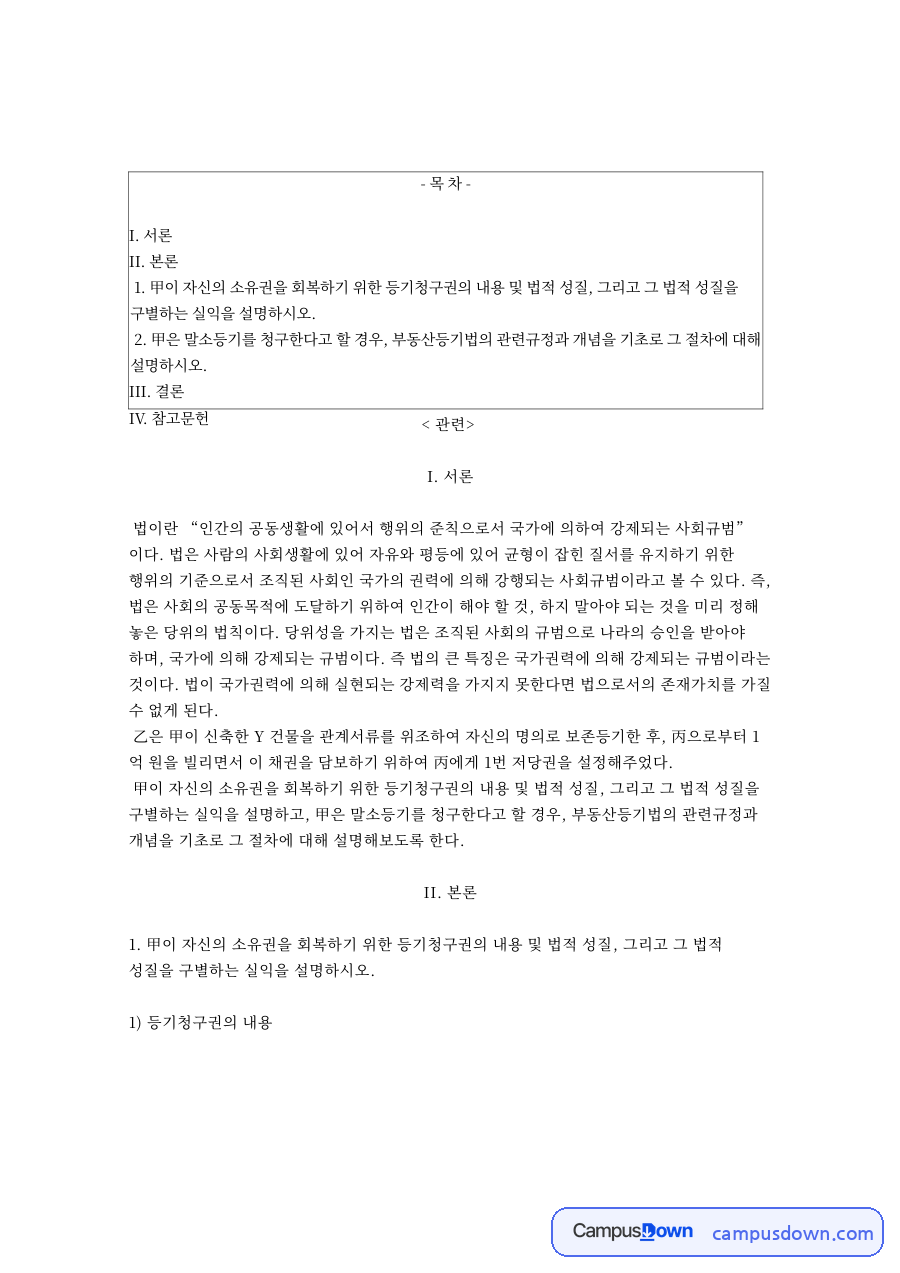
목차
- 1I. 서론
- 2II. 본론
- 2.11. 甲이 자신의 소유권을 회복하기 위한 등기청구권의 내용 및 법적 성질, 그리고 그 법적 성질을 구별하는 실익을 설명하시오
- 2.22. 甲은 말소등기를 청구한다고 할 경우, 부동산등기법의 관련규정과 개념을 기초로 그 절차에 대해 설명하시오
- 3III. 결론
- 4IV. 참고문헌
캠퍼스다운 도움말
해당 자료는 No AI 자료입니다. 인싸이트를 얻고 새롭게 가공해 보세요.
자료를 받아서 이용하면 품질이 확 올라갑니다.
- 등기청구권
- 말소등기
- 진정명의회복
- 물권적 청구권
- 채권적 청구권
- 부동산등기법
- 보존등기
- 저당권
- 이해관계 있는 제3자
Recovering Title After a Forged Registration in Korea: The Legal Nature of Registration Claims, Cancellation of Registration and Transfer to Restore True Title
※ You can preview page 1 as is. Buy it to download the complete original file right away. The file itself is written in Korean.
■ Recovering Title After a Forged Registration in Korea: The Legal Nature of Registration Claims, Cancellation of Registration and Transfer to Restore True Title — Overview
A 5-page Korean property law case problem. Someone forged papers to register another person's new building in his own name and then mortgaged it. The paper explains why registration claims exist, which ones are contractual or proprietary, how cancellation works when a mortgagee has an interest, and the alternative of a direct transfer to restore title.
■ Recovering Title After a Forged Registration in Korea: The Legal Nature of Registration Claims, Cancellation of Registration and Transfer to Restore True Title — Excerpt from the original document (English translation)
The Supreme Court once held that "when a registration has been transferred successively without cause, the true owner who wants to restore his name as owner may perhaps demand cancellation of that registration from the registered holder, but cannot demand performance of a transfer registration on the ground of recovery of ownership" (Supreme Court Decision 72Da1846, 1847, December 26, 1972). Later, however, the Court held: "A person who already had a registration showing ownership in his name, or who acquired ownership by law, should be allowed, as a way to restore the true registered title, not only to seek cancellation of the registration from the current registered holder but also to seek directly performance of a transfer registration on the ground of restoring true title. This is because the purpose of the real estate registration system in trying to show the course of real rights changes as it occurred is ultimately to exclude registrations that do not match the facts and to publicly show the present state of rights as legitimate, thereby promoting the safety of real estate transactions, and the current false registered holder has a duty to cooperate in publicly showing the true owner; whether he cooperates in restoring the true registered title by cancelling his own registration or by directly transferring it to the true holder, there is no essential difference, and either way he loses his registration and his interests are the same. Accordingly, the decisions to the contrary, including Decision 72Da1846, 1847 of December 26, 1972 and Decision 78Da1916 of January 13, 1981, are overruled."
The Supreme Court has held that "even where the consent of a third party with an interest on the register is required in the procedure for registration of restoration after cancellation, unless that third party has a substantive legal duty to consent in relation to the person entitled to registration, he has no reason to comply with the request for consent" (see Supreme Court Decision 78Da2040, November 13, 1979, and Decision 85Daka2203, May 26, 1987).
When the actual legal relationship and the registration do not match because of forged documents, the substantive owner A can exercise a claim for cancellation of registration as a real-right claim. However, when cancellation is applied for, Article 57(1) of the Real Estate Registration Act requires the consent of any third party with an interest on the register in that cancellation. Therefore A must obtain the consent of C, who registered a mortgage on the register in B's name, to seek cancellation against B. However, C need not give consent unless he has a substantive legal duty to give it to A, the person entitled to registration.
If A does not seek cancellation but instead seeks a transfer registration to restore true title, A can seek a transfer registration from B's name to his own regardless of C's consent. In that case C's mortgage remains and is carried over to A's title.
To add: the precedent that allowed a claim for transfer registration on the ground of restoring true title is Supreme Court En Banc Decision 89Daka12398 of November 27, 1990. Article 621 of the Civil Act, which the paper cites as the basis for registration claims, is the provision on a lessee's right to demand registration of a lease, and there is no single article governing registration claims in general. A forged registration is void, and because Korean law does not give registrations public faith, C, who took a mortgage relying on it, is in principle not protected either. The Real Estate Registration Act was fully revised in 2011, and the paper follows the article numbers after the revision.
■ Recovering Title After a Forged Registration in Korea: The Legal Nature of Registration Claims, Cancellation of Registration and Transfer to Restore True Title — Contents and key concepts
How does a true owner undo a forged registration?
✦ At a glance
- Registration claims and cancellation in Korea
- Structure: facts → nature of claims → procedure → solution
- Useful for property law courses
☰ What the paper covers
- Joint application rule
- Contractual vs. proprietary claims
- Why the difference matters
- Third-party consent
- Restoring true title
✎ Forged deeds in Korea and the U.S.
Korea gives registrations no public faith, so a mortgage built on a forged registration is generally void and the owner can demand cancellation.
In the U.S., a forged deed is void and passes no title even to a good faith buyer, and owners usually sue to quiet title while title insurance covers the buyer's loss.
Note: the paper itself is written in Korean and discusses Korean law. This page is general study information, not legal advice.
Related wiki: Property Deeds and Recording
■ Recovering Title After a Forged Registration in Korea: The Legal Nature of Registration Claims, Cancellation of Registration and Transfer to Restore True Title References
- 송의성. "등기청구권에 관한 연구." 국내석사학위논문 원광대학교 일반대학원, 2019.
- 전라북도 배정인. "부동산실명법의 개정 방향과 등기의 공신력 도입에 관한 연구." 국내박사학위논문 계명대학교 대학원, 2019.
- 대구 박봉남. "가등기담보에 관한 연구." 국내석사학위논문 경상대학교 대학원, 2018. 경상남도
Keyword Prompt
전문가가 만들었어요과제를 직접 쓰는 데 도움이 되는 영어 프롬프트예요.
Tip! Prompt 에 자신의 생각을 추가해서 하면 훨씬 더 ✨ 좋습니다.
캠퍼스다운에서 레포트 받고 잘 쓰는 법 3가지, AI로 참고자료 제대로 재가공하기 →Prompt 1
I'm writing a university assignment on "등기청구권의 법적 성질과 말소등기 절차: 위조 보존등기와 저당권자의 승낙, 진정명의회복 이전등기". Help me build an outline (introduction, 2-3 body sections, conclusion) that covers 등기청구권, 말소등기 and 진정명의회복. Don't write the paper for me - give me guiding questions for each section. My own perspective: [자신의 생각 넣는 곳] Please respond in Korean.
Prompt 2
Explain the key concepts "등기청구권" and "말소등기" in simple terms, then show how they connect to the topic "등기청구권의 법적 성질과 말소등기 절차: 위조 보존등기와 저당권자의 승낙, 진정명의회복 이전등기". Point out common misunderstandings students have about them. My own perspective: [자신의 생각 넣는 곳] Please respond in Korean.
Prompt 3
Suggest 3 real-world cases or examples I could analyze in an assignment on "등기청구권의 법적 성질과 말소등기 절차: 위조 보존등기와 저당권자의 승낙, 진정명의회복 이전등기", focusing on "진정명의회복". For each, tell me what I should look up and verify in official or academic sources. My own perspective: [자신의 생각 넣는 곳] Please respond in Korean.
Prompt 4
Review my draft paragraph on "등기청구권의 법적 성질과 말소등기 절차: 위조 보존등기와 저당권자의 승낙, 진정명의회복 이전등기" (key idea: "물권적 청구권"). Give feedback on logic, evidence and clarity, and mark where I need a citation. My paragraph: [paste here] My own perspective: [자신의 생각 넣는 곳] Please respond in Korean.
Take a break with a quick personality test?
Ranked by actual participation. Results in about a minute.
Loading…
Most-read content
Loading view counts…

Campusdown is a lifelong-learning community in Korea offering study materials, information on government support, student loans and scholarships, and more. Don't miss our free resources.
Go to the Campusdown home page →Refund policy
- Change of mind / refund requested after partial use / more than 7 days after purchase
◆ Exceptions
- File errors / cannot download or open the file
◆ How to request a refund: send a 1:1 inquiry via Customer Service at the top