
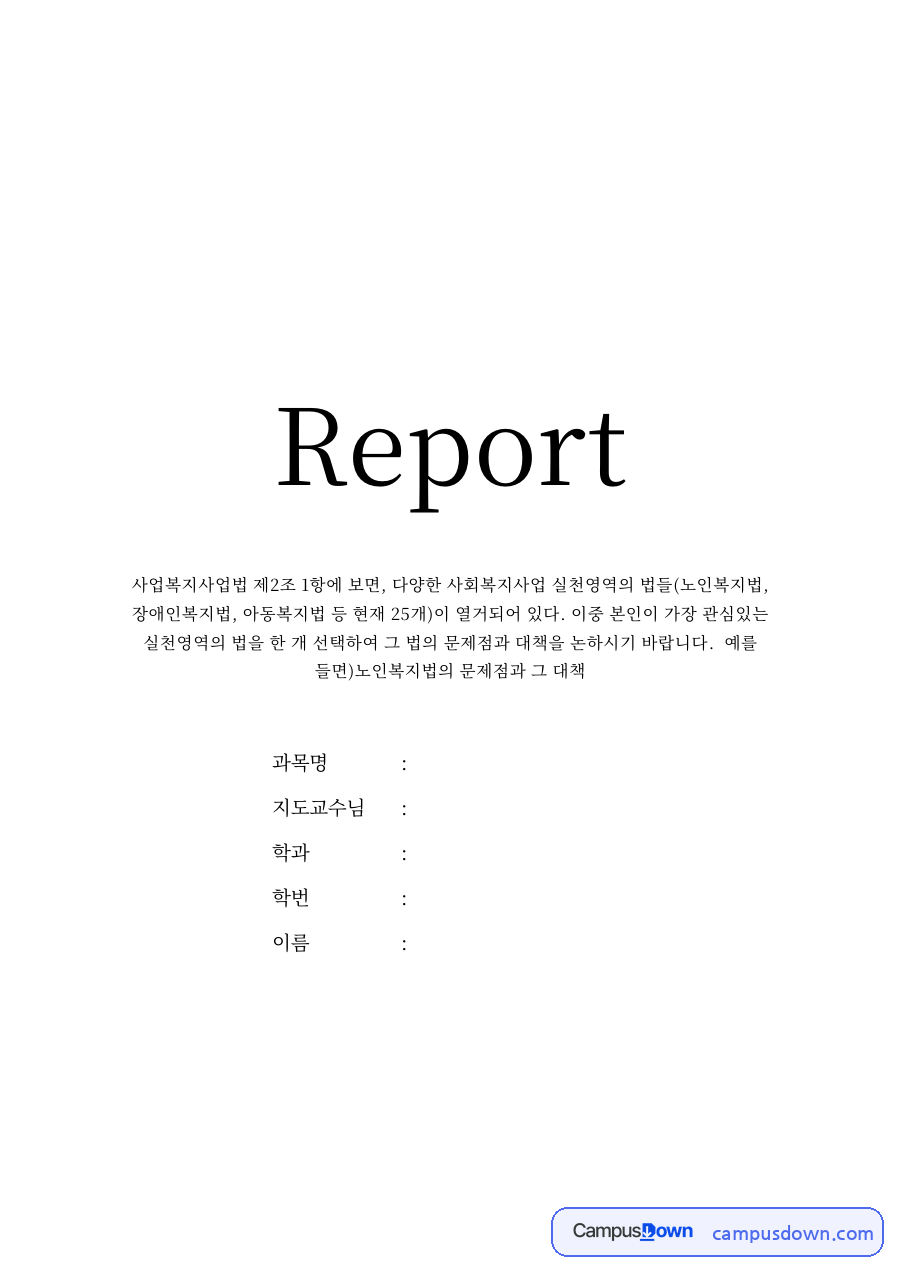
Page 1 is shown as is; from page 2 on, the preview is blurred. Buy it to download the complete original file right away (the file itself is written in Korean).
Packed with real examples and experience. Download it now and save time.
Save your valuable time
Buyer ratings
Fast, accurate and useful.
No ratings yet. Be the first to rate it.


1 / 7
좌우로 밀어서 페이지를 넘겨보세요
과제 개요
| 전체 페이지 수 | 7페이지 |
|---|---|
| 파일 형식 | 한글(HWP) |
| 등록일 | 2025.08.05 |
목차
- 1Ⅰ. 서론
- 2Ⅱ. 본론
- 2.11. 노인복지법의 개념
- 2.22. 노인복지법의 문제점
- 2.33. 해결 방안
- 3Ⅲ. 결론
- 4Ⅳ. 참고문헌
캠퍼스다운 도움말
해당 자료는 No AI 자료입니다. 인싸이트를 얻고 새롭게 가공해 보세요.
자료를 받아서 이용하면 품질이 확 올라갑니다.
- 노인복지법
- 노인복지
- 임의규정
- 국가책임
- 노인 일자리
- 고령자고용
- 사회복지법제
- 사회복지법제 과제
- 노인복지법의 개념
- 노인복지법의 문제점
Problems With Korea's Elderly Welfare Act and How to Fix Them: Discretionary Duties, Senior Jobs, Health Checkups and Housing
※ You can preview page 1 as is. Buy it to download the complete original file right away. The file itself is written in Korean.
■ Problems With Korea's Elderly Welfare Act and How to Fix Them: Discretionary Duties, Senior Jobs, Health Checkups and Housing — Overview
A 6-page Korean social welfare law paper on the Elderly Welfare Act of 1981. It shows how most duties in the act are written as permissive or aspirational rules, points to gaps in senior employment, health care and housing, and proposes making key measures mandatory and widening coverage to all older people.
■ Problems With Korea's Elderly Welfare Act and How to Fix Them: Discretionary Duties, Senior Jobs, Health Checkups and Housing — Excerpt from the original document (English translation)
To promote employment and re-employment of older people, the elderly employment provisions in Article 12 of the Aged Employment Promotion Act, written as non-binding recommendations, should be made mandatory, and the law should be improved by adding penalty clauses so that they can actually be enforced. It is also necessary to merge the senior skills bank and senior workshop programs under the Ministry of Health and Welfare's rules with the elderly employment information center and senior talent bank provided for in the Aged Employment Promotion Act.
A distinct approach is also needed for older people in need who must work to make a living, and for middle-class and wealthier older people who work mainly for meaningful social participation, for whom economic reasons are secondary.
Article 27 of the Elderly Welfare Act provides that health checkups and health education may be offered to people aged 65 or older, but within a limited budget the checkups are currently restricted to older people on livelihood assistance who want one and to those whom the head of the city, county or district finds in need of one, so poor publicity and weak follow-up keep the program from detecting and preventing disease. It should therefore be turned into a mandatory provision so that all older people can benefit from health checkups and health education.
To ease high medical costs for older people, their co-payment rate should also be lowered. Rules on special benefits that let insurance cover age-related diseases should be added to the medical insurance law, or, alongside the checkups in Article 27 of the Elderly Welfare Act, special senior medical benefits including nursing care should be provided for.
We have reviewed the definition of the Elderly Welfare Act and its problems. The act is aimed narrowly at low-income older people, and because it was written as encouragement rather than legal obligation, the state's administrative responsibility is small. This is clearly undesirable, and revising the Elderly Welfare Act can be seen as essential.
While researching this paper, I learned that elderly welfare is not working as well as I had thought. I also learned that revising and creating welfare measures for older people is urgent, and that they need not only economic support but also cultural and educational support. Above all, I think greater public attention is needed for this.
To add, the paper leaves out several important changes. The Long-Term Care Insurance Act for the Elderly took effect in July 2008 and covers, as social insurance, care for older people who struggle with daily life because of age-related illnesses such as dementia or stroke, and since July 2014 the Basic Pension Act has paid a basic pension to older people in the bottom 70% by income. The Aged Employment Promotion Act was renamed in 2008 as the Act on Prohibition of Age Discrimination in Employment and Aged Employment Promotion, and the mandatory retirement age of at least 60 applied to workplaces with 300 or more employees from 2016 and to all workplaces from 2017. Korea became a super-aged society in December 2024, when people aged 65 or older passed 20% of the population.
■ Problems With Korea's Elderly Welfare Act and How to Fix Them: Discretionary Duties, Senior Jobs, Health Checkups and Housing — Contents and key concepts
Why does Korea's Elderly Welfare Act say 'may' so often?
✦ At a glance
- Korea's Elderly Welfare Act and its weak duties
- Structure: purpose → problems → solutions → conclusion
- Useful for social welfare law and aging policy courses
☰ What the paper covers
- Purpose of the act
- State responsibility
- Senior employment
- Health and housing
- Proposed reforms
✎ Elder law in Korea and the U.S.
Korea added long-term care insurance in 2008 and a basic pension in 2014, and became a super-aged society in December 2024.
In the U.S., the Older Americans Act of 1965 funds services such as meals and caregiver support, while Medicare and Social Security cover health and income.
Note: the paper itself is written in Korean and discusses Korean law. This page is general study information, not legal advice.
■ Problems With Korea's Elderly Welfare Act and How to Fix Them: Discretionary Duties, Senior Jobs, Health Checkups and Housing References
- 이민표, 노인복지법의 문제점과 개ㅣ선방안, 한국노인복지학회, 2002
- 박 평, 노인복지법상 노인일자리 사업에 대한 평가와 제도개선 방안에 관한 연구, 선문대학교, 2013
- 권칠우, 노인의 주거복지 관련법제에 관한 연구, 동아대학교, 2014
- 성윤희, 노인복지 실현을 위한 공법적 고찰, 이화여자대학교, 2015
Keyword Prompt
전문가가 만들었어요과제를 직접 쓰는 데 도움이 되는 영어 프롬프트예요.
Tip! Prompt 에 자신의 생각을 추가해서 하면 훨씬 더 ✨ 좋습니다.
캠퍼스다운에서 레포트 받고 잘 쓰는 법 3가지, AI로 참고자료 제대로 재가공하기 →Prompt 1
I'm writing a university assignment on "노인복지법의 문제점과 해결 방안: 임의규정 위주의 국가책임, 노인 일자리·건강진단·주거보장 개선 과제". Help me build an outline (introduction, 2-3 body sections, conclusion) that covers 노인복지법, 노인복지 and 임의규정. Don't write the paper for me - give me guiding questions for each section. My own perspective: [자신의 생각 넣는 곳] Please respond in Korean.
Prompt 2
Explain the key concepts "노인복지법" and "노인복지" in simple terms, then show how they connect to the topic "노인복지법의 문제점과 해결 방안: 임의규정 위주의 국가책임, 노인 일자리·건강진단·주거보장 개선 과제". Point out common misunderstandings students have about them. My own perspective: [자신의 생각 넣는 곳] Please respond in Korean.
Prompt 3
Suggest 3 real-world cases or examples I could analyze in an assignment on "노인복지법의 문제점과 해결 방안: 임의규정 위주의 국가책임, 노인 일자리·건강진단·주거보장 개선 과제", focusing on "임의규정". For each, tell me what I should look up and verify in official or academic sources. My own perspective: [자신의 생각 넣는 곳] Please respond in Korean.
Prompt 4
Review my draft paragraph on "노인복지법의 문제점과 해결 방안: 임의규정 위주의 국가책임, 노인 일자리·건강진단·주거보장 개선 과제" (key idea: "국가책임"). Give feedback on logic, evidence and clarity, and mark where I need a citation. My paragraph: [paste here] My own perspective: [자신의 생각 넣는 곳] Please respond in Korean.
Take a break with a quick personality test?
Ranked by actual participation. Results in about a minute.
Loading…
Most-read content
Loading view counts…

Campusdown is a lifelong-learning community in Korea offering study materials, information on government support, student loans and scholarships, and more. Don't miss our free resources.
Go to the Campusdown home page →Refund policy
- Change of mind / refund requested after partial use / more than 7 days after purchase
◆ Exceptions
- File errors / cannot download or open the file
◆ How to request a refund: send a 1:1 inquiry via Customer Service at the top