
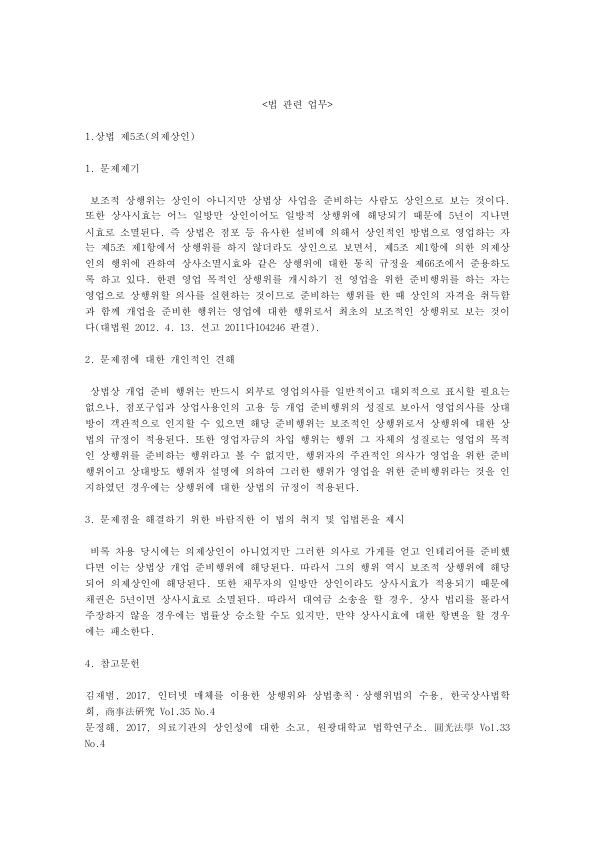
Page 1 is shown as is; from page 2 on, the preview is blurred. Buy it to download the complete original file right away (the file itself is written in Korean).
Packed with real examples and experience. Download it now and save time.
Save your valuable time
Buyer ratings
Fast, accurate and useful.
No ratings yet. Be the first to rate it.


Piercing the Corporate Veil and Other Key Korean Corporate Law Cases: Deemed Merchants, Veil Piercing, Self-Dealing and One-Person Companies
※ You can preview page 1 as is. Buy it to download the complete original file right away. The file itself is written in Korean.
■ Piercing the Corporate Veil and Other Key Korean Corporate Law Cases: Deemed Merchants, Veil Piercing, Self-Dealing and One-Person Companies — Overview
An 11-page Korean corporate law paper analyzing six issues in the same four-step format. It covers deemed merchants and pre-opening acts under Commercial Act Article 5, whether veil piercing can extend a judgment's binding and enforcement effect (93Da44531), abuse of the corporate form by a controlling shareholder (2004Da26119), defects in shareholder resolutions, directors' self-dealing, and breach of trust in one-person companies.
■ Piercing the Corporate Veil and Other Key Korean Corporate Law Cases: Deemed Merchants, Veil Piercing, Self-Dealing and One-Person Companies — Excerpt from the original document (English translation)
At issue are whether expelling a shareholder is permitted in a stock company, and the validity of articles of incorporation or internal rules that, when specific grounds such as disputes among shareholders arise, expel a particular shareholder and have the company refund that shareholder's capital contribution and the like. The company's expulsion of a shareholder who is also an appraiser belonging to an appraisal firm organized as a stock company contains not only a declaration of intent to expel the shareholder but also a declaration of intent to dismiss the person from the position of affiliated appraiser, so the question is whether such a declaration of intent by the company can exist validly regardless of whether the expulsion of the shareholder is void.
In a free-market economy, such restrictions are unjust even for financial institutions, but they are understandable in that they are standards for financial companies with a strong public character. However, uniformly imposing by statute an upper limit on the length of service for the outside directors of all listed companies is a totalitarian idea. It infringes companies' private autonomy and outside directors' constitutional freedom to choose an occupation. As far as I know, Korea is the only country in the world that imposes outside directors' terms by statute. It is also a problem that the term "affiliated company" suddenly appears in the Enforcement Decree when the Commercial Act has no such concept at all.
In Articles 218(6), 220 and 269, the Commercial Act provides expulsion as one of the grounds for a member's withdrawal from partnership companies and limited partnership companies, which are personal companies, and provides that, where there are grounds for expulsion, a request to the court for a declaration of that member's expulsion may be made by resolution of a majority of the other members. By contrast, for stock companies it has no provisions on the basis or procedure for expelling shareholders; this is legislation that takes into account the nature of the stock company as a capital company whose essence is a combination of capital rather than of persons. So even if the company's shareholders are limited to a small number or relations among shareholders are based on mutual trust, such circumstances alone do not allow the provisions on expulsion for personal companies (partnership and limited partnership companies) to be applied by analogy to the stock company, a capital company, so as to permit expulsion of shareholders. Because it violates Article 341 of the Commercial Act, which prohibits acquiring treasury shares except for grounds prescribed by law (see Supreme Court decision 2001Da44109 of May 16, 2003), articles of incorporation or internal rules providing for the company to refund such a shareholder's capital contribution and the like are ultimately contrary to the essence of the stock company as a capital company, violate the Commercial Act, and are void.
Lee Chul-song, 2020, Standards for Permitting Non-Profit Contributions by Companies: Based on the Kangwon Land Case, Ministry of Justice, Journal of Advanced Commercial Law Studies No. 89
Son Young-hwa, 2018, Corporate Division and Whether Sanctions on Unfair Business Operators Are Succeeded, Ministry of Justice, Journal of Advanced Commercial Law Studies No. 83
Even if a company's transactions under the Commercial Act are made only in the books without any movement of goods, where fees equal to a certain percentage of the transaction amount were actually paid to the plaintiff and the company for each transaction, they can be regarded as having intended that a sale with that content take place between them. However, the transaction in this case did not take place on that day; following market practice, the transactions made over the previous three months were carried out all at once, so this form was adopted merely for convenience, and the question is whether this point alone allows the transaction in this case to be regarded as a sham act constituting a fictitious declaration of intent by collusion.
For reference, the five-year commercial limitation period is based on Article 64 of the Commercial Act, and if another statute provides a shorter period, that provision applies. Article 398 on directors' self-dealing was changed by the 2011 amendment to the Commercial Act, strengthening the board approval requirement to approval by at least two-thirds of the directors and expanding its scope to major shareholders and their related parties, so when citing 2002Da20544, a pre-amendment case, write it in comparison with the current provision. It is good to check the facts of the original judgment in the Supreme Court's comprehensive legal information service. In particular, the facts determine the conclusion, so be sure to read the original text as well.
■ Piercing the Corporate Veil and Other Key Korean Corporate Law Cases: Deemed Merchants, Veil Piercing, Self-Dealing and One-Person Companies — Contents and key concepts
When will Korean courts look past a company to the people behind it?
✦ At a glance
- Veil piercing and five more corporate law issues
- Structure: issue → opinion → legislative proposal for each case
- Useful for corporate law review
☰ What the paper covers
- Deemed merchants and pre-opening acts
- Veil piercing and procedure
- New companies formed to escape debt
- Shareholder resolutions and self-dealing
- One-person companies and breach of trust
✎ Veil piercing in Korea and the U.S.
Korean courts disregard a company's separate personality under the good-faith principle when it is a mere shell or is abused to escape debts, but they won't extend a judgment against one company to another without a new suit.
U.S. courts pierce the veil on similar alter ego grounds, weighing commingling, undercapitalization and disregard of formalities, though the tests vary by state.
Note: the paper itself is written in Korean and discusses Korean law. This page is general study information, not legal advice.
Related wiki: Piercing the Corporate Veil, Nominee Shareholders
■ Piercing the Corporate Veil and Other Key Korean Corporate Law Cases: Deemed Merchants, Veil Piercing, Self-Dealing and One-Person Companies References
- 정경영, 2016, 주식회사 이사의 선관주의의무와 책임, 성균관대학교 법학연구소, 성균관법학 Vol.28 No.4 김광록, 2018, 판례를 통해 본 자연인 및 법인인 회사의 보조적 상행위, 한국상사법학회, 商事法硏究 Vol.37 No.1
Take a break with a quick personality test?
Ranked by actual participation. Results in about a minute.
Loading…
Most-read content
Loading view counts…

Campusdown is a lifelong-learning community in Korea offering study materials, information on government support, student loans and scholarships, and more. Don't miss our free resources.
Go to the Campusdown home page →Refund policy
- Change of mind / refund requested after partial use / more than 7 days after purchase
◆ Exceptions
- File errors / cannot download or open the file
◆ How to request a refund: send a 1:1 inquiry via Customer Service at the top