
Page 1 is shown as is; from page 2 on, the preview is blurred. Buy it to download the complete original file right away (the file itself is written in Korean).
Packed with real examples and experience. Download it now and save time.
Save your valuable time
Buyer ratings
Fast, accurate and useful.
No ratings yet. Be the first to rate it.


1 / 6
좌우로 밀어서 페이지를 넘겨보세요
과제 개요
| 전체 페이지 수 | 6페이지 |
|---|---|
| 파일 형식 | 한글(HWP) |
| 등록일 | 2025.07.26 |
목차
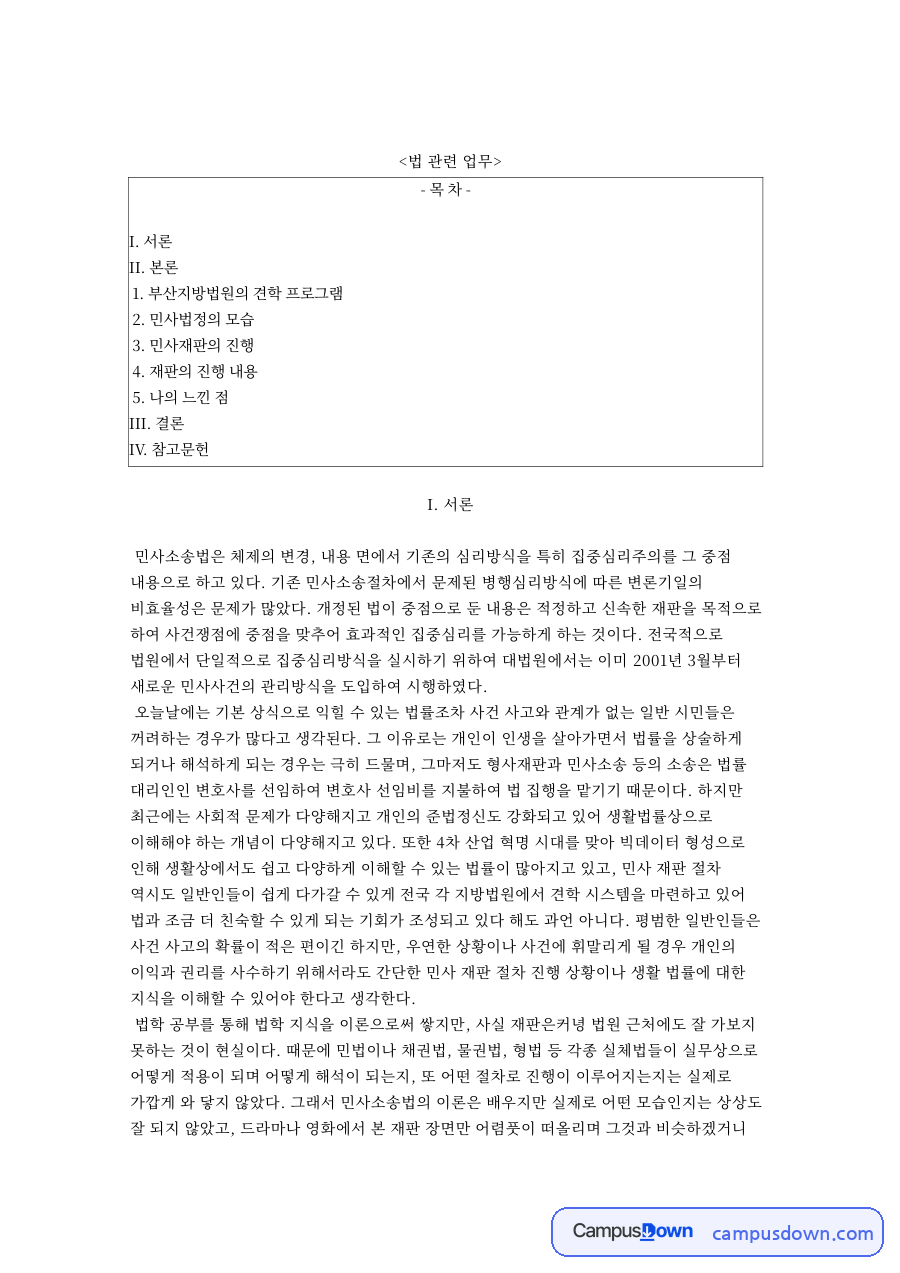
- 1I. 서론
- 2II. 본론
- 2.11. 부산지방법원의 견학 프로그램
- 2.22. 민사법정의 모습
- 2.33. 민사재판의 진행
- 2.44. 재판의 진행 내용
- 2.55. 나의 느낀 점
- 3III. 결론
- 4IV. 참고문헌
캠퍼스다운 도움말
해당 자료는 No AI 자료입니다. 인싸이트를 얻고 새롭게 가공해 보세요.
자료를 받아서 이용하면 품질이 확 올라갑니다.
- 법원 방청
- 법원 견학
- 민사재판
- 민사재판 절차
- 부산지방법원
- 민사법정
- 변론준비절차
- 집중심리
- 견학 보고서
- 민사소송법
Observing Civil Court Proceedings in Korea: A Field Report From the Busan District Court on How Civil Trials Unfold
※ You can preview page 1 as is. Buy it to download the complete original file right away. The file itself is written in Korean.
■ Observing Civil Court Proceedings in Korea: A Field Report From the Busan District Court on How Civil Trials Unfold — Overview
A 6-page Korean field report based on a visit to the Busan District Court and observation of civil hearings. It explains the concentrated-hearing reform introduced with the 2002 Civil Procedure Act, describes the court's visitor program and the layout of a civil courtroom, walks through the flow of a civil case from complaint to judgment, records what happened in the observed hearings, and reflects on what the visit showed about the gap between textbook procedure and real courtrooms.
■ Observing Civil Court Proceedings in Korea: A Field Report From the Busan District Court on How Civil Trials Unfold — Excerpt from the original document (English translation)
The "party's own statement" was also an impressive system. In the actual trial it was explained that the system of the party's own statement lets the plaintiff and defendant, the parties to the suit, convey their views directly to the presiding judge and explain the issues, which has the advantages of raising the parties' own satisfaction through their participation in the trial and helping the judge grasp the issues of the case more smoothly.
The Busan District Court, which I visited in person today, gave me a fresh stimulus. The glass exterior and the court and prosecution emblems set firmly on it seemed to inspire a sense of public duty and justice just by looking at them. Inside the building, seeing quite a few people hurrying here and there carrying thick document envelopes and reading documents intently, I felt that this was where things really happen. Visiting the court in person and seeing what the actual trial process is like, and being able to compare it with what I learned in class, was really enjoyable.
Since going to court to watch a trial was unfamiliar to me, I inevitably went through trial and error, large and small, from choosing a court to finding the courtroom. The court I chose was the Busan District Court, and I observed a trial of the 9th Civil Division held in the courtroom. The trial took less time than I expected. I was very surprised that hearing a single case took so little time. Of course, since each case has several hearing dates, a single trial does not end in one day, but it was clear that one division handles a surprisingly large number of cases. Yet if one tried to resolve complex legal disputes raised by numerous cases in a single day, establishing justice through law would rather become impossible. So I also thought that, even if each session is short, holding the trial over several hearing dates would be more appropriate for setting justice right. I also thought that, to secure several hearing dates for each of the many cases with a limited number of judges, a single division would inevitably have to handle several trials at once.
When one trial ended, the next case began right away as a waiting lawyer stated his case number, and this scene also felt novel to me and gave the overall impression that the trial process was concise. In addition, each time a trial ended, the division set the next hearing date, and I could feel anew how hard the division and both sides' lawyers would work until that date, for the establishment of law and for winning the case, respectively.
To summarize civil procedure, civil procedure is broadly conducted in two stages of hearing. In the first stage, before the date for pleadings, as the parties exchange preparatory briefs, the court exercises its right to request clarification, and evidence is examined upon applications for evidence, the main contested issues are summarized; at the same time, once the expected outcome of the judgment, such as each party's likelihood of winning or losing and the extent to which the claim may be granted, takes shape, the court offers an appropriate proposal based on this and recommends it to both parties.
This means the focus of pleadings has shifted from the date for pleadings to the pleading procedure.
For reference, the original text in places abbreviates the preparatory proceedings for pleadings as "pleading procedure," so in your assignment correct it to the preparatory proceedings under Article 279 and following of the Civil Procedure Act. Pointing out such differences between the textbook and the actual courtroom is also a strength of a court-visit report. In addition, the threshold for the amount in controversy for civil cases handled by a single judge was raised to KRW 500 million or less from March 1, 2022, so it is good to correct the old amount in the original text to the current standard. Anyone can observe a trial in an open courtroom, but photographing and recording are not allowed without the presiding judge's permission. Check the case numbers of individual judgments cited in the original text in the courts' comprehensive legal information service before citing them.
■ Observing Civil Court Proceedings in Korea: A Field Report From the Busan District Court on How Civil Trials Unfold — Contents and key concepts
What does a real Korean civil hearing look like?
✦ At a glance
- A firsthand record of observing court proceedings
- Structure: reform background → visitor program → courtroom → hearings → reflections
- Useful for civil procedure field assignments
☰ What the paper covers
- The concentrated-hearing reform
- The courtroom layout
- How a civil case moves
- What the observer noticed
✎ Open courts and concentrated hearings in Korea
Article 109 of the Korean Constitution requires trials and judgments to be public, so anyone can watch hearings in open court, though recording requires the presiding judge's permission.
Since the 2002 civil procedure reform, Korean judges organize issues through briefs and preparatory proceedings before the main hearing, which is why observed hearings often last only minutes. U.S. courts are also generally open to the public, with rules on recording that vary by court.
Note: the paper itself is written in Korean and discusses Korean law. This page is general study information, not legal advice.
■ Observing Civil Court Proceedings in Korea: A Field Report From the Busan District Court on How Civil Trials Unfold References
- 이규철, 2014, 민사소송절차에서 전자적 정보의 증거조사에 관한 연구, 忠南大學校 大學院, 국내박사 유경희, 2014, 민사전자소송에서 전자문서에 관한 연구, 東國大學校 大學院, 국내석사
Keyword Prompt
전문가가 만들었어요과제를 직접 쓰는 데 도움이 되는 영어 프롬프트예요.
Tip! Prompt 에 자신의 생각을 추가해서 하면 훨씬 더 ✨ 좋습니다.
캠퍼스다운에서 레포트 받고 잘 쓰는 법 3가지, AI로 참고자료 제대로 재가공하기 →Prompt 1
I'm writing a university assignment on "법원 방청 견학 보고서: 부산지방법원 민사법정에서 본 민사재판 진행 절차와 느낀 점". Help me build an outline (introduction, 2-3 body sections, conclusion) that covers 법원 방청, 법원 견학 and 민사재판. Don't write the paper for me - give me guiding questions for each section. My own perspective: [자신의 생각 넣는 곳] Please respond in Korean.
Prompt 2
Explain the key concepts "법원 방청" and "법원 견학" in simple terms, then show how they connect to the topic "법원 방청 견학 보고서: 부산지방법원 민사법정에서 본 민사재판 진행 절차와 느낀 점". Point out common misunderstandings students have about them. My own perspective: [자신의 생각 넣는 곳] Please respond in Korean.
Prompt 3
Suggest 3 real-world cases or examples I could analyze in an assignment on "법원 방청 견학 보고서: 부산지방법원 민사법정에서 본 민사재판 진행 절차와 느낀 점", focusing on "민사재판". For each, tell me what I should look up and verify in official or academic sources. My own perspective: [자신의 생각 넣는 곳] Please respond in Korean.
Prompt 4
Review my draft paragraph on "법원 방청 견학 보고서: 부산지방법원 민사법정에서 본 민사재판 진행 절차와 느낀 점" (key idea: "민사재판 절차"). Give feedback on logic, evidence and clarity, and mark where I need a citation. My paragraph: [paste here] My own perspective: [자신의 생각 넣는 곳] Please respond in Korean.
Take a break with a quick personality test?
Ranked by actual participation. Results in about a minute.
Loading…
Most-read content
Loading view counts…

Campusdown is a lifelong-learning community in Korea offering study materials, information on government support, student loans and scholarships, and more. Don't miss our free resources.
Go to the Campusdown home page →Refund policy
- Change of mind / refund requested after partial use / more than 7 days after purchase
◆ Exceptions
- File errors / cannot download or open the file
◆ How to request a refund: send a 1:1 inquiry via Customer Service at the top