
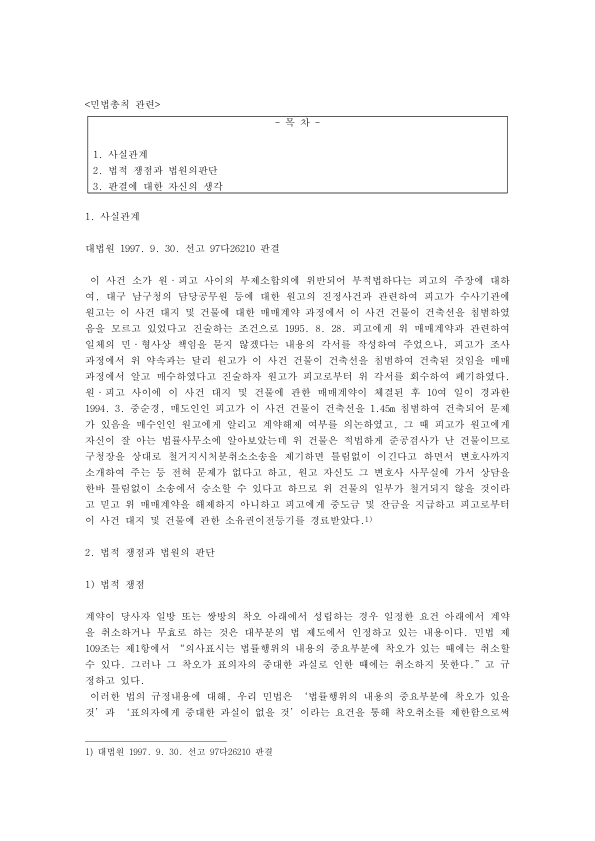
Page 1 is shown as is; from page 2 on, the preview is blurred. Buy it to download the complete original file right away (the file itself is written in Korean).
Packed with real examples and experience. Download it now and save time.
Save your valuable time
Buyer ratings
Fast, accurate and useful.
No ratings yet. Be the first to rate it.


Mistake in Motive and Rescission Under Korean Civil Law: Supreme Court 97Da26210 on a Building Sale Crossing the Setback Line, Article 109 and a No-Suit Agreement
※ You can preview page 1 as is. Buy it to download the complete original file right away. The file itself is written in Korean.
■ Mistake in Motive and Rescission Under Korean Civil Law: Supreme Court 97Da26210 on a Building Sale Crossing the Setback Line, Article 109 and a No-Suit Agreement — Overview
A 6-page Korean civil law case analysis of Supreme Court judgment 97Da26210 (September 30, 1997). After a sale it turned out that the building crossed the legal setback line by 1.45 m, but the seller assured the buyer that a lawsuit would fix it, so the buyer paid the balance. The paper explains the requirements of Article 109 of the Korean Civil Act (mistake about an essential part of the juristic act, no gross negligence), why a mistake in motive caused by the other party can justify rescission, the role of a no-suit agreement, and compares Supreme Court judgment 2004Da43824.
■ Mistake in Motive and Rescission Under Korean Civil Law: Supreme Court 97Da26210 on a Building Sale Crossing the Setback Line, Article 109 and a No-Suit Agreement — Excerpt from the original document (English translation)
This is also sound in light of the fact that, in the end, whether rescission for mistake is recognized is a question of who should properly bear the risk of mistake. Among domestic views, some say that, in regulating mistake, the decision should basically be made from the perspective of whether it is just to protect the declarant or just to protect the other party's reliance, and that this should be resolved from the perspective of which party it is just to make bear the risk of making a declaration of intent by mistake, or the resulting loss; others say that the theory of mistake should allow the disadvantage arising from mistake, that is, the risk, to be appropriately allocated between the declarant and the other party, and it is said that some consensus seems to have formed that the perspective of risk allocation between the declarant and the other party is an important factor in regulating mistake. The standard for risk allocation can be said to be sound when it takes into account not only the declarant's circumstances but also the other party's. What deserves attention above all is the doctrine of "mistake induced by the other party" formed by case law. Our courts have been achieving concrete justice regarding mistake by forming new doctrines to a degree not found in other areas; under this doctrine, one can see cases where, if the mistake was induced or contributed to by the other party, the assessment of requirements traditionally demanded for rescission for mistake is omitted or those requirements are judged to be satisfied. Scholars generally support this, some saying that this attitude of the case law is fully acceptable since the other party who induced the mistake does not deserve protection, and others saying that there is no doubt that, where the declarant's false notion was induced not by the declarant but by the other party, the resulting disadvantage should also be borne not by the declarant but by the other party who created or realized the risk of that mistake, and thus that the Supreme Court's approach of placing the disadvantage on the other party where the declarant's mistake was induced by the other party is justified. Although it cannot be concluded that the formation of this doctrine has completely rejected the existing view of rescission for mistake, one can at least see that, in recognizing rescission for mistake, the requirements of the existing system have been modified so that the other party's circumstances are actively considered. If one takes the position that whether to allow rescission for mistake must be decided by considering only the declarant's circumstances, how should the formation of such case law be accepted? It could only be seen as the formation of a deformed and destructive customary law; but if the perspective is changed to one that actively considers the other party's position in deciding whether to allow rescission, the above case-law theory becomes natural. Perhaps changing the perspective and amending the statutory text is the only means of accepting the current case-law theory.
Case law on mistakes of motive has developed in the direction that, where the motive was expressed as part of the content of the declaration of intent and the other party knew of it, or where the mistake was induced by the other party's improper methods or provision of information, it is treated as a mistake in an important part and rescission is allowed regardless of whether it was expressed. There is also case law holding that even where the mistake arose from the declarant's gross negligence, rescission cannot be barred if the other party knew of the mistake and took advantage of it, so for case-type questions on the general provisions of the Civil Act it is essential to practice breaking down the requirements and applying them one by one. The facts in this material are a suitable example for that practice.
■ Mistake in Motive and Rescission Under Korean Civil Law: Supreme Court 97Da26210 on a Building Sale Crossing the Setback Line, Article 109 and a No-Suit Agreement — Contents and key concepts
When can you undo a contract because of a mistaken assumption?
✦ At a glance
- How a mistake in motive caused by the other party can allow rescission
- Structure: facts → issues and holding → opinion → references
- Good for contract law and case-comment papers
☰ What the paper covers
- Facts: building over the setback line and the seller's assurance
- Article 109 requirements
- The court's reasoning on induced mistakes
- Comparison with 2004Da43824
- References and related cases
✎ Mistake under the Korean Civil Act
Article 109 allows rescission for a mistake about an essential part of the deal unless the mistaken party was grossly negligent.
A mistake in motive normally does not count, but Korean courts allow rescission when the motive was shown to the other side or when the other side caused the mistake.
Note: the paper itself is written in Korean and discusses Korean law. This page is general study information, not legal advice.
■ Mistake in Motive and Rescission Under Korean Civil Law: Supreme Court 97Da26210 on a Building Sale Crossing the Setback Line, Article 109 and a No-Suit Agreement References
- 대법원 1997. 9. 30.
- 선고 97다26210 판결 대법원 2005. 5. 27.
- 선고 2004다43824 판결 대법원 1997. 8. 22.
- 선고 97다13023 정성헌(JEONG, SEONGHEON), 김규완(Kim, Kyu Wan), 2016, 착오취소와 손해배상, 인하대학교 법학연구소, 法學硏究 Vol.19 No.3 김종현, 2010, 인터넷쇼핑몰거래에 있어 착오취소에 관한 주요쟁점, 한국재산법학회, 재산법연구 Vol.27 No.2 이동진(Dongjin Lee), 2020, 착오개념과 취소요건 – 비교법적 고찰로부터의 시사(示唆) –, 한국법학원, 저스티스 Vol.- No.178 노성(Noh Sung), 2012, 착오로 인한 보증계약의 성립과 그 취소의 가부, 전북대학교 법학연구소, 法學硏究 Vol.35 No.- 송덕수, 2010, 판례평석(判例評釋) : 사기에 의한 의사표시와 착오의 관계 -대법원 2005. 5. 27.
- 선고 2004다43824 판결-, 법조협회, 法曹 Vol.59 No.5 서종희, 2020, 민법상 착오와 하자담보책임과의 관계 - 대법원 2018. 9. 13.
- 선고 2015다78703 판결에 대한 검토 -, 한국민사법학회, 民事法學 Vol.- No.92 송덕수, 2017, 강행법규 위반과 착오 : 대상판결: 대법원 2009. 4. 23.
- 선고 2008다96291, 96307 판결, 梨花女子大學校 法學硏究所, 法學論集 Vol.21 No.4
Take a break with a quick personality test?
Ranked by actual participation. Results in about a minute.
Loading…
Most-read content
Loading view counts…

Campusdown is a lifelong-learning community in Korea offering study materials, information on government support, student loans and scholarships, and more. Don't miss our free resources.
Go to the Campusdown home page →Refund policy
- Change of mind / refund requested after partial use / more than 7 days after purchase
◆ Exceptions
- File errors / cannot download or open the file
◆ How to request a refund: send a 1:1 inquiry via Customer Service at the top