
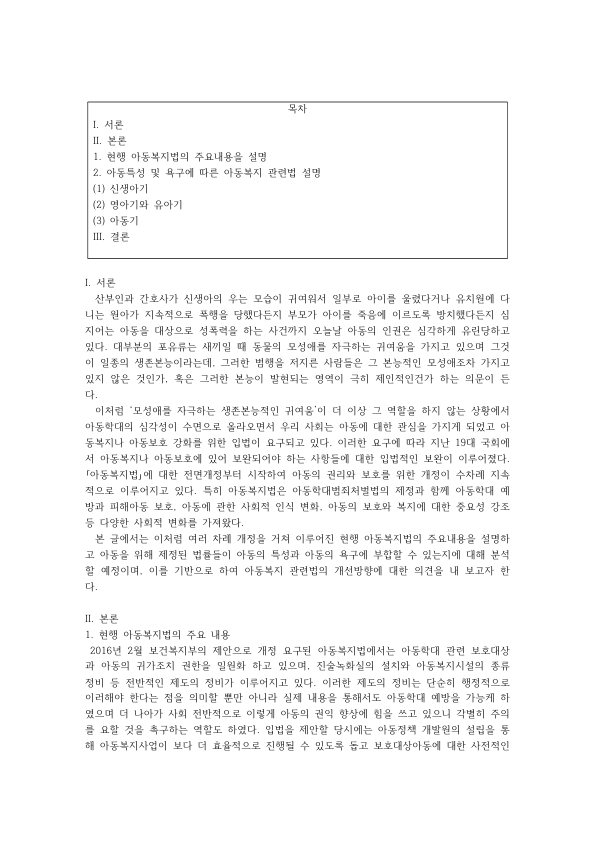
Page 1 is shown as is; from page 2 on, the preview is blurred. Buy it to download the complete original file right away (the file itself is written in Korean).
Packed with real examples and experience. Download it now and save time.
Save your valuable time
Buyer ratings
Fast, accurate and useful.
No ratings yet. Be the first to rate it.


Main Provisions of Korea's Child Welfare Act and Related Laws by Developmental Stage: The 2016 Amendment, Needs From Infancy to Childhood, and Directions for Reform
※ You can preview page 1 as is. Buy it to download the complete original file right away. The file itself is written in Korean.
■ Main Provisions of Korea's Child Welfare Act and Related Laws by Developmental Stage: The 2016 Amendment, Needs From Infancy to Childhood, and Directions for Reform — Overview
A 4-page Korean social welfare law paper on the Child Welfare Act. It explains the 2016 amendment on child abuse protection and child welfare facilities, matches the needs of newborns, infants, preschoolers and school-age children with the laws that serve them, and argues the law focuses too narrowly on abuse while neglecting prevention and family support.
■ Main Provisions of Korea's Child Welfare Act and Related Laws by Developmental Stage: The 2016 Amendment, Needs From Infancy to Childhood, and Directions for Reform — Excerpt from the original document (English translation)
In childhood, it must be kept in mind that the people who influence children expand from caregivers to peers. Even if caregivers or facilities provide children with sufficient welfare, conflict with their peer group can have the greatest effect. So in this period there may be aspects of children's welfare that rules on care facilities alone cannot protect. But childhood, covering kindergarten through elementary school, overlaps with school laws and the Juvenile Protection Act as well as child welfare laws, so it is hard to discuss simply. For children in this period, child welfare laws should therefore be made to fill the gaps that other laws leave.
So far, this paper has reviewed the main provisions of the current child welfare law and, based on the characteristics of each stage of child development, discussed what welfare should be provided to children and what direction legislation should take.
Article 1 of the Child Welfare Act states that its purpose is to secure children's welfare so that they are born healthy and grow up happy and safe. Given today's frequent cruel and heartless incidents involving children, children's rights can be said to be seriously violated. The child welfare laws made for this aim to protect children as much as possible, but they tend to focus on preventing abuse and protecting children, and so somewhat neglect support for families. The revised act makes the child's family the main agent of child welfare and focuses on measures for child protection, creating various systems to protect children, which is good, but as a result measures for children abused in their own families are practically lacking. Another shortcoming of the act is that it is too passive. This passivity has two sides. The first, mentioned earlier, is that it focuses only on abused children. Children's welfare can be harmed by what is done to them, but also by nothing being done for them, and the act does little about the latter. The act also imposes duties on heads and staff of child welfare facilities and calls for compliance, yet lacks penalty provisions, which is another way it is passive.
To add: the National Center for the Rights of the Child was established in July 2019 to support child policy, and from October 2020 investigations of child abuse were taken over by child abuse officials employed by city, county and district governments. In January 2021, Article 915 of the Civil Code, which gave parents a right to discipline their children, was repealed, removing the legal basis for corporal punishment in the name of discipline. Child abuse can be reported by calling 112, and teachers, childcare workers and medical staff are mandatory reporters. In 2023, Korea also adopted a birth notification system under which medical institutions report births.
■ Main Provisions of Korea's Child Welfare Act and Related Laws by Developmental Stage: The 2016 Amendment, Needs From Infancy to Childhood, and Directions for Reform — Contents and key concepts
Does Korea's child welfare law do more than respond to abuse?
✦ At a glance
- Korea's Child Welfare Act and its 2016 amendment
- Structure: background → main provisions → laws by stage → conclusion
- Useful for child welfare and social welfare law courses
☰ What the paper covers
- Why the law changed
- 2016 amendment
- Child protection agencies
- Needs by age
- Gaps in prevention
✎ Child protection in Korea and the U.S.
Since 2020, local public officials in Korea have handled child abuse investigations, and parents' legal right to discipline was repealed in 2021.
In the U.S., state child protective services investigate reports, and federal laws such as CAPTA and the Family First Prevention Services Act fund prevention and foster care.
Note: the paper itself is written in Korean and discusses Korean law. This page is general study information, not legal advice.
■ Main Provisions of Korea's Child Welfare Act and Related Laws by Developmental Stage: The 2016 Amendment, Needs From Infancy to Childhood, and Directions for Reform References
- 두뇌질환 한방치료 브레인리더 연구팀 (2016) '아동의 발달적 특성에 대해 알아봅시다' http://brainleader.tistory.com/782 문영희 (2016)
- '2016년 개정 「아동복지법」에 관한 법정책적 고찰'. 법학연구
Take a break with a quick personality test?
Ranked by actual participation. Results in about a minute.
Loading…
Most-read content
Loading view counts…

Campusdown is a lifelong-learning community in Korea offering study materials, information on government support, student loans and scholarships, and more. Don't miss our free resources.
Go to the Campusdown home page →Refund policy
- Change of mind / refund requested after partial use / more than 7 days after purchase
◆ Exceptions
- File errors / cannot download or open the file
◆ How to request a refund: send a 1:1 inquiry via Customer Service at the top