
Page 1 is shown as is; from page 2 on, the preview is blurred. Buy it to download the complete original file right away (the file itself is written in Korean).
Packed with real examples and experience. Download it now and save time.
Save your valuable time
Buyer ratings
Fast, accurate and useful.
No ratings yet. Be the first to rate it.


Love and the Law in Korea: Constitutional Rulings on Seduction under Promise of Marriage, Adultery, and the Military Sodomy Provision
※ You can preview page 1 as is. Buy it to download the complete original file right away. The file itself is written in Korean.
■ Love and the Law in Korea: Constitutional Rulings on Seduction under Promise of Marriage, Adultery, and the Military Sodomy Provision — Overview
A 6-page Korean constitutional and criminal law paper comparing three Constitutional Court rulings: the 2009 decision striking down the crime of sexual intercourse under a false promise of marriage, the 2015 decision striking down adultery, and the 2016 decision upholding the military criminal provision on sexual acts between soldiers, framed by the right to sexual self-determination.
■ Love and the Law in Korea: Constitutional Rulings on Seduction under Promise of Marriage, Adultery, and the Military Sodomy Provision — Excerpt from the original document (English translation)
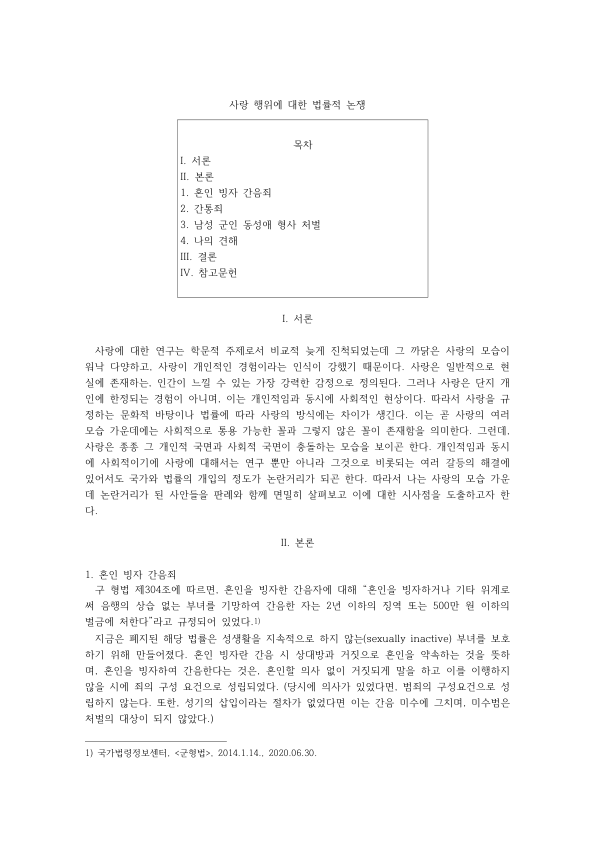
Under former Article 304 of the Criminal Act, a person who had sexual intercourse under a pretext of marriage was punished: 'A person who, by pretext of marriage or other fraudulent means, deceives a woman not of habitually immoral character and has sexual intercourse with her shall be punished by imprisonment for not more than two years or a fine not exceeding five million won.'
The now-abolished provision was made to protect women who were not sexually active. A pretext of marriage meant falsely promising marriage at the time of intercourse, and the crime was established when a person spoke falsely with no intention to marry and then did not keep the promise. (If there was an intention at the time, the elements of the crime were not met. Also, without penetration it remained an attempt, and attempts were not punished.)
The provision became controversial because of the clash between the personal and social sides of love mentioned in the introduction. People's sex lives in general, including premarital sex, are personal matters that should be free from state intervention. Yet when the Constitutional Court upheld the provision, it seems to have assumed unwanted pregnancy or an emphasis on chastity. In Korea, where abortion was banned, unmarried mothers did not even fit the ideology of the 'normal family,' and with negative views of women's premarital sex still lingering, premarital pregnancy drew even harsher looks. And because the responsibility was often placed entirely on women, the Court is thought to have spoken of sharing 'responsibility.' The Court said that although a woman's carelessness or indiscretion might be a cause, 'responsibility' could not be placed entirely on the victim.
But that premise is wrong, as the decision in 2008Hun-Ba58 and 2009Hun-Ba191 (consolidated) shows well. According to that decision, as noted above, people's sex lives are a personal domain that should be worked out through sufficient conversation between the parties. If violence or threats were involved, punishment could follow, but an intention to marry is an intrusion into an overly private domain and reflects a patriarchal ideology that stresses chastity and treats women as instruments and as children. Because the provision claims to protect women's right to sexual self-determination while actually harming it, it was declared unconstitutional in 2012.
The adultery law was made to punish both people in an affair when a married person had a relationship with someone else. (It covered only sexual intercourse; infidelity short of intercourse did not meet the elements of adultery.) It was set out in Article 231 of the Criminal Act: '(Adultery) (1) A married person who commits adultery shall be punished by imprisonment for not more than two years. The same shall apply to the other party. (2) The crime in the preceding paragraph shall be prosecuted only on the complaint of the spouse. However, a complaint may not be filed if the spouse encouraged or condoned the adultery.' In short, the crime was established when a married person and the other party committed adultery.
Note: The Constitutional Court struck down the crime of intercourse under a pretext of marriage 6 to 3 on November 26, 2009, and the provision was deleted from the Criminal Act on December 18, 2012. The adultery crime was struck down 7 to 2 on February 26, 2015. The paper's statements that the former was 'declared unconstitutional in 2012' and that both were 'abolished in 2020' are incorrect, and the adultery provision was Article 241 of the Criminal Act, not Article 231. Article 92-6 of the Military Criminal Act was upheld 5 to 4 on July 28, 2016; the Supreme Court en banc changed its interpretation on April 21, 2022 to hold that the provision does not apply to voluntary acts in private spaces, and the Constitutional Court upheld it again 5 to 4 on October 26, 2023 on that interpretation.
■ Love and the Law in Korea: Constitutional Rulings on Seduction under Promise of Marriage, Adultery, and the Military Sodomy Provision — Contents and key concepts
Should the state stop at the bedroom door?
✦ At a glance
- Three Korean rulings on criminal law and private sexual life
- Structure: marriage-promise crime → adultery → military provision → opinion
- Useful for constitutional law and criminal law courses
☰ What the paper covers
- Personal and social sides of love
- Marriage-promise crime
- Adultery
- Military provision
- Clarity of law
✎ Sex, privacy and criminal law in Korea and the U.S.
Korea struck down its marriage-promise crime in 2009 and adultery in 2015, but its Constitutional Court upheld the military provision in 2016 and 2023.
In the U.S., Lawrence v. Texas (2003) struck down sodomy laws, and the military's Don't Ask, Don't Tell policy was repealed in 2010.
Note: the paper itself is written in Korean and discusses Korean law. This page is general study information, not legal advice.
Related wiki: Sexual Autonomy and the Law, The Right to Privacy
■ Love and the Law in Korea: Constitutional Rulings on Seduction under Promise of Marriage, Adultery, and the Military Sodomy Provision References
- 단행본 김희경(2017). <이상한 정상가족>. 서울: 동아시아. 2.
- 판례 1) 혼인빙자간음죄 - 사건번호: 2008헌바58, 2009헌바191(병합)
- 간통죄 - 사건번호: 2009헌바17
- 남성 군인 동성애 형사 처벌 – 사건번호: 2012헌바258 3.
- 온라인 자료 국가법령정보센터, 군형법.
Take a break with a quick personality test?
Ranked by actual participation. Results in about a minute.
Loading…
Most-read content
Loading view counts…

Campusdown is a lifelong-learning community in Korea offering study materials, information on government support, student loans and scholarships, and more. Don't miss our free resources.
Go to the Campusdown home page →Refund policy
- Change of mind / refund requested after partial use / more than 7 days after purchase
◆ Exceptions
- File errors / cannot download or open the file
◆ How to request a refund: send a 1:1 inquiry via Customer Service at the top