
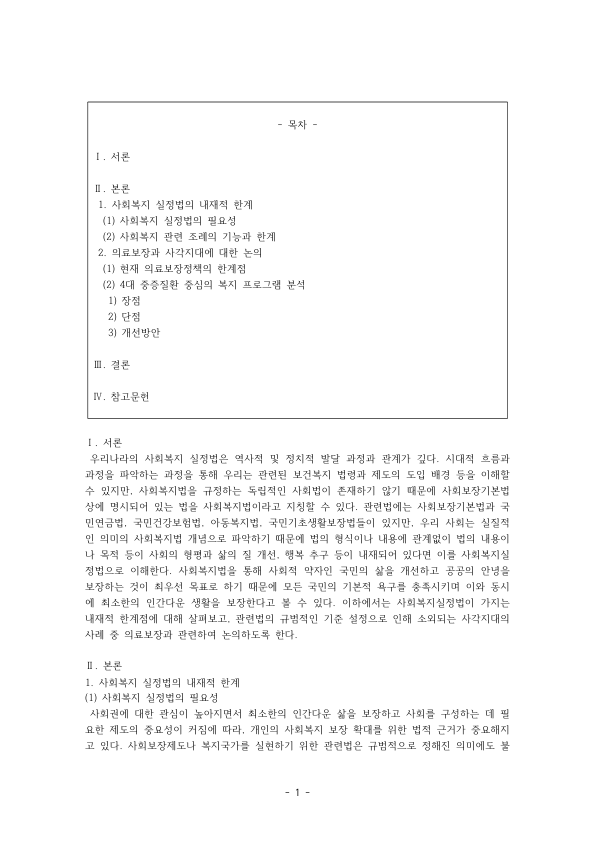
Page 1 is shown as is; from page 2 on, the preview is blurred. Buy it to download the complete original file right away (the file itself is written in Korean).
Packed with real examples and experience. Download it now and save time.
Save your valuable time
Buyer ratings
Fast, accurate and useful.
No ratings yet. Be the first to rate it.
Limits of Korean Social Welfare Law and Gaps in Health Coverage: Local Welfare Ordinances and the Pros and Cons of Focusing on Four Major Diseases
※ You can preview page 1 as is. Buy it to download the complete original file right away. The file itself is written in Korean.
■ Limits of Korean Social Welfare Law and Gaps in Health Coverage: Local Welfare Ordinances and the Pros and Cons of Focusing on Four Major Diseases — Overview
A 4-page Korean social welfare law paper on why statutory welfare rules leave people out. It explains why welfare rights need legislation, how local ordinances can respond flexibly but are limited by national law, and weighs Korea's policy of expanding coverage for four major diseases against unmet needs of people with chronic illness.
■ Limits of Korean Social Welfare Law and Gaps in Health Coverage: Local Welfare Ordinances and the Pros and Cons of Focusing on Four Major Diseases — Excerpt from the original document (English translation)
The current programs to strengthen coverage for serious diseases are viewed positively because introducing selective benefits blocked the rapid growth of uninsured care at the source. With selective benefits, non-essential care such as cosmetic surgery was excluded while other medically recognized essential treatment was fully brought under insurance. The stagnation in health insurance coverage feared under earlier programs has largely eased, and because benefits were designed on a value basis, a new form of benefit has taken hold in which patients pay different shares depending on the care they receive.
Programs centered on the four major diseases have limits as a way to strengthen coverage disease by disease. The typical problem is fairness toward diseases left out of the four, which causes unmet medical need: cases where people have a medical need that goes unmet and do not receive proper care, including people whose illness could have been eased if proper treatment had come first. Identifying this precisely is not easy, and unmet need is felt very subjectively, so it is admittedly debated. Still, the very large gap in insurance coverage rates between ordinary illnesses and the four major diseases may mean that a high share of unmet need exists that we have not yet identified, so the current service system needs to be improved more effectively.
The first need is to expand benefits for low-income people who are excluded from medical aid. Because managing chronic illness is part of long-term planning for serious illness, I believe a broad survey and management are needed so that these patients face no barriers to care. People with chronic illness are likely to skip needed care because of heavy co-payments, or to fall into poverty because of continuing treatment. The coverage gap for them is far more serious than we expect, so measures should be prepared to ease medical costs for some share of people below the median income or to make sure they get needed care on time. And since chronic illness is more common among socially and economically vulnerable groups, detailed policies and support are needed so that they face no barriers in using medical services.
This paper examined the inherent limits of positive social welfare law and discussed the gaps in health coverage policy. Korea's welfare has developed a great deal compared with the past, but indifference to people falling through the gaps keeps causing social problems.
To add: the push to strengthen coverage for the four major diseases (cancer, heart disease, cerebrovascular disease and rare intractable diseases), which the paper analyzes, ran from 2013 to 2016, and from August 2017 it widened into a plan to bring uninsured care under insurance step by step, which abolished extra fees for designated doctors and covered upper-tier hospital rooms, MRI and ultrasound. The annual out-of-pocket ceiling that varies with income and the catastrophic medical expense support program are other safeguards against crushing medical bills. Under Article 28 of the Local Autonomy Act, an ordinance that limits residents' rights or imposes duties needs authorization from a statute.
■ Limits of Korean Social Welfare Law and Gaps in Health Coverage: Local Welfare Ordinances and the Pros and Cons of Focusing on Four Major Diseases — Contents and key concepts
Why do welfare laws still leave people behind?
✦ At a glance
- Korean welfare law and coverage gaps
- Structure: need for law → ordinances → health coverage → reforms
- Useful for social welfare law and health policy courses
☰ What the paper covers
- Why welfare needs law
- Local ordinances
- Welfare rights
- Four major diseases
- Help for chronic illness
✎ Welfare rules in Korea and the U.S.
In Korea, national welfare law sets most benefits, and local governments must consult the Health Ministry before creating new programs.
In the U.S., states have wide room to design programs such as Medicaid within federal rules, which is why coverage differs from state to state.
Note: the paper itself is written in Korean and discusses Korean law. This page is general study information, not legal advice.
■ Limits of Korean Social Welfare Law and Gaps in Health Coverage: Local Welfare Ordinances and the Pros and Cons of Focusing on Four Major Diseases References
- 최윤주, 이원영(2015). 만성질환에 대한 의료보장 사각지대 연구 : 잠재적 빈곤가구의 미충족의료 및 과부담의료비 실증분석. <한국사회정책> 22권 4호 pp.161-187 조성규(2013).
- 사회보장법제에 있어 조례의 역할과 한계. <지방자치법연구> 13권 4호 pp.131-163
Take a break with a quick personality test?
Ranked by actual participation. Results in about a minute.
Loading…
Most-read content
Loading view counts…

Campusdown is a lifelong-learning community in Korea offering study materials, information on government support, student loans and scholarships, and more. Don't miss our free resources.
Go to the Campusdown home page →Refund policy
- Change of mind / refund requested after partial use / more than 7 days after purchase
◆ Exceptions
- File errors / cannot download or open the file
◆ How to request a refund: send a 1:1 inquiry via Customer Service at the top