
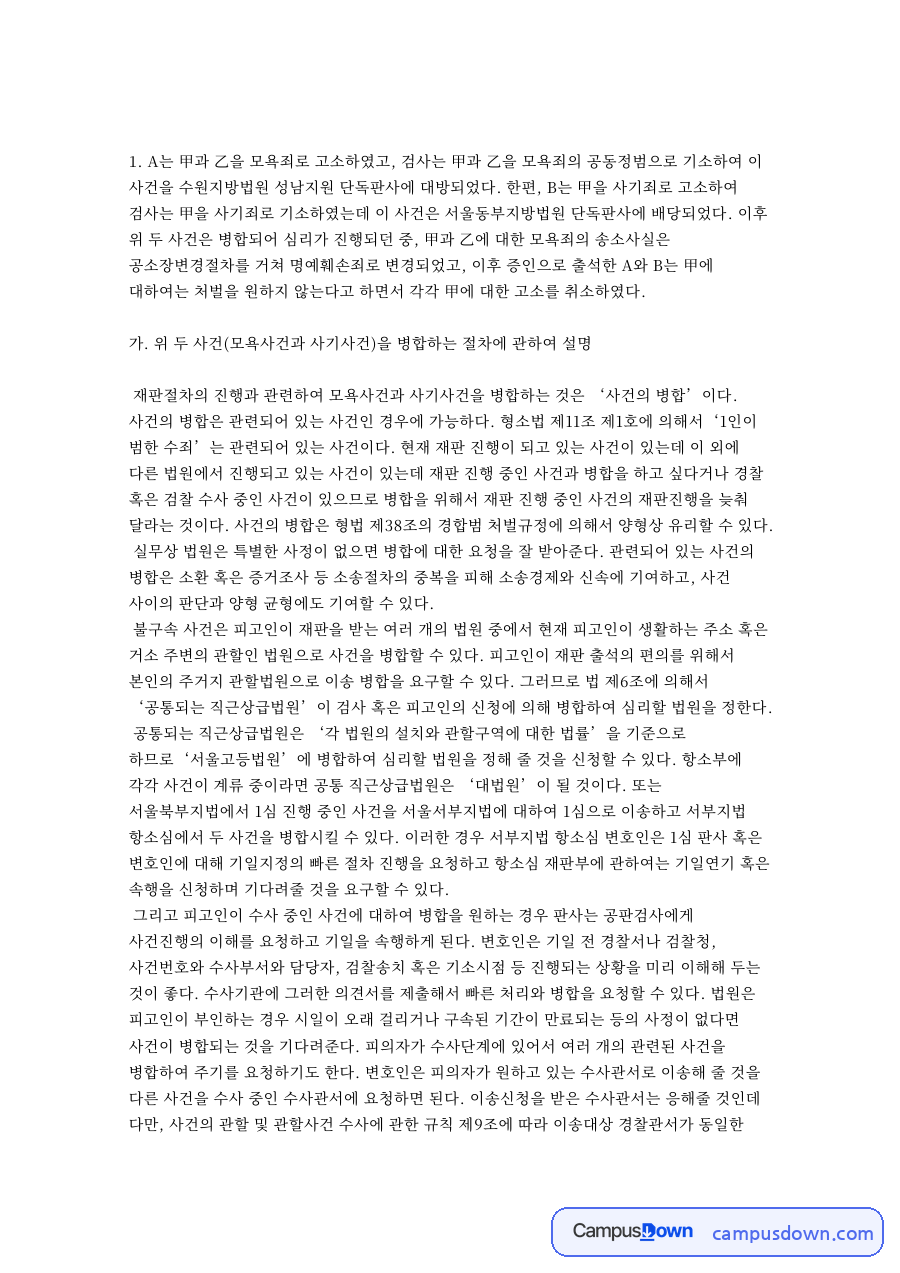
Page 1 is shown as is; from page 2 on, the preview is blurred. Buy it to download the complete original file right away (the file itself is written in Korean).
Packed with real examples and experience. Download it now and save time.
Save your valuable time
Buyer ratings
Fast, accurate and useful.
No ratings yet. Be the first to rate it.


1 / 4
좌우로 밀어서 페이지를 넘겨보세요
과제 개요
| 전체 페이지 수 | 4페이지 |
|---|---|
| 파일 형식 | 한글(HWP) |
| 등록일 | 2025.07.04 |
캠퍼스다운 도움말
해당 자료는 No AI 자료입니다. 인싸이트를 얻고 새롭게 가공해 보세요.
자료를 받아서 이용하면 품질이 확 올라갑니다.
- 형사소송법
- 사건의 병합
- 고소불가분의 원칙
- 반의사불벌죄
- 공소장변경
- 공소기각
- 명예훼손죄
- 공모공동정범
- 재판권
- 현행범 체포
Korean Criminal Procedure Case Study: Joinder of Cases, Indivisibility of Complaints, Non-Prosecution Wishes and the Somali Pirates Trial
※ You can preview page 1 as is. Buy it to download the complete original file right away. The file itself is written in Korean.
■ Korean Criminal Procedure Case Study: Joinder of Cases, Indivisibility of Complaints, Non-Prosecution Wishes and the Somali Pirates Trial — Overview
A 4-page Korean criminal procedure case study. Case one covers how two cases pending before different district courts are joined (Articles 6 and 11 of the Criminal Procedure Act), what happens after an insult charge is amended to defamation, and whether a victim's wish not to punish one accomplice also protects the other. Korean case law says the indivisibility rule for complaint-only crimes (Article 233) does not extend to crimes that cannot be prosecuted against the victim's wishes.
Case two reviews the Somali pirates trial: jurisdiction over crimes on the high seas, arrest by navy personnel as a citizen's arrest, and the limits of joint principal liability.
■ Korean Criminal Procedure Case Study: Joinder of Cases, Indivisibility of Complaints, Non-Prosecution Wishes and the Somali Pirates Trial — Excerpt from the original document (English translation)
The ringleader, Abdi Risk Shaqe, had the captain of the mother ship in this case sail to waters with frequent foreign merchant-ship traffic, and around January 13, 2011, the pirates in this case came to waters near Arabia in the northern Indian Ocean and searched for a ship to hijack. At dawn on January 15, 2011, on the high seas at the entrance to the Arabian Sea about 515 km southeast of Oman, they found the Samho Jewelry, owned by GSH1 of Norway and chartered by the victim company, while it was sailing. The defendants, together with the pirates who were killed, aimed the weapons each carried at the crew, behaving as though they would kill them, and suppressed resistance; they then made the crew put both hands on their heads, went to the Samho Jewelry's wheelhouse and kept watch, thereby seizing the Samho Jewelry, and confined the crew in its wheelhouse.
Charges: attempted maritime robbery-murder; attempted robbery-murder; maritime robbery causing injury; robbery causing injury; aggravated obstruction of the performance of official duties causing injury; attempted murder in the course of ship hijacking, etc. under the Act on the Punishment of Acts Endangering Ships; and injury in the course of ship hijacking, etc. under the same Act.
Article 4(1) of the Criminal Procedure Act provides that "territorial jurisdiction shall be determined by the place of the crime or the defendant's domicile, residence or present location." "Present location" means the place where the defendant is at the time of indictment; it is not limited to a voluntary present location and includes a present location resulting from compulsion, but not one resulting from unlawful compulsion. In a case where Somali pirates hijacked a ship already in operation for a Korean shipping company on the high seas near the Arabian Sea in the northern Indian Ocean, committed many crimes such as attempted maritime robbery-murder against Korean crew members, were arrested, forcibly transported to Korea, detained and indicted, the Republic of Korea, under Article 6 of the Korean Criminal Act and Article 105 of the United Nations Convention on the Law of the Sea, among others, can arrest persons who committed piracy against Korean nationals outside Korean territory and exercise jurisdiction over them under the Korean Criminal Procedure Act. In this case, the arrest of the defendants by members of the Korean Navy constitutes an "arrest of a flagrant offender by a private person" under Article 213 of the Criminal Procedure Act, and even though about nine days passed in forcibly transporting the defendants to Korea after the arrest, this was unavoidable due to spatial and physical constraints. It cannot be regarded as delaying the handover or continuing the arrest without justifiable reason, so it is lawful. The defendants were detained in Korea under warrants requested and issued within 48 hours of being handed over to Korean investigative authorities, and they received the assistance of counsel in that process, so their detention is also lawful. Since the defendants' present location is in Korea, Korean courts have territorial jurisdiction under Article 4(1) of the Criminal Procedure Act.
The common immediately superior court for consolidating cases is determined by the high court to which each first-instance court belongs, so since the Suwon High Court opened in 2019, where the high courts differ, as with cases at the Seongnam Branch of the Suwon District Court and the Seoul Eastern District Court, the Supreme Court designates the court that will hear the consolidated cases. If you organize, within a single case, this recent change in jurisdiction together with the victim's expression of not wanting punishment for crimes not prosecutable against the victim's will, judgments dismissing prosecution, and the doctrine of conspiratorial co-principals, you can use it right away for case-type questions on criminal procedure midterms and finals and for foundational study for the bar exam.
■ Korean Criminal Procedure Case Study: Joinder of Cases, Indivisibility of Complaints, Non-Prosecution Wishes and the Somali Pirates Trial — Contents and key concepts
Does withdrawing a complaint against one accomplice free the other?
✦ At a glance
- Joinder of cases in different courts and indivisibility of complaints
- Structure: case one (joinder, amendment, non-prosecution wish) → case two (pirates)
- Useful for criminal procedure exam practice
☰ What the paper covers
- Joinder procedure and the common superior court
- Amended charges and the victim's non-prosecution wish
- Why Article 233 does not apply to non-prosecution crimes
- Somali pirates: jurisdiction, arrest and detention
- Scope of joint principal liability
✎ Prosecution conditions and jurisdiction
Some Korean crimes need a victim's complaint before prosecution, while others cannot be prosecuted once the victim says they do not want punishment. If that happens after indictment, the court dismisses the prosecution without ruling on guilt.
Jurisdiction asks whether Korean courts can try the case at all, while venue decides which court hears it. The pirates case shows both questions in one ruling.
Note: the paper itself is written in Korean and discusses Korean law. This page is general study information, not legal advice.
■ Korean Criminal Procedure Case Study: Joinder of Cases, Indivisibility of Complaints, Non-Prosecution Wishes and the Somali Pirates Trial References
- 박상욱, 2019, 사이버 명예훼손·모욕 대량고소의 형사적 절차 개선방안, 고려대학교 정보보호대학원, 국내석사
Keyword Prompt
전문가가 만들었어요과제를 직접 쓰는 데 도움이 되는 영어 프롬프트예요.
Tip! Prompt 에 자신의 생각을 추가해서 하면 훨씬 더 ✨ 좋습니다.
캠퍼스다운에서 레포트 받고 잘 쓰는 법 3가지, AI로 참고자료 제대로 재가공하기 →Prompt 1
I'm writing a university assignment on "형사소송법 사례: 사건 병합과 고소불가분의 원칙, 반의사불벌죄 처벌불원과 소말리아 해적 재판권". Help me build an outline (introduction, 2-3 body sections, conclusion) that covers 형사소송법, 사건의 병합 and 고소불가분의 원칙. Don't write the paper for me - give me guiding questions for each section. My own perspective: [자신의 생각 넣는 곳] Please respond in Korean.
Prompt 2
Explain the key concepts "형사소송법" and "사건의 병합" in simple terms, then show how they connect to the topic "형사소송법 사례: 사건 병합과 고소불가분의 원칙, 반의사불벌죄 처벌불원과 소말리아 해적 재판권". Point out common misunderstandings students have about them. My own perspective: [자신의 생각 넣는 곳] Please respond in Korean.
Prompt 3
Suggest 3 real-world cases or examples I could analyze in an assignment on "형사소송법 사례: 사건 병합과 고소불가분의 원칙, 반의사불벌죄 처벌불원과 소말리아 해적 재판권", focusing on "고소불가분의 원칙". For each, tell me what I should look up and verify in official or academic sources. My own perspective: [자신의 생각 넣는 곳] Please respond in Korean.
Prompt 4
Review my draft paragraph on "형사소송법 사례: 사건 병합과 고소불가분의 원칙, 반의사불벌죄 처벌불원과 소말리아 해적 재판권" (key idea: "반의사불벌죄"). Give feedback on logic, evidence and clarity, and mark where I need a citation. My paragraph: [paste here] My own perspective: [자신의 생각 넣는 곳] Please respond in Korean.
Take a break with a quick personality test?
Ranked by actual participation. Results in about a minute.
Loading…
Most-read content
Loading view counts…

Campusdown is a lifelong-learning community in Korea offering study materials, information on government support, student loans and scholarships, and more. Don't miss our free resources.
Go to the Campusdown home page →Refund policy
- Change of mind / refund requested after partial use / more than 7 days after purchase
◆ Exceptions
- File errors / cannot download or open the file
◆ How to request a refund: send a 1:1 inquiry via Customer Service at the top