
Page 1 is shown as is; from page 2 on, the preview is blurred. Buy it to download the complete original file right away (the file itself is written in Korean).
Packed with real examples and experience. Download it now and save time.
Save your valuable time
Buyer ratings
Fast, accurate and useful.
No ratings yet. Be the first to rate it.


Korean Commercial Law Case Analysis: Pledge Forfeiture Agreements, Commercial Liens for Building Materials and Business Lease Under Article 42
※ You can preview page 1 as is. Buy it to download the complete original file right away. The file itself is written in Korean.
■ Korean Commercial Law Case Analysis: Pledge Forfeiture Agreements, Commercial Liens for Building Materials and Business Lease Under Article 42 — Overview
A Korean commercial law paper that analyses three Supreme Court cases with an IRAC framework: whether a pledge forfeiture agreement is allowed when the pledgor is not a merchant (Article 59 of the Commercial Act), whether a claim for building material costs supports a lien over the building, and whether Article 42(1) on liability of a business transferee using the same trade name applies by analogy to a business lease.
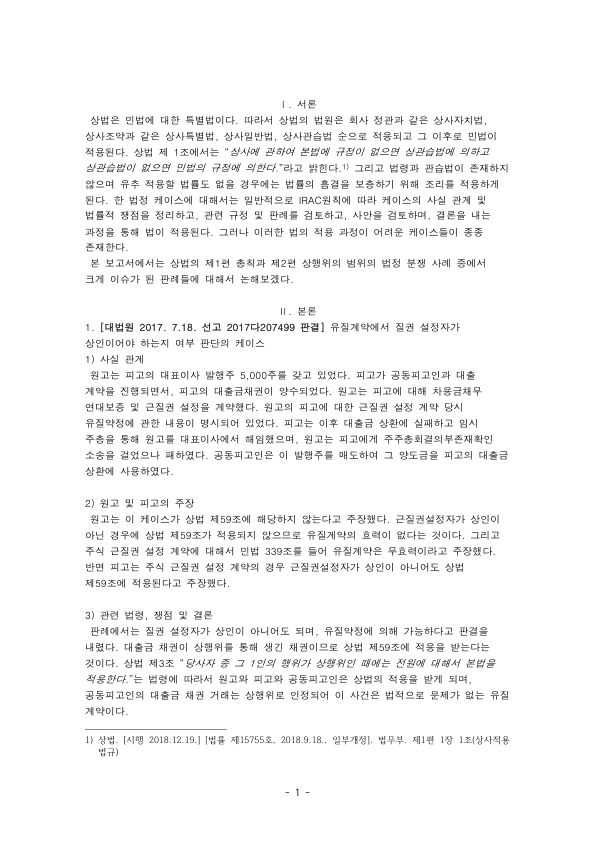
■ Korean Commercial Law Case Analysis: Pledge Forfeiture Agreements, Commercial Liens for Building Materials and Business Lease Under Article 42 — Excerpt from the original document (English translation)
There are two issues in this case: whether the gas-station lease contract amounts to an acquisition of a business, and, if it is not an acquisition of a business, whether Article 42(1) of the Commercial Act can be applied by analogy. First, this case is a lease of a business. Under existing case law, a business is recognized only when three requirements are met: profit-seeking, continuity, and external recognizability. Both cases are businesses, but in this case ownership of the gas station did not pass to A and remained with the defendant, so this case is a lease of a business, not a transfer of a business.
The question then is the analogical application of Article 42(1) of the Commercial Act. However, the Supreme Court held that, for a lease of a business, there is no separate statutory provision like Article 42(1) of the Commercial Act, and that the business property A had taken as security at the time was separate from the lessee, so there was no need to protect the creditor to the point of imposing joint and several (non-genuine) liability on the defendant. On this, there was a split between the position that analogical application of Article 42(1) is appropriate and the position that it is not. The position that analogical application of Article 42(1) is necessary argues that, under the appearance principle, where the gas station's trade name continues to be used it is hard to know whether the lease contract has ended, so the lessor should also be held liable for repayment to protect creditors. However, people's view is that this judgment, in line with past precedents, declined to apply Article 42(1) of the Commercial Act by analogy to a lease of a business.
Laws and judgments change with the times. For example, the past precedent that women could not be members of a jongjung (clan association) was a case in which the Supreme Court invalidated the customary law in 2010 on the ground that it contravened the principle of gender equality. In general, however, judges tend to be conservative in law-making, so even where there is some justification, judges do not simply create law; and even if they do, strict justification is required to fill gaps in the statute at a level that is consistent and harmonious with the entire legal system. Therefore, when there is a gap in the statute, analogical application is widely used. Gaps in the law include open gaps and hidden gaps. An open gap is a case where no relevant statute exists at all, and a hidden gap is a case where a relevant provision exists but its application does not fit its purpose. Analogical application is mainly used for open gaps, but there are also cases where no legal provision is available to borrow. In such cases, supplementation by jori (the nature of things/reason) takes place.
Even now, there are many debates about legal disputes involving analogical application, jori and the like. Since the Supreme Court generally tends to maintain its existing positions, it is worth watching carefully what precedents the Supreme Court will hand down on these issues in the future.
For the general provisions of the Commercial Act and the law of commercial transactions, the key is to understand why special rules different from the Civil Act are needed, so organizing provisions that contrast with the Civil Act, such as forfeiture-of-pledge agreements, commercial liens and the liability of a transferee who continues to use the trade name, together with case law, is useful for both assignments and exams. Comparing the three cases in this material within the same framework clearly shows how the basic ideals of commercial law, speed of transactions and protection of appearance, work in actual cases. Practicing comparing the requirements of civil liens and commercial liens, as in the building-materials payment case, also helps in understanding practical problems related to real-estate auctions.
■ Korean Commercial Law Case Analysis: Pledge Forfeiture Agreements, Commercial Liens for Building Materials and Business Lease Under Article 42 — Contents and key concepts
Korean Commercial Law Case Analysis
✦ At a glance
- How Commercial Act special rules differ from the Civil Act
- Structure: introduction → three cases → conclusion
- Useful for commercial law case analysis assignments
☰ What the paper covers
- Pledge forfeiture under Article 59
- Building material claims and liens
- Business lease and Article 42 by analogy
- Filling legal gaps by analogy
✎ Background in brief
Korean commercial law adjusts civil law rules to favor speed and reliability in trade.
Courts sometimes extend those rules by analogy when the statute is silent.
Note: the paper itself is written in Korean and discusses Korean law. This page is general study information, not legal advice.
Related wiki: Possessory Lien
■ Korean Commercial Law Case Analysis: Pledge Forfeiture Agreements, Commercial Liens for Building Materials and Business Lease Under Article 42 References
- 최광석. (2012.02.10.). 공사에 사용된 건축자재의 대금과 유치권의 견련성. 한국경제 부동산. URL: http://land.hankyung.com/board/view.php?id=_column_117_1&no=431&category=0&ch=land.
- 검색일자: 2019.05.05.
- 정완용. (2018). 2017년 상법 분야 주요 대법원 판례의 경향 - 상법총칙·상행위법, 보험법 분야를 중심으로 -. 선진상사법률연구 통권 제83호 2018년 7월호.
- 김홍기. 2019. 상법강의-commercial law- 제4판. 서울: 박영사
- 김혁붕, 정인환. 2017. 회계사 상법신강 제 12판. 서울: 도서출판 여울.
Take a break with a quick personality test?
Ranked by actual participation. Results in about a minute.
Loading…
Most-read content
Loading view counts…

Campusdown is a lifelong-learning community in Korea offering study materials, information on government support, student loans and scholarships, and more. Don't miss our free resources.
Go to the Campusdown home page →Refund policy
- Change of mind / refund requested after partial use / more than 7 days after purchase
◆ Exceptions
- File errors / cannot download or open the file
◆ How to request a refund: send a 1:1 inquiry via Customer Service at the top