
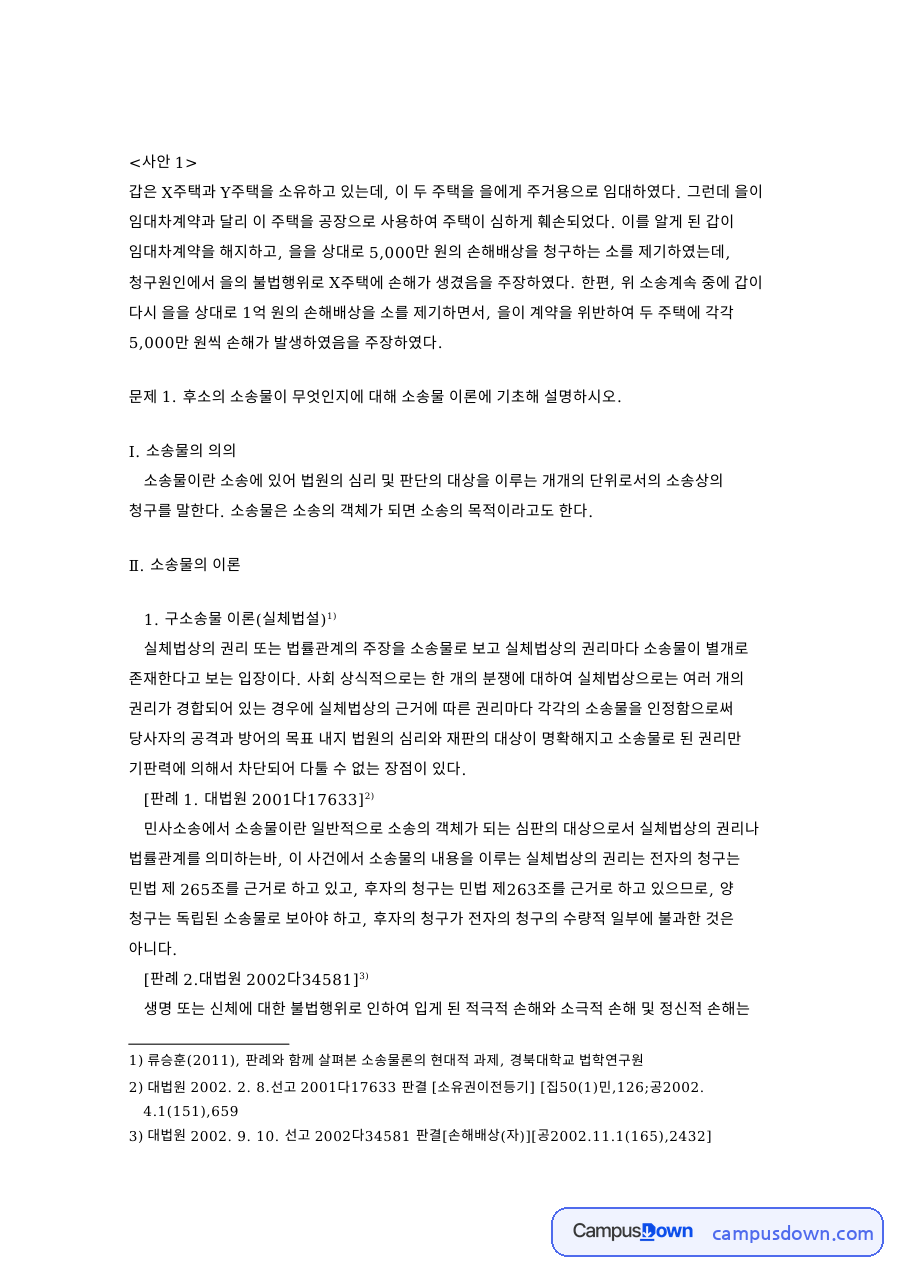
Page 1 is shown as is; from page 2 on, the preview is blurred. Buy it to download the complete original file right away (the file itself is written in Korean).
Packed with real examples and experience. Download it now and save time.
Save your valuable time
Buyer ratings
Fast, accurate and useful.
No ratings yet. Be the first to rate it.


1 / 5
좌우로 밀어서 페이지를 넘겨보세요
과제 개요
| 전체 페이지 수 | 5페이지 |
|---|---|
| 파일 형식 | 한글(HWP) |
| 등록일 | 2025.07.05 |
캠퍼스다운 도움말
해당 자료는 No AI 자료입니다. 인싸이트를 얻고 새롭게 가공해 보세요.
자료를 받아서 이용하면 품질이 확 올라갑니다.
- 민사소송법
- 소송물
- 구소송물이론
- 신소송물이론
- 중복소송
- 점유취득시효
- 소유권이전등기청구
- 파기자판
- 본안판단
- 손해배상
Korean Civil Procedure Case Study: Subject Matter of Litigation, Duplicate Lawsuits, Adverse Possession Claims and Self-Judgment on Reversal
※ You can preview page 1 as is. Buy it to download the complete original file right away. The file itself is written in Korean.
■ Korean Civil Procedure Case Study: Subject Matter of Litigation, Duplicate Lawsuits, Adverse Possession Claims and Self-Judgment on Reversal — Overview
A 6-page Korean civil procedure case study. Case one asks whether a second damages suit against a tenant who used rented houses as a factory is the same lawsuit as the first, comparing the traditional substantive-law theory of the subject matter of litigation with the procedural theories, and links the answer to the ban on duplicate lawsuits. Case two explains acquisitive prescription by possession under Article 245(1) of the Korean Civil Act and whether a claim for transfer registration is lawful after an appellate court reverses and decides the case itself.
Supreme Court rulings 2001Da17633 and 2002Da34581 are cited.
■ Korean Civil Procedure Case Study: Subject Matter of Litigation, Duplicate Lawsuits, Adverse Possession Claims and Self-Judgment on Reversal — Excerpt from the original document (English translation)
The legal status given to de facto control over a thing is legally called "possession." Article 245(1) of the Civil Act (period for acquiring ownership of real estate through possession) provides that "a person who has possessed real estate peacefully and openly for 20 years with the intention of owning it acquires ownership by registration." A system that, where a certain factual state continues, recognizes the legal relationship as it stands without examining whether that state reflects the true right is called prescription, and taken together this is called acquisitive prescription by possession. (Kim Sang-mu, 2011, A Study on the Relationship between a Person Who Has Completed Acquisitive Prescription of Real Estate by Possession and Third Parties, Yeungnam University)
1. Autonomous possession (Park Chan-hui, 2014, A Study on Acquisitive Prescription of Real Estate by Possession, Wonkwang University Graduate School, Department of Law)
Possession held with the intention of ownership is legally called autonomous possession. A possessor is presumed to possess with the intention of ownership (Civil Act Article 197(1)).
The presumption of the intention of ownership under Article 197(1) of the Civil Act is rebutted when (1) it is proven that the possessor acquired possession under a title whose nature indicates that there was no intention of ownership, or (2) circumstances are proven from which, according to the rules of experience, it can be seen that there was no intention of ownership, that is, circumstances from which, judging outwardly and objectively, the possessor can be seen as not having had the intention to possess while excluding another's ownership, such as where, during possession, the possessor showed an attitude a true owner would not ordinarily take, or failed to act as an owner would naturally have acted.
(Supreme Court decision 90Da15808, rendered February 22, 1991) Supreme Court decision 90Da15808, rendered February 22, 1991 [Registration of Transfer of Ownership of Real Estate] [Gong 1991.4.15.(894), 1054]
Since Gap asserted acquisitive prescription by possession, one must determine autonomous possession, the title at the time possession began, and, based on Supreme Court decisions, assess the period of possession, conduct during that period, and any change of owner at the time prescription was completed. The fact of acquisition after the completion of prescription as determined by the court cannot be an object of assessment.
Question 2. Gap disagreed with the first-instance court's decision and appealed. Afterward, the first-instance court realized its decision was wrong and wishes to make a decision on the merits as to whether acquisitive prescription by possession was completed. Explain whether this is possible.
(Civil Procedure Act Article 437) In any of the following cases, the court of final appeal shall render a final judgment on the case: (1) where the judgment is reversed on the ground that the application of law to the established facts was wrong and the case is sufficiently ready to be decided on the basis of those facts; (2) where the judgment is reversed on the ground that the case does not fall within the jurisdiction of the courts.
When the Supreme Court reverses the lower court's judgment and decides the case itself rather than remanding or transferring it to the lower court, this is called reversal and self-judgment.
Because the subject matter of the suit is the starting point for determining the prohibition of duplicate suits (Civil Procedure Act Article 259), the joinder and amendment of claims, and the objective scope of res judicata, in case questions it is important first to fix the subject matter of the suit and then apply it to each system. Our case law generally follows the old theory of the subject matter of suit and treats each substantive right as a separate subject matter, so claims for damages for tort and for non-performance of an obligation are separate subject matters. This material is well suited to case-type questions on civil procedure midterms and finals, foundational study for legal aptitude, and case-summary assignments.
■ Korean Civil Procedure Case Study: Subject Matter of Litigation, Duplicate Lawsuits, Adverse Possession Claims and Self-Judgment on Reversal — Contents and key concepts
Is a second damages lawsuit on a new legal basis really a new case?
✦ At a glance
- How theories of the subject matter of litigation decide duplicate suits
- Structure: case one (subject matter) → case two (adverse possession, reversal)
- Good for civil procedure exam practice
☰ What the paper covers
- Traditional and procedural theories
- Duplicate lawsuits and merits review
- Acquisitive prescription by possession
- Reversal with self-judgment
- Key Supreme Court rulings
✎ Why the subject matter comes first
Under the traditional theory followed by Korean courts, each substantive right is a separate claim, so tort damages and contract damages are different lawsuits.
Acquisitive prescription requires 20 years of peaceful, open possession as owner, and ownership passes only when registration is completed.
Note: the paper itself is written in Korean and discusses Korean law. This page is general study information, not legal advice.
■ Korean Civil Procedure Case Study: Subject Matter of Litigation, Duplicate Lawsuits, Adverse Possession Claims and Self-Judgment on Reversal References
- 류승훈(2011), 판례와 함께 살펴본 소송물론의 현대적 과제, 경북대학교 법학연구원
- 민사소송법2(2015), https://b4death.tistory.com/628
- 민소법의 본안판단(2013), https://blog.naver.com/yeonong10/80194471539
- 김상무(2011), 부동산점유 취득시효 완성자와 제3자의 관계에 관한 연구, 영남대학교
- 박찬희(2014), 부동산 점유취득시효에 관한 연구, 원광대학교 대학원 법학과
- 이재명,김제완(2019), 시효취득으로 인한 소유권이전등기청구권의 양도에 관한 고찰, 고 려대학교 법학연구원
Keyword Prompt
전문가가 만들었어요과제를 직접 쓰는 데 도움이 되는 영어 프롬프트예요.
Tip! Prompt 에 자신의 생각을 추가해서 하면 훨씬 더 ✨ 좋습니다.
캠퍼스다운에서 레포트 받고 잘 쓰는 법 3가지, AI로 참고자료 제대로 재가공하기 →Prompt 1
I'm writing a university assignment on "민사소송법 사례: 소송물 이론으로 본 후소와 중복소송, 점유취득시효 등기청구와 파기자판". Help me build an outline (introduction, 2-3 body sections, conclusion) that covers 민사소송법, 소송물 and 구소송물이론. Don't write the paper for me - give me guiding questions for each section. My own perspective: [자신의 생각 넣는 곳] Please respond in Korean.
Prompt 2
Explain the key concepts "민사소송법" and "소송물" in simple terms, then show how they connect to the topic "민사소송법 사례: 소송물 이론으로 본 후소와 중복소송, 점유취득시효 등기청구와 파기자판". Point out common misunderstandings students have about them. My own perspective: [자신의 생각 넣는 곳] Please respond in Korean.
Prompt 3
Suggest 3 real-world cases or examples I could analyze in an assignment on "민사소송법 사례: 소송물 이론으로 본 후소와 중복소송, 점유취득시효 등기청구와 파기자판", focusing on "구소송물이론". For each, tell me what I should look up and verify in official or academic sources. My own perspective: [자신의 생각 넣는 곳] Please respond in Korean.
Prompt 4
Review my draft paragraph on "민사소송법 사례: 소송물 이론으로 본 후소와 중복소송, 점유취득시효 등기청구와 파기자판" (key idea: "신소송물이론"). Give feedback on logic, evidence and clarity, and mark where I need a citation. My paragraph: [paste here] My own perspective: [자신의 생각 넣는 곳] Please respond in Korean.
Take a break with a quick personality test?
Ranked by actual participation. Results in about a minute.
Loading…
Most-read content
Loading view counts…

Campusdown is a lifelong-learning community in Korea offering study materials, information on government support, student loans and scholarships, and more. Don't miss our free resources.
Go to the Campusdown home page →Refund policy
- Change of mind / refund requested after partial use / more than 7 days after purchase
◆ Exceptions
- File errors / cannot download or open the file
◆ How to request a refund: send a 1:1 inquiry via Customer Service at the top