
Page 1 is shown as is; from page 2 on, the preview is blurred. Buy it to download the complete original file right away (the file itself is written in Korean).
Packed with real examples and experience. Download it now and save time.
Save your valuable time
Buyer ratings
Fast, accurate and useful.
No ratings yet. Be the first to rate it.


1 / 7
좌우로 밀어서 페이지를 넘겨보세요
과제 개요
| 전체 페이지 수 | 7페이지 |
|---|---|
| 파일 형식 | 한글(HWP) |
| 등록일 | 2025.07.04 |
캠퍼스다운 도움말
해당 자료는 No AI 자료입니다. 인싸이트를 얻고 새롭게 가공해 보세요.
자료를 받아서 이용하면 품질이 확 올라갑니다.
- 관습헌법
- 수도 서울
- 헌법유보사항
- 헌법 개정
- 국민투표권
- 국기
- 헌법재판
- 헌법 과제
Korea's Unwritten Constitution and the Capital City Ruling: Requirements for Customary Constitutional Law, the National Flag Debate and Amendment
※ You can preview page 1 as is. Buy it to download the complete original file right away. The file itself is written in Korean.
■ Korea's Unwritten Constitution and the Capital City Ruling: Requirements for Customary Constitutional Law, the National Flag Debate and Amendment — Overview
A 7-page Korean constitutional law paper reviewing an article on the 2004 Constitutional Court ruling that Seoul's status as capital is customary constitutional law. It summarizes the Court's requirements, explains why the subjective requirement is hard to prove for a fact like a capital's location, discusses the founding assembly's rejection of a flag clause, and argues the custom did not exist.
■ Korea's Unwritten Constitution and the Capital City Ruling: Requirements for Customary Constitutional Law, the National Flag Debate and Amendment — Excerpt from the original document (English translation)
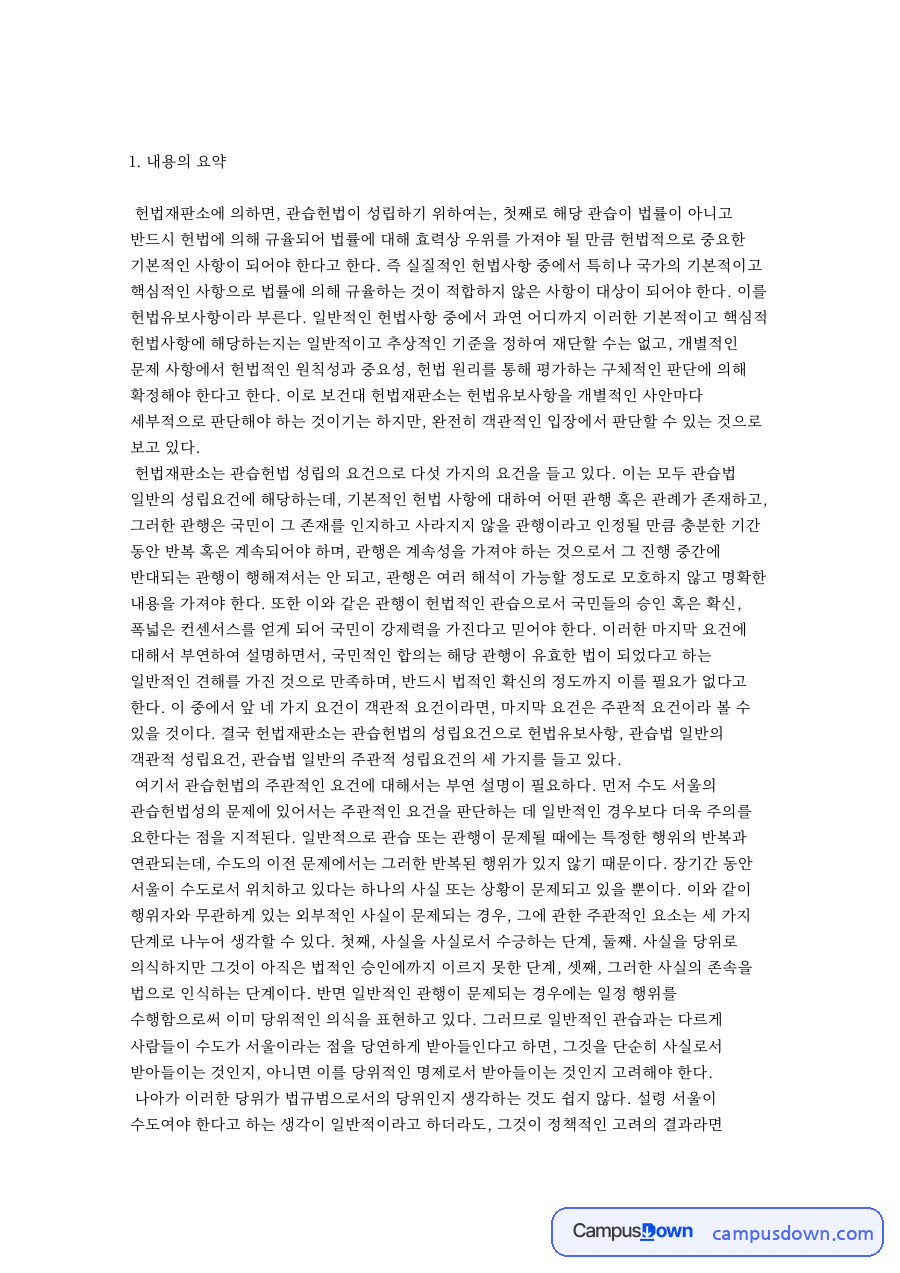
The Constitutional Court lists five requirements for customary constitutional law to arise, all of which are requirements for customary law in general. On a basic constitutional matter, a practice or precedent must exist; it must be repeated or continued long enough that the people recognize it and accept that it will not disappear; it must be constant, with no contrary practice arising along the way; and it must be clear rather than vague enough to allow several interpretations. In addition, the practice must win the people's approval or conviction, a broad consensus, as a constitutional custom, so that the people believe it is binding. Elaborating on this last requirement, the Court says it is enough that the people generally regard the practice as having become valid law, without needing to reach the level of legal conviction. The first four may be seen as objective requirements and the last as a subjective one. In the end, the Court names three requirements: a matter reserved to the constitution, the objective requirements of customary law, and the subjective requirement of customary law.
The subjective requirement needs further explanation. It has been pointed out that, for the question of whether Seoul's status as capital is customary constitutional law, the subjective requirement must be judged with more care than usual. A custom or practice normally involves the repetition of certain acts, but there is no such repeated act in the question of moving the capital; what is at issue is only the single fact or situation that Seoul has long been the capital. Where an external fact independent of any actor is at issue, the subjective element can be divided into three stages: accepting the fact as a fact; being conscious of the fact as something that ought to be, though not yet as law; and recognizing the continuation of the fact as law. In an ordinary practice, by contrast, performing the act already expresses a sense of obligation. So if people take it for granted that Seoul is the capital, one must ask whether they accept it merely as a fact or as a normative proposition.
It is also hard to tell whether such an 'ought' is a legal norm. Even if the idea that Seoul should be the capital is widespread, if it results from policy considerations, that alone would not make it customary constitutional law. For ordinary customary law, legal recognition can be found when people generally feel that acting against the custom breaches a legal duty. But when a constitutional custom is changed by legal measures, as with moving the capital, this does not appear as a sense of illegality; there is only an awareness that an old rule in the form of custom is being replaced by a new written law.
Note: On October 21, 2004, the Constitutional Court ruled 8 to 1 that the Special Act on the Construction of a New Administrative Capital was unconstitutional because it changed the customary constitutional rule that Seoul is the capital by statute rather than by amendment, infringing the right to vote in a constitutional referendum (2004Hun-Ma554). On November 24, 2005, it dismissed challenges to the later special act on a multifunctional administrative city, finding that the city would not become the capital and Seoul's capital functions would not be dismantled (2005Hun-Ma579), and Sejong Special Self-Governing City was launched on July 1, 2012.
■ Korea's Unwritten Constitution and the Capital City Ruling: Requirements for Customary Constitutional Law, the National Flag Debate and Amendment — Contents and key concepts
An unwritten constitution, and who may change it
✦ At a glance
- A critical review of Korea's customary constitution ruling
- Structure: summary → new insights → agreement and dissent → further topics
- Useful for constitutional law and case commentary assignments
☰ What the paper covers
- Matters reserved to the constitution
- Objective and subjective requirements
- Proving consensus
- The flag debate
- Changing a custom
✎ Unwritten constitutional rules in Korea and the U.S.
Korea's Constitutional Court in 2004 struck down a law moving the capital, holding that Seoul's status was customary constitutional law that only an amendment could change.
The U.S. has written-constitution traditions too, but practices such as the two-term presidential limit were customs until the 22nd Amendment made them law in 1951.
Note: the paper itself is written in Korean and discusses Korean law. This page is general study information, not legal advice.
Related wiki: Judicial Review
■ Korea's Unwritten Constitution and the Capital City Ruling: Requirements for Customary Constitutional Law, the National Flag Debate and Amendment References
- 이영록 ( Young Lok Lee ). "연구논문 : 수도() 및 국기()에 관한 관습헌법론 검토." 11.1 (2005): 259-276.
Keyword Prompt
전문가가 만들었어요과제를 직접 쓰는 데 도움이 되는 영어 프롬프트예요.
Tip! Prompt 에 자신의 생각을 추가해서 하면 훨씬 더 ✨ 좋습니다.
캠퍼스다운에서 레포트 받고 잘 쓰는 법 3가지, AI로 참고자료 제대로 재가공하기 →Prompt 1
I'm writing a university assignment on "관습헌법과 수도 서울 결정 비판: 헌법재판소의 관습헌법 성립요건, 국기 규정 논의, 수도 이전과 헌법 개정의 관계". Help me build an outline (introduction, 2-3 body sections, conclusion) that covers 관습헌법, 수도 서울 and 헌법유보사항. Don't write the paper for me - give me guiding questions for each section. My own perspective: [자신의 생각 넣는 곳] Please respond in Korean.
Prompt 2
Explain the key concepts "관습헌법" and "수도 서울" in simple terms, then show how they connect to the topic "관습헌법과 수도 서울 결정 비판: 헌법재판소의 관습헌법 성립요건, 국기 규정 논의, 수도 이전과 헌법 개정의 관계". Point out common misunderstandings students have about them. My own perspective: [자신의 생각 넣는 곳] Please respond in Korean.
Prompt 3
Suggest 3 real-world cases or examples I could analyze in an assignment on "관습헌법과 수도 서울 결정 비판: 헌법재판소의 관습헌법 성립요건, 국기 규정 논의, 수도 이전과 헌법 개정의 관계", focusing on "헌법유보사항". For each, tell me what I should look up and verify in official or academic sources. My own perspective: [자신의 생각 넣는 곳] Please respond in Korean.
Prompt 4
Review my draft paragraph on "관습헌법과 수도 서울 결정 비판: 헌법재판소의 관습헌법 성립요건, 국기 규정 논의, 수도 이전과 헌법 개정의 관계" (key idea: "헌법 개정"). Give feedback on logic, evidence and clarity, and mark where I need a citation. My paragraph: [paste here] My own perspective: [자신의 생각 넣는 곳] Please respond in Korean.
Take a break with a quick personality test?
Ranked by actual participation. Results in about a minute.
Loading…
Most-read content
Loading view counts…

Campusdown is a lifelong-learning community in Korea offering study materials, information on government support, student loans and scholarships, and more. Don't miss our free resources.
Go to the Campusdown home page →Refund policy
- Change of mind / refund requested after partial use / more than 7 days after purchase
◆ Exceptions
- File errors / cannot download or open the file
◆ How to request a refund: send a 1:1 inquiry via Customer Service at the top