
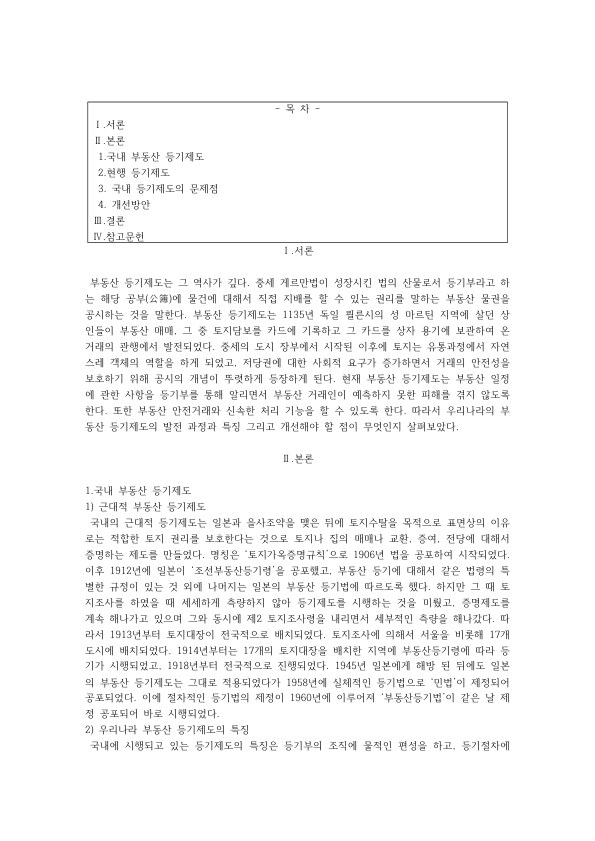
Page 1 is shown as is; from page 2 on, the preview is blurred. Buy it to download the complete original file right away (the file itself is written in Korean).
Packed with real examples and experience. Download it now and save time.
Save your valuable time
Buyer ratings
Fast, accurate and useful.
No ratings yet. Be the first to rate it.


Korea's Real Property Registration System: Joint Filing, Provisional Registration, Registration Certificates, and the Problem of No Public Faith in the Register
※ You can preview page 1 as is. Buy it to download the complete original file right away. The file itself is written in Korean.
■ Korea's Real Property Registration System: Joint Filing, Provisional Registration, Registration Certificates, and the Problem of No Public Faith in the Register — Overview
An 8-page Korean property law paper on real estate registration. It traces the system from 1906 to the 1960 Registration Act, walks through the filing steps, provisional registration, registration certificates and seal certificates, and argues for reforms because Korea does not protect buyers who rely on the register.
■ Korea's Real Property Registration System: Joint Filing, Provisional Registration, Registration Certificates, and the Problem of No Public Faith in the Register — Excerpt from the original document (English translation)
Because safety matters most in a property deal, the parties and other interested persons should, before the transaction, rule out doubts about whether the ownership is genuine and whether the property is being misused, and should assess whether the money paid can be protected or recovered. Most parties do not know everything about the property, so they must read the register and the rights involved, and for anything the register does not show they have to rely on the broker or the seller. This imbalance of information causes problems during and after the deal. If the parties cannot obtain enough information, they may suffer losses they did not foresee. The current register shows mainly the latest property rights and attachments and leaves out a great deal, so it is hard for a party to analyze the rights, find the relevant law and gather the needed documents alone. To ease this uncertainty and imbalance, the register should add information that affects the rights in the property, such as the households registered at the address, which shows whether there are small-deposit tenants, and the dates on which tenants obtained fixed-date stamps.
Under the seal certificate system, the issuing office checks the identity of the person or the agent and then issues the certificate, so there is a risk that someone forges an agent's identity to obtain one. For the seal certificate to protect the validity of registration, the issuing procedure should be tightened to prevent issuance that could be used for crime. Forged seal certificates also appear, so a way to detect them is needed. When the registration certificate information is missing, a qualified agent must confirm the person's identity and prepare a confirmation document, which is close to notarial work. Yet the rules for a qualified agent's identity check differ greatly from the notary rules for checking a client or agent, and the agent's verification procedure has no clear rules. The Certified Judicial Scriveners Act only says that a scrivener taking a case should check the resident registration card or seal certificate and confirm the person or the agent. This shows the weakness of identity checks by qualified agents, and anyone who targets this gap with false statements may go undetected. The identity checks for seal certificates should be strengthened, and detailed rules for qualified agents' identity checks should be made.
People who rely on the Korean property register and suffer losses are not properly compensated. Compensation is not paid to each victim; instead the state pays damages under the State Compensation Act according to the fault of the registry official. Compensation schemes are usually discussed as a way to guarantee public faith in the register. Even in Korea, where the register has no public faith, many people lose money after trusting it. To fill this gap, a scheme compensating losses caused by defective registration should be introduced. It is needed because losses occur in transactions even though public faith is not recognized, and it can also be seen as preparing in advance, legally and institutionally, for a time when public faith is recognized.
To add: the accredited certificate mentioned in the paper was renamed the joint certificate after the Electronic Signatures Act was revised in December 2020, and electronic filing and register copies are now available through the Internet Registry Office. The Civil Code still does not give the register public faith; the courts give a registration only a presumption of validity and, in principle, do not protect a buyer who relied on a registration made with forged papers. Under the Act on Special Measures for Registration of Real Estate, a transfer of ownership based on a contract must be filed within 60 days of the final payment, and late filing brings an administrative fine.
■ Korea's Real Property Registration System: Joint Filing, Provisional Registration, Registration Certificates, and the Problem of No Public Faith in the Register — Contents and key concepts
Can you trust the property register in Korea?
✦ At a glance
- Korean property registration step by step
- Structure: history → filing steps → transfer → problems → reforms
- Useful for property law and real estate courses
☰ What the paper covers
- History of registration
- What gets registered
- Joint filing and certificates
- Transfer registration
- Problems and reforms
✎ Property records in Korea and the U.S.
In Korea, ownership passes only on registration, but the register has no public faith, so a buyer who relied on a forged entry generally loses the property.
U.S. states use recording acts instead, and buyers usually rely on a title search and title insurance; a few areas still offer Torrens registration.
Note: the paper itself is written in Korean and discusses Korean law. This page is general study information, not legal advice.
Related wiki: Property Deeds and Recording
■ Korea's Real Property Registration System: Joint Filing, Provisional Registration, Registration Certificates, and the Problem of No Public Faith in the Register References
- 부동산 등기제도의 개선 방안에 관한 연구(2015.04).pdf-대법원 사법정책 연구원
- 현행 우리나라 등기제도의 특징과 문제점 http://tip.daum.net/question/54158807
Take a break with a quick personality test?
Ranked by actual participation. Results in about a minute.
Loading…
Most-read content
Loading view counts…

Campusdown is a lifelong-learning community in Korea offering study materials, information on government support, student loans and scholarships, and more. Don't miss our free resources.
Go to the Campusdown home page →Refund policy
- Change of mind / refund requested after partial use / more than 7 days after purchase
◆ Exceptions
- File errors / cannot download or open the file
◆ How to request a refund: send a 1:1 inquiry via Customer Service at the top