
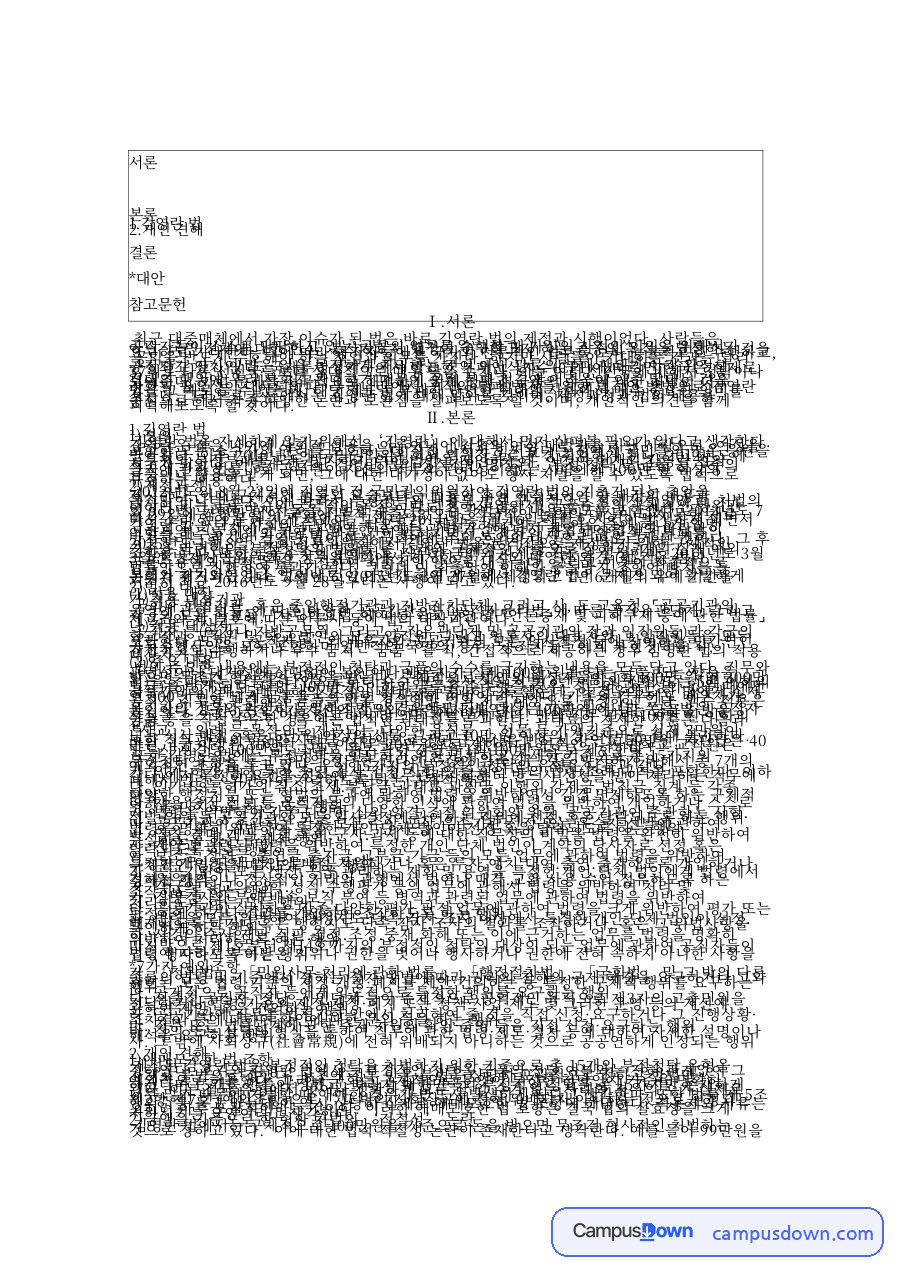
Page 1 is shown as is; from page 2 on, the preview is blurred. Buy it to download the complete original file right away (the file itself is written in Korean).
Packed with real examples and experience. Download it now and save time.
Save your valuable time
Buyer ratings
Fast, accurate and useful.
No ratings yet. Be the first to rate it.


1 / 2
좌우로 밀어서 페이지를 넘겨보세요
과제 개요
| 전체 페이지 수 | 2페이지 |
|---|---|
| 파일 형식 | 한글(HWP) |
| 등록일 | 2025.07.16 |
캠퍼스다운 도움말
해당 자료는 No AI 자료입니다. 인싸이트를 얻고 새롭게 가공해 보세요.
자료를 받아서 이용하면 품질이 확 올라갑니다.
- 김영란법
- 청탁금지법
- 부정청탁
- 금품수수 금지
- 공직자
- 국민권익위원회
- 부패방지
- 연좌제 논란
- 행정법
- 법학 과제
Korea's Kim Young-ran Act (Improper Solicitation and Graft Act): Legislative History, Scope, the Ban on Gifts, the 15 Types of Solicitation, and Criticism
※ You can preview page 1 as is. Buy it to download the complete original file right away. The file itself is written in Korean.
■ Korea's Kim Young-ran Act (Improper Solicitation and Graft Act): Legislative History, Scope, the Ban on Gifts, the 15 Types of Solicitation, and Criticism — Overview
A 6-page Korean public law paper on the Improper Solicitation and Graft Act, known as the Kim Young-ran Act. It traces the bill from its 2012 proposal to enactment in March 2015 and entry into force on September 28, 2016, explains who is covered, the criminal ban on gifts over 1 million won, the 15 listed types of improper solicitation and 7 exceptions, and criticizes vague clauses, amount thresholds and coverage.
■ Korea's Kim Young-ran Act (Improper Solicitation and Graft Act): Legislative History, Scope, the Ban on Gifts, the 15 Types of Solicitation, and Criticism — Excerpt from the original document (English translation)
The law that drew the most media attention recently was the enactment and entry into force of the Kim Young-ran Act. People demand and expect that public officials, when carrying out public duties, act not for private gain but as servants devoted to the whole nation, achieving the public purposes that administration pursues. Accordingly, officials bear the responsibility and duty to perform the state's specialized work more efficiently and to protect the public interest. Contrary to these expectations, however, corruption by officials who fail to handle their work fairly has not yet been rooted out. According to Transparency International's Corruption Perceptions Index (CPI), Korea ranks 37th, a relatively low position compared with other advanced countries. This shows that because our society is more tolerant of solicitations and entertainment than many advanced countries, rooting out public corruption is very difficult. To tackle this problem actively, the need to strengthen punishment for solicitation and receipt of money and goods emerged. The Kim Young-ran Act is an example of a legal means of preventing corruption in public office in Korea, and it has great significance in a modern society where corruption is widespread. In the main body, I will therefore examine the Kim Young-ran Act, focusing on its legislative process and content, look at the various controversies and points for improvement, and give my own opinion.
To understand the Kim Young-ran Act in detail, I think we first need to look at Kim Young-ran herself. Achieving social success at a young age, she became the first woman Supreme Court justice and won wide public support for working directly to protect the rights of women and all minorities. She later took office as chair of the Anti-Corruption and Civil Rights Commission in 2010. In 2012 she proposed a bill to prevent all corruption by public officials, which became the origin of today's Kim Young-ran Act. The official name of the law is the Improper Solicitation and Graft Act, and it provides that an official who receives money, goods or entertainment worth 1 million won or more from a person unrelated to his or her duties can be criminally punished even without any quid pro quo.
On August 22, 2012, former commission chair Kim Young-ran presented the draft that formed the basis of the act. At that point it showed only the general content and purpose of the law to be enacted rather than its concrete form. As a result, the content of improper solicitation was not specified in detail and the ultimate purpose of the receipt of money to be punished was not defined, so it covered a very broad range under which the parties could be punished as long as a concrete act of receiving money existed. On July 29, 2013 the bill was formally submitted to the National Assembly, but it was quietly buried without becoming the subject of active debate. Then, with the Sewol ferry disaster on April 16, 2014, the Kim Young-ran Act rose to the surface again.
Note: Punishment for receiving more than 1 million won at a time applies regardless of whether it is related to the official's duties, and the value limits in the paper are those in force when the law took effect in 2016. A decree amendment in force from January 17, 2018 lowered congratulatory and condolence money to 50,000 won (100,000 won for wreaths), raised the limit for agricultural, livestock and fishery gifts to 100,000 won, set public officials' outside lecture fees within a 400,000 won cap determined by each institution, and set fees for journalists and private school staff at 1 million won per hour. From August 27, 2024, the limit for meals was raised from 30,000 won to 50,000 won. The provisions covering journalists and private school staff were upheld by the Constitutional Court on July 28, 2016.
■ Korea's Kim Young-ran Act (Improper Solicitation and Graft Act): Legislative History, Scope, the Ban on Gifts, the 15 Types of Solicitation, and Criticism — Contents and key concepts
A law that punishes gifts even without a quid pro quo
✦ At a glance
- Korea's anti-graft law, how it was made and what it bans
- Structure: history → scope → gift ban → solicitation types → criticism
- Useful for public law and ethics courses
☰ What the paper covers
- Legislative history
- Who is covered
- Gift ban
- Solicitation types
- Criticism
✎ Anti-graft rules in Korea and the U.S.
Korea's act bans gifts over set amounts to officials, teachers and journalists regardless of any quid pro quo, with value limits set by decree and revised several times.
In the U.S., federal bribery law generally requires a quid pro quo, while separate ethics rules cap gifts to federal employees.
Note: the paper itself is written in Korean and discusses Korean law. This page is general study information, not legal advice.
■ Korea's Kim Young-ran Act (Improper Solicitation and Graft Act): Legislative History, Scope, the Ban on Gifts, the 15 Types of Solicitation, and Criticism References
- 김영란의 열린 법 이야기(김영란, 풀빛, 2016)
- 김영란법 적용 대상기관(편집부, 진한엠앤비, 2016)
- 이것만 알면 된다 김영한법(백성문, 한성준 외 1명, 삼일인포마인, 2016)
Keyword Prompt
전문가가 만들었어요과제를 직접 쓰는 데 도움이 되는 영어 프롬프트예요.
Tip! Prompt 에 자신의 생각을 추가해서 하면 훨씬 더 ✨ 좋습니다.
캠퍼스다운에서 레포트 받고 잘 쓰는 법 3가지, AI로 참고자료 제대로 재가공하기 →Prompt 1
I'm writing a university assignment on "김영란법(청탁금지법)의 제정 과정과 내용, 쟁점: 적용 대상, 금품수수 금지, 부정청탁 15개 유형과 예외, 개선 방안". Help me build an outline (introduction, 2-3 body sections, conclusion) that covers 김영란법, 청탁금지법 and 부정청탁. Don't write the paper for me - give me guiding questions for each section. My own perspective: [자신의 생각 넣는 곳] Please respond in Korean.
Prompt 2
Explain the key concepts "김영란법" and "청탁금지법" in simple terms, then show how they connect to the topic "김영란법(청탁금지법)의 제정 과정과 내용, 쟁점: 적용 대상, 금품수수 금지, 부정청탁 15개 유형과 예외, 개선 방안". Point out common misunderstandings students have about them. My own perspective: [자신의 생각 넣는 곳] Please respond in Korean.
Prompt 3
Suggest 3 real-world cases or examples I could analyze in an assignment on "김영란법(청탁금지법)의 제정 과정과 내용, 쟁점: 적용 대상, 금품수수 금지, 부정청탁 15개 유형과 예외, 개선 방안", focusing on "부정청탁". For each, tell me what I should look up and verify in official or academic sources. My own perspective: [자신의 생각 넣는 곳] Please respond in Korean.
Prompt 4
Review my draft paragraph on "김영란법(청탁금지법)의 제정 과정과 내용, 쟁점: 적용 대상, 금품수수 금지, 부정청탁 15개 유형과 예외, 개선 방안" (key idea: "금품수수 금지"). Give feedback on logic, evidence and clarity, and mark where I need a citation. My paragraph: [paste here] My own perspective: [자신의 생각 넣는 곳] Please respond in Korean.
Take a break with a quick personality test?
Ranked by actual participation. Results in about a minute.
Loading…
Most-read content
Loading view counts…

Campusdown is a lifelong-learning community in Korea offering study materials, information on government support, student loans and scholarships, and more. Don't miss our free resources.
Go to the Campusdown home page →Refund policy
- Change of mind / refund requested after partial use / more than 7 days after purchase
◆ Exceptions
- File errors / cannot download or open the file
◆ How to request a refund: send a 1:1 inquiry via Customer Service at the top