
Page 1 is shown as is; from page 2 on, the preview is blurred. Buy it to download the complete original file right away (the file itself is written in Korean).
Packed with real examples and experience. Download it now and save time.
Save your valuable time
Buyer ratings
Fast, accurate and useful.
No ratings yet. Be the first to rate it.


1 / 7
좌우로 밀어서 페이지를 넘겨보세요
과제 개요
| 전체 페이지 수 | 7페이지 |
|---|---|
| 파일 형식 | 한글(HWP) |
| 등록일 | 2025.07.18 |
목차
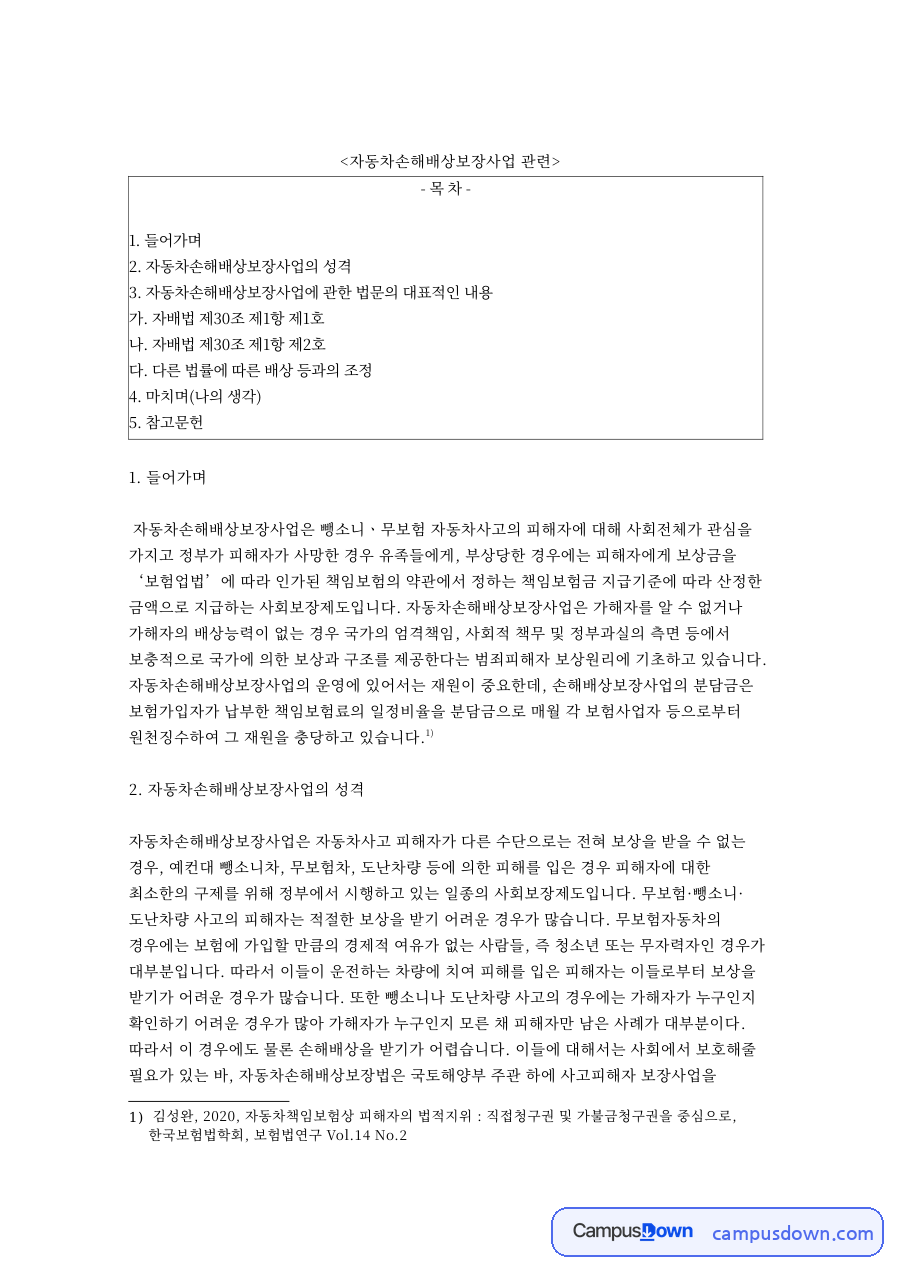
- 11. 들어가며
- 22. 자동차손해배상보장사업의 성격
- 33. 자동차손해배상보장사업에 관한 법문의 대표적인 내용
- 4가. 자배법 제30조 제1항 제1호
- 5나. 자배법 제30조 제1항 제2호
- 6다. 다른 법률에 따른 배상 등과의 조정
- 74. 마치며(나의 생각)
- 85. 참고문헌
캠퍼스다운 도움말
해당 자료는 No AI 자료입니다. 인싸이트를 얻고 새롭게 가공해 보세요.
자료를 받아서 이용하면 품질이 확 올라갑니다.
- 보험법
- 자동차손해배상보장법
- 자동차손해배상보장사업
- 정부보장사업
- 무보험차 사고
- 책임보험
- 대위권
- 사회보장
- 자배법 제30조 제1항 제2호
Korea's Government Guarantee Program for Car Accident Victims: Hit-and-Run and Uninsured Vehicle Compensation Under Article 30
※ You can preview page 1 as is. Buy it to download the complete original file right away. The file itself is written in Korean.
■ Korea's Government Guarantee Program for Car Accident Victims: Hit-and-Run and Uninsured Vehicle Compensation Under Article 30 — Overview
A 7-page Korean insurance and social security law paper on the Automobile Accident Compensation Guarantee Program under the Guarantee of Automobile Accident Compensation Act. It explains how the state compensates victims of hit-and-run, uninsured, stolen or unauthorized-use vehicles up to the compulsory liability insurance limits, funded by levies on premiums. It covers Article 30(1) items 1 and 2, case law on the owner's liability for stolen cars, the debate over whether the program applies while an insurer disputes coverage, coordination with other compensation (Article 36) and subrogation (Article 39).
■ Korea's Government Guarantee Program for Car Accident Victims: Hit-and-Run and Uninsured Vehicle Compensation Under Article 30 — Excerpt from the original document (English translation)
The Automobile Accident Compensation Guarantee Project is a social security system in which society as a whole takes an interest in victims of hit-and-run and uninsured traffic accidents, paying compensation to the bereaved family when the victim dies and to the victim when the victim is injured. The project originates in the principle of crime-victim compensation, under which, where the wrongdoer in a car accident cannot be identified or lacks the ability to pay damages, the state supplementarily provides compensation and relief measures from the standpoints of the state's strict liability, social responsibility and government fault. In interpreting the representative express provisions on the project, combining the project's purpose of enactment with its legislative intent is most important. This is all the more so for Article 30(1)(2) of the Guarantee of Automobile Accident Compensation Act, which relates to the project's scope of application.
In interpreting the law on the project's scope of application, the Supreme Court limits it to the grounds stated in the statute and regards its main content only as compensating, within the limit of compulsory liability insurance payments, the damages of victims killed or injured in accidents where the vehicle owner cannot be identified, as in hit-and-runs, or caused by driving an uninsured vehicle. It says the project, while aiming to protect victims, is meant to supplement to some extent the legally mandated automobile liability insurance system, and does not have speedy compensation of victims as its main purpose. It holds that a case where the insurer that concluded the auto insurance contract refuses to pay on grounds of exemption, so that the insurer's compensation liability is not objectively determined, does not fit the project's scope of application under Article 30(1)(2) of the Act.
Where the government has compensated for damage under Article 30(1) of the Act, it may, within the limit of the compensation amount, exercise by subrogation the victim's claim for damages against a person liable for damages under Article 3 (Article 39(1) of the Act). This right of subrogation is a statutory subrogation right by which the project operator, after compensating the victim's loss, can recover that amount from the person liable to the victim. Accordingly, the victim's claim for damages against the wrongdoer passes to the project operator while retaining its identity. However, where the victim's loss exceeds the compensation paid by the project, and the project operator's subrogation right against the wrongdoer acquired under Article 39 of the Act competes with the victim's claim against the wrongdoer for the remaining loss, the victim's claim for the remaining loss takes priority, considering the Act's purpose of protecting victims and the intent of the project.
The material states that the ministry in charge of the project is the Ministry of Land, Transport and Maritime Affairs, but since the 2013 government reorganization the competent ministry has been the Ministry of Land, Infrastructure and Transport, and actual receipt and review of compensation claims are carried out through entrusted non-life insurance companies and others. Compensation limits also follow the liability insurance payment standards, so when citing them in an assignment it is good to check the amounts in the latest Enforcement Decree of the Guarantee of Automobile Accident Compensation Act. Organizing the case law and doctrinal debates together with such current information makes it good for assignments linking insurance law and social security law. Also look up and read the original texts of the related cases.
■ Korea's Government Guarantee Program for Car Accident Victims: Hit-and-Run and Uninsured Vehicle Compensation Under Article 30 — Contents and key concepts
Who compensates victims when the driver is unknown or uninsured?
✦ At a glance
- The state safety net for car accident victims
- Structure: nature of the program → Article 30 → coordination → subrogation
- Useful for insurance law and social security law assignments
☰ What the paper covers
- Hit-and-run accidents with unknown owners
- Uninsured, stolen and unauthorized-use vehicles
- Narrow versus broad readings by courts and scholars
- Coordination with other laws and state subrogation
✎ The program in brief
Korean law requires every car owner to carry liability insurance, but some victims still fall through the gaps.
The government guarantee program pays those victims up to the insurance limits and then pursues the person liable.
Note: the paper itself is written in Korean and discusses Korean law. This page is general study information, not legal advice.
■ Korea's Government Guarantee Program for Car Accident Victims: Hit-and-Run and Uninsured Vehicle Compensation Under Article 30 References
- 김성완, 2020, 자동차책임보험상 피해자의 법적지위 : 직접청구권 및 가불금청구권을 중심으로, 한국보험법학회, 보험법연구 Vol.14 No.2 김규승, 2020, 보험금청구권의 소멸시효, 서강대학교 대학원, 국내석사 권영국, 2018, 산재법상 출퇴근 재해 인정의 문제점에 관한 연구 : 자동차보험과의 관계를 중심으로, 전북대학교 법무대학원, 국내석사 전우식, 2016, 자동차보험 약관상 지급기준과 손해배상액에 관한 연구 : 대인 배상책임 중심으로, 국민대학교, 국내석사 윤혜원, 2018, 가압류이후장기간본압류가이루어지지아니한 구상금 채권 처리방안 검토, 한국보험법학회, 보험법연구 Vol.12 No.1 윤해성, 2017, 교통사고 범죄의 합리적 근절 방안 - 자동차 보험사기를 중심으로 -, 한국경찰연구학회, 한국경찰연구 Vol.16 No.2 조규성, 2016, 자배법상 ‘자동차사고 피해지원사업'의 문제점과 개선방안에 대한 고찰, 조선대학교 법학연구원, 法學論叢 Vol.23 No.1 김성완, 2016, 자동차손해배상보장법상 압류ㆍ양도 금지 조항에 관한 소고, 보험연구원, 보험금융연구 Vol.27 No.3 정희철, 2016, 도주차량운전의 실태 및 대응방안, 공주대학교 대학원, 국내석사 정상진, 2015, 출퇴근 재해의 보상법제에 관한 개선방안 연구, 아주대학교, 국내박사
Keyword Prompt
전문가가 만들었어요과제를 직접 쓰는 데 도움이 되는 영어 프롬프트예요.
Tip! Prompt 에 자신의 생각을 추가해서 하면 훨씬 더 ✨ 좋습니다.
캠퍼스다운에서 레포트 받고 잘 쓰는 법 3가지, AI로 참고자료 제대로 재가공하기 →Prompt 1
I'm writing a university assignment on "자동차손해배상보장사업(정부보장사업) 정리: 뺑소니·무보험차 피해자 보상과 자배법 제30조 해석". Help me build an outline (introduction, 2-3 body sections, conclusion) that covers 보험법, 자동차손해배상보장법 and 자동차손해배상보장사업. Don't write the paper for me - give me guiding questions for each section. My own perspective: [자신의 생각 넣는 곳] Please respond in Korean.
Prompt 2
Explain the key concepts "보험법" and "자동차손해배상보장법" in simple terms, then show how they connect to the topic "자동차손해배상보장사업(정부보장사업) 정리: 뺑소니·무보험차 피해자 보상과 자배법 제30조 해석". Point out common misunderstandings students have about them. My own perspective: [자신의 생각 넣는 곳] Please respond in Korean.
Prompt 3
Suggest 3 real-world cases or examples I could analyze in an assignment on "자동차손해배상보장사업(정부보장사업) 정리: 뺑소니·무보험차 피해자 보상과 자배법 제30조 해석", focusing on "자동차손해배상보장사업". For each, tell me what I should look up and verify in official or academic sources. My own perspective: [자신의 생각 넣는 곳] Please respond in Korean.
Prompt 4
Review my draft paragraph on "자동차손해배상보장사업(정부보장사업) 정리: 뺑소니·무보험차 피해자 보상과 자배법 제30조 해석" (key idea: "정부보장사업"). Give feedback on logic, evidence and clarity, and mark where I need a citation. My paragraph: [paste here] My own perspective: [자신의 생각 넣는 곳] Please respond in Korean.
Take a break with a quick personality test?
Ranked by actual participation. Results in about a minute.
Loading…
Most-read content
Loading view counts…

Campusdown is a lifelong-learning community in Korea offering study materials, information on government support, student loans and scholarships, and more. Don't miss our free resources.
Go to the Campusdown home page →Refund policy
- Change of mind / refund requested after partial use / more than 7 days after purchase
◆ Exceptions
- File errors / cannot download or open the file
◆ How to request a refund: send a 1:1 inquiry via Customer Service at the top