
Page 1 is shown as is; from page 2 on, the preview is blurred. Buy it to download the complete original file right away (the file itself is written in Korean).
Packed with real examples and experience. Download it now and save time.
Save your valuable time
Buyer ratings
Fast, accurate and useful.
No ratings yet. Be the first to rate it.


Korea's Anti-Graft Act (Kim Young-ran Act) Upheld: Constitutional Court 2015Hun-Ma236 on Journalists, Private School Staff and the Principle of Clarity
※ You can preview page 1 as is. Buy it to download the complete original file right away. The file itself is written in Korean.
■ Korea's Anti-Graft Act (Kim Young-ran Act) Upheld: Constitutional Court 2015Hun-Ma236 on Journalists, Private School Staff and the Principle of Clarity — Overview
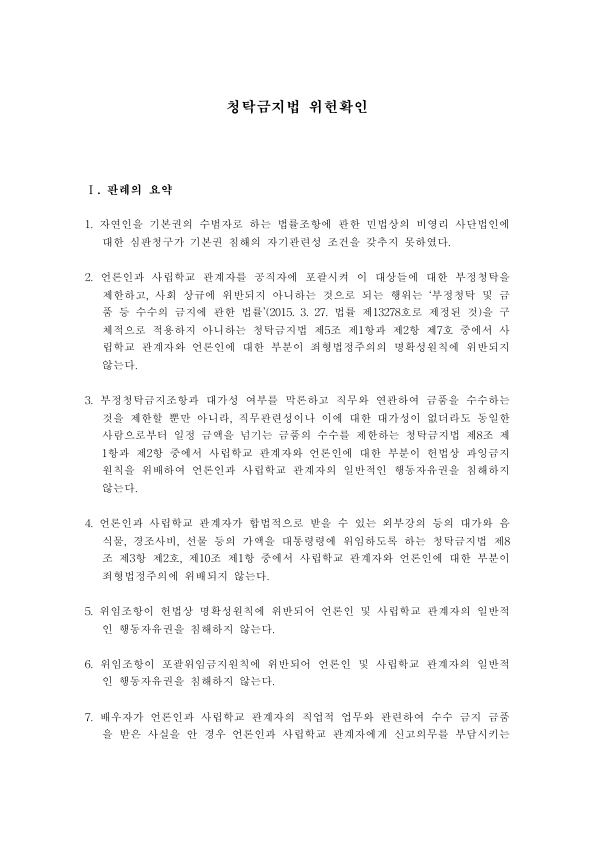
A 6-page Korean constitutional law paper on Constitutional Court decision 2015Hun-Ma236 (July 28, 2016), which upheld the Improper Solicitation and Graft Act as applied to journalists and private school staff. It summarizes ten holdings: standing of the Korean Bar Association, clarity of the solicitation ban, the proportionality of the ban on accepting money, delegation of price limits to presidential decree, the duty to report a spouse's gifts and related sanctions, and equality.
It then sets out arguments for and against the decision and the author's own view.
■ Korea's Anti-Graft Act (Kim Young-ran Act) Upheld: Constitutional Court 2015Hun-Ma236 on Journalists, Private School Staff and the Principle of Clarity — Excerpt from the original document (English translation)
In education and the press, there have been continuous efforts and expert activity to spread anti-corruption and integrity culture. Attempts were also made to eliminate corrupt practices in specific fields and establish transparency and fairness by preparing a code of ethics for private kindergartens, measures to eradicate chonji (cash gifts to teachers), and a code of ethics for journalists. However, if the effectiveness of such measures to eradicate corruption in the private sector is rated low merely because they did not produce visible results in a short period, and the state intervenes broadly without considering these actors' self-regulation and self-cleansing functions, it may instead cause private actors to lose their voluntary will to reform. As a result, they may voluntarily narrow their range of action to only those areas where punishment can be avoided, or end up relying solely on the state's criminal laws and policies without further self-cleansing efforts.
The public interest the definition clause seeks to achieve is to keep people from expecting that private school personnel and journalists will grant favors to those who made improper solicitations or gave them money or valuables, and to prevent in advance a decline in the general public's trust in those fields; but this is merely a vague and abstract future risk that has not actually materialized.
Meanwhile, the degree of restriction on the general freedom of action that arises because the definition clause brings private school personnel and journalists within the scope of the Improper Solicitation and Graft Act is significant, and as a result there is a real possibility that freedom of education and freedom of the press will be chilled. Therefore, on balancing, the private interests restricted are far greater than the public interest the definition clause seeks to achieve, so the balance of legal interests is also not met. Accordingly, the definition clause violates the principle against excessive restriction and infringes the general freedom of action of the petitioners, who are private school personnel and journalists.
1. Including journalists and private school staff within the scope of the Improper Solicitation and Graft Act is excessive interference in the private sector and infringes freedom of the press and the general freedom of action. Fundamentally, the private economic sphere is based on freedom and creativity, unlike the public sphere where integrity and incorruptibility in official duties are emphasized; so the principle is that criminal sanctions intervene when an "improper solicitation" damages a competitive order founded on such freedom and creativity. Yet the Act prohibits journalists and private school staff from receiving solicitations unrelated to their duties, and the state's power to punish intrudes deeply into the private sphere, so it is highly likely to violate the principle of private autonomy.
The private economic sphere is based on freedom and creativity, unlike the public sphere where integrity and incorruptibility in official duties are asserted; so the principle is that criminal sanctions intervene when an "improper solicitation" destroys a competitive order founded on such freedom and creativity.
Since it took effect, the value limits under the Improper Solicitation and Graft Act have been adjusted several times. The limits at its 2016 entry into force were KRW 30,000 for meals, KRW 50,000 for gifts and KRW 100,000 for congratulatory or condolence money; through amendments to the Enforcement Decree, the limits for agricultural and fishery product gifts and holiday gifts were raised, and in August 2024 the limit for meals was raised to KRW 50,000. When citing amounts in an assignment, it is accurate to check the latest Enforcement Decree from the Anti-Corruption and Civil Rights Commission and the National Law Information Center, and then describe them together with the Constitutional Court's reasoning in holding constitutional the delegation clause that leaves the amounts to Presidential Decree.
■ Korea's Anti-Graft Act (Kim Young-ran Act) Upheld: Constitutional Court 2015Hun-Ma236 on Journalists, Private School Staff and the Principle of Clarity — Contents and key concepts
Why can journalists be held to public-official ethics rules?
✦ At a glance
- Whether the Anti-Graft Act may cover journalists and private school staff
- Structure: ten holdings → arguments for → arguments against → opinion
- Useful for constitutional law and media law debates
☰ What the paper covers
- Ten holdings of the decision
- Arguments supporting the decision
- Arguments against it
- Author's view
✎ The Act in brief
The Act took effect on September 28, 2016. It covers public officials and also journalists and private school staff, and bans taking more than KRW 1 million at once or KRW 3 million a year from one person regardless of job relevance.
The Court found that the public nature of education and the press justified the rules and that leaving price limits to decree was not an excessive delegation.
Note: the paper itself is written in Korean and discusses Korean law. This page is general study information, not legal advice.
Take a break with a quick personality test?
Ranked by actual participation. Results in about a minute.
Loading…
Most-read content
Loading view counts…

Campusdown is a lifelong-learning community in Korea offering study materials, information on government support, student loans and scholarships, and more. Don't miss our free resources.
Go to the Campusdown home page →Refund policy
- Change of mind / refund requested after partial use / more than 7 days after purchase
◆ Exceptions
- File errors / cannot download or open the file
◆ How to request a refund: send a 1:1 inquiry via Customer Service at the top