
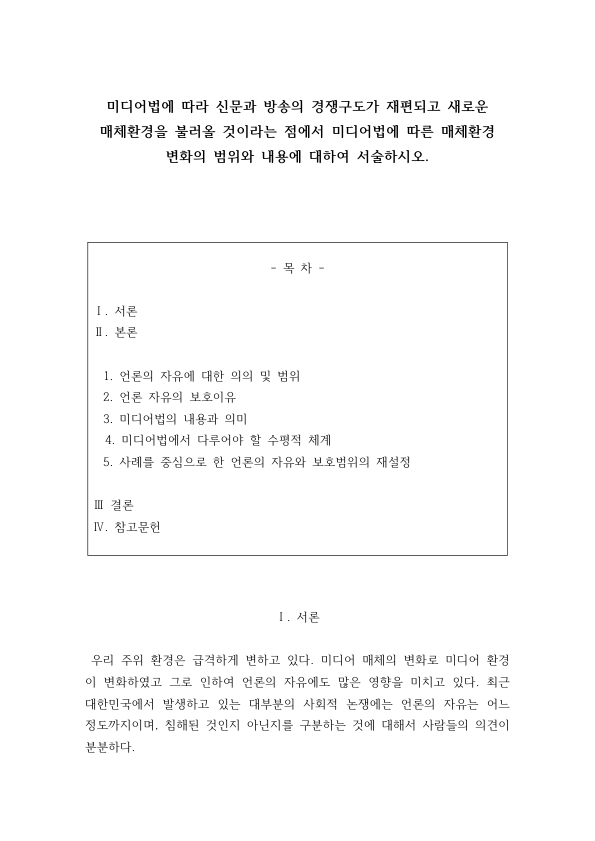
Page 1 is shown as is; from page 2 on, the preview is blurred. Buy it to download the complete original file right away (the file itself is written in Korean).
Packed with real examples and experience. Download it now and save time.
Save your valuable time
Buyer ratings
Fast, accurate and useful.
No ratings yet. Be the first to rate it.


Korea's 2009 Media Law and Press Freedom: Newspaper-Broadcast Cross-Ownership, Horizontal Regulation, Online Defamation and the Minerva Case
※ You can preview page 1 as is. Buy it to download the complete original file right away. The file itself is written in Korean.
■ Korea's 2009 Media Law and Press Freedom: Newspaper-Broadcast Cross-Ownership, Horizontal Regulation, Online Defamation and the Minerva Case — Overview
A 15-page Korean media law paper. It explains the 2009 media law package that let newspapers and large companies own broadcasters, the arguments for and against it, the meaning and scope of press freedom under Article 21 of the Constitution, the case for horizontal regulation of converged media, and online defamation through the Minerva case.
■ Korea's 2009 Media Law and Press Freedom: Newspaper-Broadcast Cross-Ownership, Horizontal Regulation, Online Defamation and the Minerva Case — Excerpt from the original document (English translation)
The media law is divided into the Newspaper Act, the Broadcasting Act, the IPTV Act and the Information and Communications Network Act. The broadcasting bills mainly deal with ownership and cross-ownership in existing law, and the government announced it would ease rules on newspaper-broadcast cross-ownership, citing a Constitutional Court ruling of nonconformity and the need for competitiveness. They also imply an intention to manage internet news separately from press organizations. Allowing newspapers and broadcasters to be owned together could achieve the aim of expanding media industry infrastructure, but concentration of capital could undermine fair reporting, so the regulatory system needs to be supplemented.
The Newspaper Act amendment focuses on cross-ownership among large companies, foreign capital and newspapers. Most of the amendment eases rules so that newspapers, large companies and foreign capital can take part in each other within set limits. Provisions on telecom and broadcast ownership and broadcast advertising were newly created with newspapers and large companies entering broadcasting in mind. Participation in converged telecom-broadcast media is also specified, so sanctions were strengthened as well.
Deregulation of broadcasting is handled mainly through the Newspaper Act because the earlier rules were written mainly to limit newspapers' scope of activity. The amendment sets out ownership and cross-ownership limits for newspapers, broadcasters and large companies, and its overall direction is to relax them.
Within the media law's aims, the IPTV provisions are most closely tied to expanding media industry infrastructure. IPTV has struggled from its launch to secure content and improve quality, so the amendment seeks to boost it by easing limits on capital investment and program providers. Introducing general programming and news channels can be expected to increase diversity of content, ideas and viewpoints, and also gives viewers wider exposure diversity. Because viewers can choose among more media content and perspectives, allowing general programming and news channels is expected to increase exposure diversity.
IPTV must compete with digital cable TV, but it has spread slowly because of difficulty securing content for its many channels. The media law therefore aims to expand the converged telecom-broadcast market around IPTV by easing limits and rules on program providers.
The bill on information and communications networks stems from the need to regulate the internet's many convenient functions. It mainly covers insults to personality online and copyright protection. In particular, the proposed 'cyber insult' offense was drafted because online insults are often hard to trace owing to anonymity and indiscriminate copying and distribution, making it difficult to rely on reports or complaints.
Diversity of opinion in media without a stable business base raises even more problems of fairness and accountability in reporting. The damage to journalism from weak management structures can be greater than the threat to fair reporting from monopolistic operation by big capital, which makes it a question of after-the-fact regulation.
The problem of fair reporting spans a wide range, from structural levels such as media ownership to the personal ethics of individual journalists.
To add: the media law this paper discusses was passed by the National Assembly in July 2009. On October 29 of that year, the Constitutional Court found that lawmakers' rights to deliberate and vote had been infringed in declaring the Newspaper Act and Broadcasting Act passed, but rejected claims to nullify the declarations (2009Hun-Ra8 and others). The laws therefore took effect, and in December 2011 four general programming channels with newspaper participation went on air. In the Minerva case, Article 47(1) of the Framework Act on Telecommunications, which punished false communications, was struck down by the Constitutional Court on December 28, 2010 for violating the principle of clarity (2008Hun-Ba157 and others). A cyber insult offense was discussed but never adopted.
■ Korea's 2009 Media Law and Press Freedom: Newspaper-Broadcast Cross-Ownership, Horizontal Regulation, Online Defamation and the Minerva Case — Contents and key concepts
Competition or concentration of opinion?
✦ At a glance
- Korea's 2009 media law and freedom of the press
- Structure: debate → press freedom → contents → regulation → online cases
- Useful for media law, broadcasting policy and constitutional law courses
☰ What the paper covers
- Scope of the media law
- Arguments for and against
- Press freedom
- Horizontal regulation
- Online defamation
✎ Media ownership rules in Korea and the U.S.
Korea's 2009 law let newspapers and large companies take stakes in broadcasters, leading to four general programming cable channels in 2011.
In the U.S., the FCC's newspaper-broadcast cross-ownership ban dating from 1975 was repealed in 2017, a move the Supreme Court upheld in FCC v. Prometheus Radio Project (2021).
Note: the paper itself is written in Korean and discusses Korean law. This page is general study information, not legal advice.
Related wiki: The First Amendment and Free Speech
■ Korea's 2009 Media Law and Press Freedom: Newspaper-Broadcast Cross-Ownership, Horizontal Regulation, Online Defamation and the Minerva Case References
- 2009.10 ,최일도 (한국외국어대학교 언론정보연구소 연구원, 언론학 박사), ‘미디어법과 매체환경의 변화’
- 2009, 성낙인, ‘인터넷과 표현의 자유’
- 2009.07, 전국경제인연합회, ‘미디어 관련법 개정안의 주요 쟁점과 현실’
- 2009.03.13., 곽은경, ‘방송과 신문시장의 현황과 개혁과제’, CFE Report No. 82, 자유기업원
- 2008, 김영주, ‘신문의 방송진출, 사업성과 가능성’, 「미디어 인사이트」4월호, 한국언론재단
- 2009.02.23., 김영주, ‘방송산업의 구조변화와 규제 쟁점 유료방송 관련 법개정 논의를 중심으로’, 서울대학교 공익산업법센터 제23회 세미나 발표자료
- 2008.10.21., 문재완, ‘방송의 소유규제 완화 추진방안, 방송경쟁력강화 및 공공성 구축방안’, KISDI 세미나 발표자료
- 2009.02.10., 문재완, ‘방송통신융합시대의 방송법개정 소유규제 대 사후규제’, 한국언론인협회 세미나 발표자료
- 2009.02.04., 문종대, ‘방송규제완화의 경제적 효과분석에 대한 논의’, 미디어공공성포럼 제5차 쟁점 토론 발표자료
- 2008.07.25., 박소라, ‘신문・방송 겸영과 다양성’, 공영방송발전을 위한 시민연대 워크샵 발표자료
- 2008, 박주연, ‘신문・방송의 교차소유정책: 해외사례와 그 시사점’, 「미디어인사이트」4월호, 한국언론재단
- 2008.12, 방송통신위원회, ‘2008년 방송 산업 실태조사 보고서’
- 2008.08.15., 성숙희, ‘융합 환경에 대응하는 해외 주요국의 방송 소유규제 방법론 분석’, KBI포커스
- 2000.03, 송해룡, ‘각국의 방송에 대한 소유・진입・겸영규제 비교연구’, 염용섭외4인(2009), 방송규제완화의 경제적 효과 분석, KISDI이슈리포트 09-01
- 2009.02.27., 윤석민, ‘방송소유 규제완화와 여론독과점’, 공영방송발전을 위한 시민연대 세미나 발표자료
- 2008.11.04., 이영주, ‘종합편성채널과 보도전문채널 사업자 구도와 주요 쟁점’, 방송경쟁력강화 및 공공성 구축방안 KISDI 세미나 발표자료
- 2008.08.13., 장호순, ‘신문과 방송의 교차소유 규제완화에 관한 찬반론 분석’, 공영방송발전을 위한 시민연대 세미나 발표자료
- 2008, 정인숙, ‘신문과 방송의 겸영 규제 정책판단을 위한 세가지 기준과 대안’, 「정보법학」 제12권 제1호, 221-256
- 2009.02.23., 정인숙, ‘지상파방송 규제의 현황과 방송법 개정 전망’, 서울대학교 공익산업법센터
- 문재완(한국외국어대학교 법학전문대학원 부교수), ‘미디어 환경 변화에 따른 언론의 자유의 보호범위 재설정에 관한 연구’
Take a break with a quick personality test?
Ranked by actual participation. Results in about a minute.
Loading…
Most-read content
Loading view counts…

Campusdown is a lifelong-learning community in Korea offering study materials, information on government support, student loans and scholarships, and more. Don't miss our free resources.
Go to the Campusdown home page →Refund policy
- Change of mind / refund requested after partial use / more than 7 days after purchase
◆ Exceptions
- File errors / cannot download or open the file
◆ How to request a refund: send a 1:1 inquiry via Customer Service at the top