
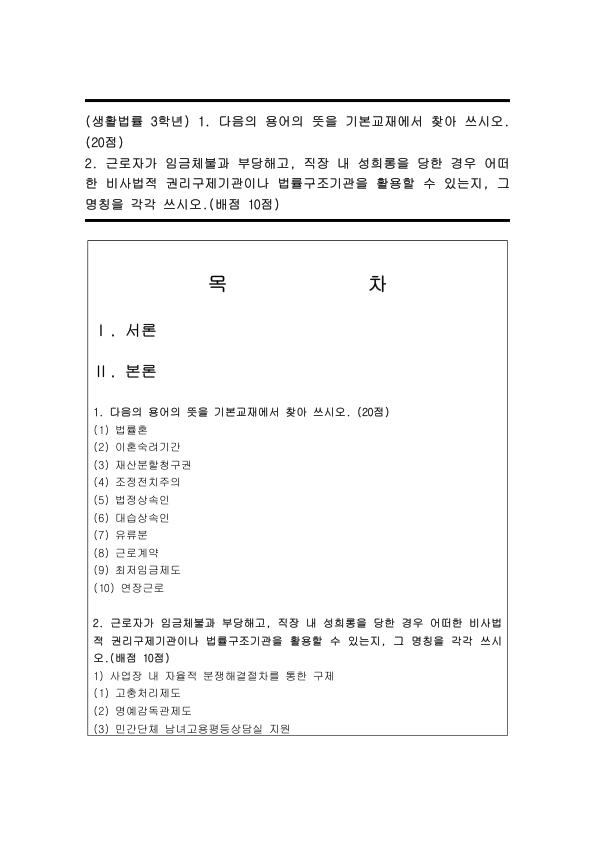
Page 1 is shown as is; from page 2 on, the preview is blurred. Buy it to download the complete original file right away (the file itself is written in Korean).
Packed with real examples and experience. Download it now and save time.
Save your valuable time
Buyer ratings
Fast, accurate and useful.
No ratings yet. Be the first to rate it.
Key Terms in Korean Everyday Law: Marriage Registration, Divorce Cooling-Off, Property Division, Forced Heirship and Remedies for Wage Theft, Unfair Dismissal and Harassment
※ You can preview page 1 as is. Buy it to download the complete original file right away. The file itself is written in Korean.
■ Key Terms in Korean Everyday Law: Marriage Registration, Divorce Cooling-Off, Property Division, Forced Heirship and Remedies for Wage Theft, Unfair Dismissal and Harassment — Overview
A 9-page Korean everyday law assignment. It defines ten terms, from legal marriage, the divorce cooling-off period and property division to forced heirship shares, inheritance by representation, the minimum wage and overtime. It then lists the bodies workers can use for unpaid wages, unfair dismissal and workplace sexual harassment.
■ Key Terms in Korean Everyday Law: Marriage Registration, Divorce Cooling-Off, Property Division, Forced Heirship and Remedies for Wage Theft, Unfair Dismissal and Harassment — Excerpt from the original document (English translation)
If a lineal descendant or sibling who would become an heir dies before the inheritance opens or becomes disqualified, and that person has a lineal descendant or spouse, the lineal descendant or spouse becomes an heir in place of the deceased or disqualified person, taking that person's rank (Articles 1001 and 1003(2) of the Civil Act).
On the nature of inheritance by representation, two views compete: the succession theory, which holds that the representative heir succeeds to the rights of the person represented, and the independent right theory, which holds that the representative heir inherits directly by his or her own right. The independent right theory is the prevailing view.
The heir must have died or become disqualified before the inheritance opened (Articles 1001 and 1003(2) of the Civil Act); renunciation of inheritance is not a ground for representation. If representation is seen as the representative's own right, it should logically be recognized even in cases of renunciation. Case law also recognizes representation when the heir died at the moment the inheritance opened, that is, when the decedent and the presumptive heir died at the same time (Supreme Court Decision 99Da13157, March 9, 2001). The representative heir must be a lineal descendant or spouse of the person represented and must not have lost the qualification to inherit. Thus a spouse of the person represented who remarried before the decedent's death cannot be a representative heir. The person represented must be a lineal descendant or sibling of the decedent.
Even when the decedent has made bequests or gifts, a certain portion of the estate must be reserved for the heirs, and this minimum share reserved for the heirs is called the reserved portion, or forced share. In other words, the forced share system was introduced to resolve the conflict between freedom of testation and statutory inheritance.
The reasons generally given for the forced share system are: (1) inheritance serves to continue support for the surviving family; (2) when children's expected shares are distorted by bequests, this goes against natural human feeling and may destroy the harmony and unity of the family; (3) if the decedent's dispositions make it hard for the heirs to make a living, this burdens society, so the system is also needed from a social security standpoint; (4) since the estate is essentially the tangible and intangible property of the heirs centered on the decedent, the heirs should naturally have a right to acquire part of it; (5) the heirs' expectations regarding the estate should be protected; and (6) a fixed proportion of the statutory share should be set as the forced share to secure contributions to building the estate.
The employment contract grew out of the contract of service in the Civil Act and developed into a concept of labor law, which is part of social law. In other words, the contract of service is a concept of the Civil Act, a body of civil law, while the employment contract is a concept of labor law, a body of social law. As contradictions emerged between civil law and social reality, social law centered on labor law gradually took shape, and as social law developed, labor law established its own field as positive law. As a result, the legal concept of the employment contract also gained a firm footing in positive law. The leading body of law governing employment contracts is the Labor Standards Act, and matters not covered by it are governed by analogous application of the Civil Act or by case law. The employment relationships of workers in special types of employment who are not covered by the Labor Standards Act are governed by separate special acts.
The Minimum Wage Act does not separately define the minimum wage system. In general, a minimum wage system is one in which the state sets a minimum level of wages and legally compels employers to comply with it. However, the minimum wage refers to the lowest level of wages an employer must pay covered workers and does not include the rate or method of wage increases. The current Minimum Wage Act also does not directly define "wages," and Article 2 adopts the concept of wages under Article 2 of the Labor Standards Act.
To add: on April 25, 2024, in case 2020Hun-Ka4 and others, the Constitutional Court struck down Article 1112(4) of the Civil Act, which gave siblings a forced share, and found other parts, such as the lack of grounds to deny a forced share to heirs who gravely wronged the decedent, incompatible with the Constitution. The 2026 minimum wage is 10,320 won per hour. The 'Ministry of Labor' in the paper became the Ministry of Employment and Labor in 2010, and since May 2022 workers can ask the Labor Relations Commission to correct employment discrimination based on sex and workplace sexual harassment. Mandatory prior mediation is also a term used in family litigation, where divorce suits generally go to mediation first.
■ Key Terms in Korean Everyday Law: Marriage Registration, Divorce Cooling-Off, Property Division, Forced Heirship and Remedies for Wage Theft, Unfair Dismissal and Harassment — Contents and key concepts
What do Korea's key family and labor law terms mean?
✦ At a glance
- Ten core terms in Korean everyday law
- Structure: definitions → remedies for workplace disputes
- Useful for everyday law and intro family or labor law courses
☰ What the paper covers
- Legal marriage
- Divorce cooling-off period
- Forced heirship and representation
- Minimum wage and overtime
- Labor commission remedies
✎ Forced heirship in Korea and the U.S.
Korea reserves a minimum share of an estate for children, spouses and parents, and in 2024 the Constitutional Court struck down the share for siblings.
Most U.S. states let people disinherit children entirely, though spouses are protected by elective share or community property rules; Louisiana is the main exception with limited forced heirship.
Note: the paper itself is written in Korean and discusses Korean law. This page is general study information, not legal advice.
Related wiki: How to Write a Will
■ Key Terms in Korean Everyday Law: Marriage Registration, Divorce Cooling-Off, Property Division, Forced Heirship and Remedies for Wage Theft, Unfair Dismissal and Harassment References
- 김엘림, 최용근, 「생활법률」(2020년 개정판), KNOUPRESS, 2020.7.
- 김엘림·최용근, 「생활법률 워크북 」(2019년 개정판), KNOUPRESS, 2019.7 송덕수, 「친족상속법」, 박영사, 2015.
- 박영규, 판례로 보는 친족법·상속법, 법원사, 2018.
- 윤진수, 친족상속법강의(제2권), 박영사, 2019.
- 김선화(2015). "동성혼의 법제화에 관한 고찰." 이화젠더법학. 하갑래, 「근로기준법 제23판」, ㈜중앙경제, 2011.
- 민길자(2006). "사실혼의 현대적 전개-파트너십의 유형과 그 보호법리를 중심으로", 「고려대학교 박사학위논문」. 박양숙, 2002, “노동쟁의조정제도에 과한 연구-조정전치주의를 중심으로”, 고려대학교 노동대학원 석사학위논문.
- 강금봉(2019), 근로기준법 벌칙제도가 근로계약서 작성에 미치는 효과분석: 한국노동패널을 통한 연도별 효과를 중심으로, 국회입법조사처, 입법과 정책.
Take a break with a quick personality test?
Ranked by actual participation. Results in about a minute.
Loading…
Most-read content
Loading view counts…

Campusdown is a lifelong-learning community in Korea offering study materials, information on government support, student loans and scholarships, and more. Don't miss our free resources.
Go to the Campusdown home page →Refund policy
- Change of mind / refund requested after partial use / more than 7 days after purchase
◆ Exceptions
- File errors / cannot download or open the file
◆ How to request a refund: send a 1:1 inquiry via Customer Service at the top