
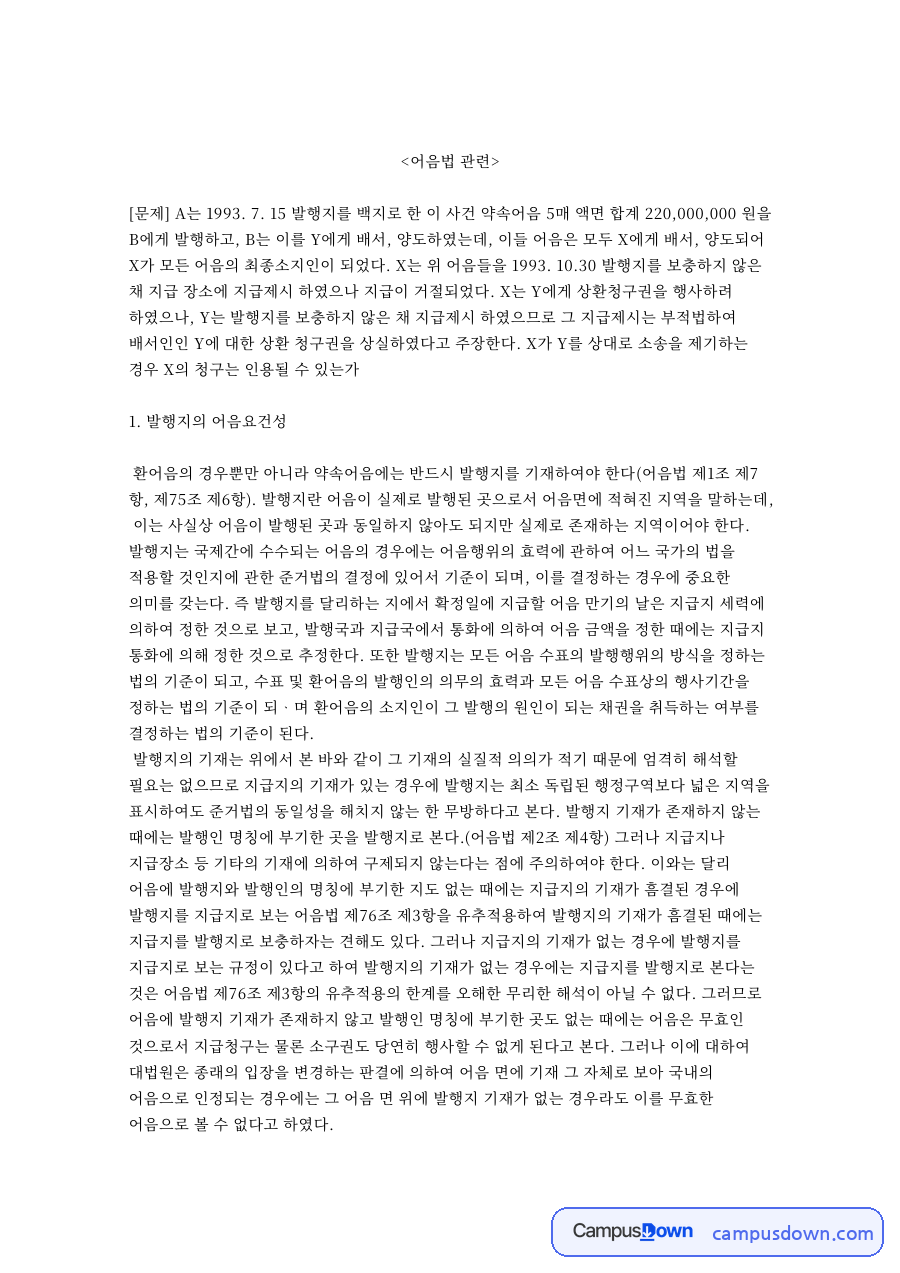
Page 1 is shown as is; from page 2 on, the preview is blurred. Buy it to download the complete original file right away (the file itself is written in Korean).
Packed with real examples and experience. Download it now and save time.
Save your valuable time
Buyer ratings
Fast, accurate and useful.
No ratings yet. Be the first to rate it.


1 / 5
좌우로 밀어서 페이지를 넘겨보세요
과제 개요
| 전체 페이지 수 | 5페이지 |
|---|---|
| 파일 형식 | 한글(HWP) |
| 등록일 | 2025.07.04 |
캠퍼스다운 도움말
해당 자료는 No AI 자료입니다. 인싸이트를 얻고 새롭게 가공해 보세요.
자료를 받아서 이용하면 품질이 확 올라갑니다.
- 어음법
- 약속어음
- 발행지
- 백지어음
- 어음요건
- 95다36466
- 국내어음
- 상환청구권
- 상법 과제
Is a Promissory Note Without a Place of Issue Valid? Korean Supreme Court En Banc Decision 95Da36466 (1998), Domestic Notes, Blank Notes and the Holder's Right of Recourse
※ You can preview page 1 as is. Buy it to download the complete original file right away. The file itself is written in Korean.
■ Is a Promissory Note Without a Place of Issue Valid? Korean Supreme Court En Banc Decision 95Da36466 (1998), Domestic Notes, Blank Notes and the Holder's Right of Recourse — Overview
A 5-page Korean commercial law case problem on promissory notes. Notes issued with the place of issue left blank passed by endorsement to a holder, who was refused payment and sued an endorser. The paper explains why the place of issue is a formal requirement and how the 1998 en banc decision treated domestic notes, and reviews the dissent.
■ Is a Promissory Note Without a Place of Issue Valid? Korean Supreme Court En Banc Decision 95Da36466 (1998), Domestic Notes, Blank Notes and the Holder's Right of Recourse — Excerpt from the original document (English translation)
In this case, A issued to B on July 15, 1993 five promissory notes with the place of issue left blank, with a total face value of 220,000,000 won; B endorsed and transferred them to Y, and all of them were then endorsed and transferred to X, who became the final holder of all the notes. On October 30, 1993, X presented the notes for payment at the place of payment without filling in the place of issue, but payment was refused. X sought to exercise the right of recourse against Y, but Y argued that because X presented the notes without filling in the place of issue, the presentment was improper and X lost the right of recourse against Y as endorser. If X sues Y, X's claim can be upheld. The notes in this case are clearly domestic notes issued and paid in Korea, so they cannot be treated as invalid even though no place of issue appears on their face, and even though they were presented without a place of issue, the presentment should be regarded as proper.
The en banc decision is an important precedent that denied the place of issue the status of a formal requirement for notes used within Korea. The majority opinion reasons that the place of issue is an important standard for interpreting acts on international notes but has little meaning for domestic notes, and lists criteria for domestic notes that are valid without a place of issue. Under those criteria, the place of payment or paying location is in Korea, the issuer and payee are Korean, the amount is stated in won, the wording of the note is written in Korean or Chinese characters, and the name of the clearing house is in Korea. Whether all these criteria are reasonable is questionable, and they could be read as recognizing domestic notes only for promissory notes, because they say nothing about the drawee or acceptor.
In this respect, the court should have made clear why a bill of exchange cannot be a domestic note. On the premise that domestic notes are limited to promissory notes, if a blank note bearing only an endorsement and no formal requirements at all is issued and the place of issue is never filled in, the note's fate would be that it becomes valid if all requirements later fit the criteria in this decision and invalid if even one is missing, which would rather harm the security of transactions. On the criteria for domestic notes, there is criticism that "as the domestic market opens further and the currencies of major countries circulate freely in Korea, disputes are expected over whether a note is domestic.
To add: this en banc decision overruled earlier cases that treated notes without a place of issue as invalid. Where the paper cites "Article 1(7) and Article 75(6) of the Bills of Exchange and Promissory Notes Act," the correct references are items 7 and 6 of those articles. After the decision, the Act on the Issuance and Distribution of Electronic Promissory Notes was enacted in 2004 and took effect in 2005, and as the use of notes declined, the government has pursued a policy of gradually phasing down paper promissory notes. The right of recourse on bills and promissory notes can be exercised only after proper presentment for payment and refusal (Articles 43 and 77).
■ Is a Promissory Note Without a Place of Issue Valid? Korean Supreme Court En Banc Decision 95Da36466 (1998), Domestic Notes, Blank Notes and the Holder's Right of Recourse — Contents and key concepts
Does a missing place of issue void a note?
✦ At a glance
- A 1998 Korean en banc ruling on promissory notes
- Structure: problem → requirement → decision → conclusion → critique
- Useful for commercial law and negotiable instruments courses
☰ What the paper covers
- The blank note problem
- Place of issue as a requirement
- Test for domestic notes
- Holder wins recourse
- Critique and dissent
✎ Formal requirements for notes in Korea and the U.S.
Korea follows the Geneva uniform law on bills and notes, which lists the place of issue as a formal requirement, though the Supreme Court excused it for domestic notes in 1998.
In the U.S., UCC Article 3 does not require a place of issue for a negotiable note, and an incomplete instrument can be completed and enforced as authorized.
Note: the paper itself is written in Korean and discusses Korean law. This page is general study information, not legal advice.
■ Is a Promissory Note Without a Place of Issue Valid? Korean Supreme Court En Banc Decision 95Da36466 (1998), Domestic Notes, Blank Notes and the Holder's Right of Recourse References
- 이성우, 2019, 어음행위관련이론의 현실적 적합성에 관한 검토, 동아대학교 법학연구소, 東亞法學 Vol.- No.82 정응기, 2020, 어음행위의 실질적 요건에 관한 어음항변, 사법발전재단, 사법 Vol.1 No.54
Keyword Prompt
전문가가 만들었어요과제를 직접 쓰는 데 도움이 되는 영어 프롬프트예요.
Tip! Prompt 에 자신의 생각을 추가해서 하면 훨씬 더 ✨ 좋습니다.
캠퍼스다운에서 레포트 받고 잘 쓰는 법 3가지, AI로 참고자료 제대로 재가공하기 →Prompt 1
I'm writing a university assignment on "발행지 백지 약속어음의 효력: 대법원 95다36466 전원합의체 판결, 국내어음과 어음요건, 배서인 상환청구권 사례 풀이". Help me build an outline (introduction, 2-3 body sections, conclusion) that covers 어음법, 약속어음 and 발행지. Don't write the paper for me - give me guiding questions for each section. My own perspective: [자신의 생각 넣는 곳] Please respond in Korean.
Prompt 2
Explain the key concepts "어음법" and "약속어음" in simple terms, then show how they connect to the topic "발행지 백지 약속어음의 효력: 대법원 95다36466 전원합의체 판결, 국내어음과 어음요건, 배서인 상환청구권 사례 풀이". Point out common misunderstandings students have about them. My own perspective: [자신의 생각 넣는 곳] Please respond in Korean.
Prompt 3
Suggest 3 real-world cases or examples I could analyze in an assignment on "발행지 백지 약속어음의 효력: 대법원 95다36466 전원합의체 판결, 국내어음과 어음요건, 배서인 상환청구권 사례 풀이", focusing on "발행지". For each, tell me what I should look up and verify in official or academic sources. My own perspective: [자신의 생각 넣는 곳] Please respond in Korean.
Prompt 4
Review my draft paragraph on "발행지 백지 약속어음의 효력: 대법원 95다36466 전원합의체 판결, 국내어음과 어음요건, 배서인 상환청구권 사례 풀이" (key idea: "백지어음"). Give feedback on logic, evidence and clarity, and mark where I need a citation. My paragraph: [paste here] My own perspective: [자신의 생각 넣는 곳] Please respond in Korean.
Take a break with a quick personality test?
Ranked by actual participation. Results in about a minute.
Loading…
Most-read content
Loading view counts…

Campusdown is a lifelong-learning community in Korea offering study materials, information on government support, student loans and scholarships, and more. Don't miss our free resources.
Go to the Campusdown home page →Refund policy
- Change of mind / refund requested after partial use / more than 7 days after purchase
◆ Exceptions
- File errors / cannot download or open the file
◆ How to request a refund: send a 1:1 inquiry via Customer Service at the top