
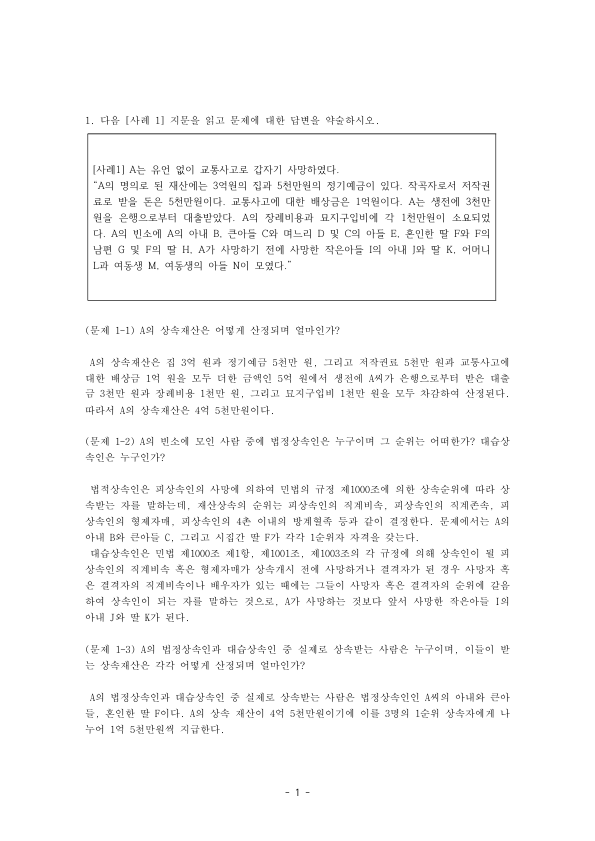
Page 1 is shown as is; from page 2 on, the preview is blurred. Buy it to download the complete original file right away (the file itself is written in Korean).
Packed with real examples and experience. Download it now and save time.
Save your valuable time
Buyer ratings
Fast, accurate and useful.
No ratings yet. Be the first to rate it.


Intestate Succession in Korea: Order of Heirs, Statutory Shares and Representation, Plus Key Everyday Law Terms and Dispute Bodies
※ You can preview page 1 as is. Buy it to download the complete original file right away. The file itself is written in Korean.
■ Intestate Succession in Korea: Order of Heirs, Statutory Shares and Representation, Plus Key Everyday Law Terms and Dispute Bodies — Overview
A 6-page Korean everyday law assignment. It works through an inheritance case to find the estate, the legal heirs and the heirs by representation, then defines basic labor, welfare, contract and criminal law terms and explains which Korean courts and commissions handle which disputes.
■ Intestate Succession in Korea: Order of Heirs, Statutory Shares and Representation, Plus Key Everyday Law Terms and Dispute Bodies — Excerpt from the original document (English translation)
A loan for consumption is a contract in which one party, the lender, promises to transfer ownership of money or other fungible things to the other party, and the other party, the borrower, promises to return things of the same kind, quality and quantity.
A sales contract is set out in Article 563 of the Civil Code: the seller agrees to transfer a property right the seller holds to the other party, and the buyer agrees to pay the price for it.
A lease contract is set out in Article 618 of the Civil Code: the lessor agrees to let the lessee use and profit from the leased property, and the lessee agrees to pay rent in return.
A crime is an act that violates a law providing for punishment, such as the Criminal Act. The principle of legality in criminal law is set out in the second sentence of Article 12(1) and the first part of Article 13(1) of the Constitution. The principle of legality means that crimes and punishments must be defined by statute, and the principle of clarity that follows from it means that the elements of an offense must be defined precisely, so that anyone can foresee exactly what conduct the law punishes and what the punishment will be, and can decide how to act accordingly.
An offense prosecutable only on complaint is a crime for which a complaint by a person entitled to file one, such as the victim or the victim's legal representative, is required before the prosecutor can indict the offender.
Indictment means a prosecutor's request to a court for judgment in a particular criminal case. It is also called the filing of a public prosecution; the prosecutor's indictment marks the end of the investigation, and with the indictment the court proceedings begin.
The citizen participation trial system is the jury trial system that began in earnest in Korea in January 2008. The selected jurors give the judge their opinions on findings of fact, application of the law and sentencing in a criminal trial.
A suspended sentence is a system in which, when a judge pronounces a sentence and finds the circumstances minor or no real need to carry out the sentence, the execution of the sentence is put off, and once the suspension period passes, the pronounced sentence loses its effect.
3. Briefly describe what dispute resolution and remedies each of the following bodies provides.
The family court is a Korean court established to specialize in family matters such as marriage, divorce, inheritance and adoption, as defined in Article 2 of the Family Litigation Act, and in juvenile cases.
The civil court resolves the various disputes involved in civil litigation, and civil litigation here means the procedure for resolving and settling disputes over private rights or legal relationships through the state's judicial power, by law and with binding force.
The criminal court resolves the various disputes involved in criminal proceedings, and a criminal trial in principle begins when the prosecutor files a public prosecution. A prosecutor who judges that a case calls for a fine may instead ask the court for a summary order. In that case the judge can issue a summary order right away without a trial, and if a summary order is judged inappropriate, the case is usually sent back to a regular trial. The defendant can request a formal trial within seven days of being notified of the summary order.
To add: the answer to the case needs correcting. The spouse B inherits jointly with the children, and the share of the younger son I, who died earlier, passes by representation to his wife J and daughter K (Civil Code Articles 1001 and 1003(2)). Because the spouse receives half again as much as a child's share (Article 1009), the ratio is B 1.5, C 1, F 1 and I's share 1, so an estate of 450 million won gives B 150 million won, C and F 100 million won each, and I's 100 million won share is split into 60 million won for J and 40 million won for K. Also, the threshold for filing work rules is 10 or more regular employees and for setting up a labor-management council 30 or more, the family court is governed by the Family Litigation Act, and the main public assistance program is the National Basic Livelihood Security system.
■ Intestate Succession in Korea: Order of Heirs, Statutory Shares and Representation, Plus Key Everyday Law Terms and Dispute Bodies — Contents and key concepts
Who inherits when there is no will?
✦ At a glance
- Order of heirs and representation in a Korean case
- Structure: inheritance case → legal terms → dispute bodies
- Useful for everyday law and intro to law courses
☰ What the paper covers
- Calculating the estate
- Legal heirs and their order
- Labor and welfare law terms
- Contract and criminal law terms
- Courts and commissions
✎ Inheritance without a will in Korea and the U.S.
Under Korea's Civil Code, children inherit first together with the spouse, who takes one and a half times a child's share, and a child who died earlier is represented by that child's spouse and children.
In the U.S., intestate succession is set by each state's law, so the spouse's share and the order of relatives differ from state to state.
Note: the paper itself is written in Korean and discusses Korean law. This page is general study information, not legal advice.
Related wiki: Arbitration
■ Intestate Succession in Korea: Order of Heirs, Statutory Shares and Representation, Plus Key Everyday Law Terms and Dispute Bodies References
- 김엘림·최용근, 「생활법률」(2020년 개정판 기본교재), KNOUPRESS.
- 김엘림·최용근, 「생활법률 워크북」(2019년 개정판), KNOUPRESS.
Take a break with a quick personality test?
Ranked by actual participation. Results in about a minute.
Loading…
Most-read content
Loading view counts…

Campusdown is a lifelong-learning community in Korea offering study materials, information on government support, student loans and scholarships, and more. Don't miss our free resources.
Go to the Campusdown home page →Refund policy
- Change of mind / refund requested after partial use / more than 7 days after purchase
◆ Exceptions
- File errors / cannot download or open the file
◆ How to request a refund: send a 1:1 inquiry via Customer Service at the top