
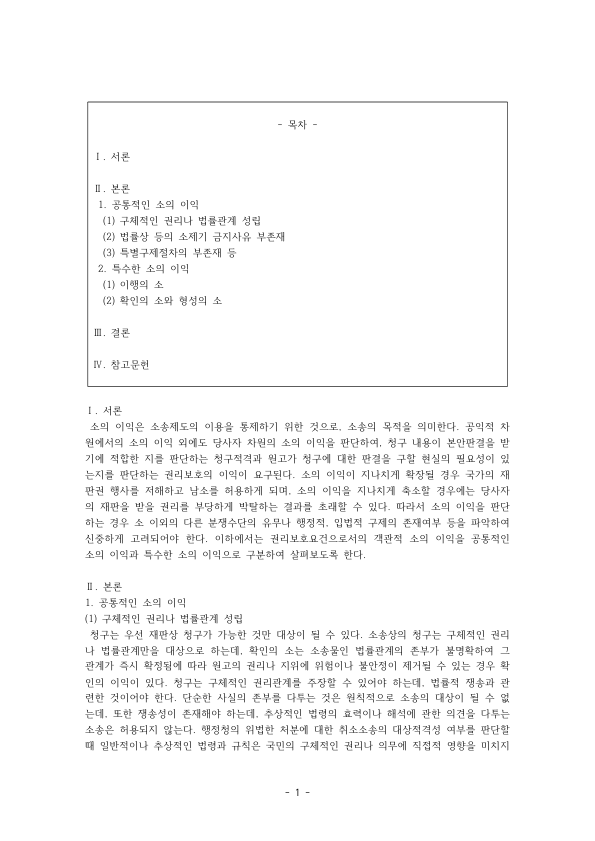
Page 1 is shown as is; from page 2 on, the preview is blurred. Buy it to download the complete original file right away (the file itself is written in Korean).
Packed with real examples and experience. Download it now and save time.
Save your valuable time
Buyer ratings
Fast, accurate and useful.
No ratings yet. Be the first to rate it.


Interest in Bringing a Lawsuit in Korean Civil Procedure: Common Requirements and Rules for Performance, Declaratory and Formative Actions
※ You can preview page 1 as is. Buy it to download the complete original file right away. The file itself is written in Korean.
■ Interest in Bringing a Lawsuit in Korean Civil Procedure: Common Requirements and Rules for Performance, Declaratory and Formative Actions — Overview
A 3-page Korean civil procedure paper on the interest in bringing suit, the requirement that a plaintiff have a real need for a judgment before a court reaches the merits. It covers the common requirements, bars such as duplicate suits, re-filing after withdrawal and agreements not to sue, and how the requirement applies to actions for present and future performance, declaratory actions and actions to change a legal relationship.
■ Interest in Bringing a Lawsuit in Korean Civil Procedure: Common Requirements and Rules for Performance, Declaratory and Formative Actions — Excerpt from the original document (English translation)
An "action for future performance" may be brought where there is a need to claim in advance. The underlying relationship for the claim that will arise in the future must already be established, and even if such an underlying relationship exists, the interest in bringing the action is not recognized where the probability is so slight that it is deemed to have no property value. Compulsory execution of the judgment must be possible once the time limit arrives or the condition is fulfilled, and in principle it is not permitted to bring an action on a claim whose time for performance arrives only after the plaintiff first performs its own obligation. In addition, where the original purpose cannot be achieved or damage would occur if performance is not made on time, an interest in obtaining a judgment for performance in advance is considered to exist. An action for future performance brought jointly with an action for present performance is also possible.
The interest in bringing an action is recognized where there is an interest that can justify proceeding by way of an action for declaratory judgment. The subject must be a present right or legal relationship, and confirmation of the existence or non-existence of a past rights relationship cannot be claimed. However, it may exceptionally be allowed if its true intent relates to the formation of present rights and legal relationships. Also, in the case of comprehensive legal relationships such as status relationships, even past ones are allowed where they are an appropriate means of resolving the dispute. Matters concerning future rights relationships are in principle not allowed either, but exceptions are recognized for conditional rights and rights subject to a time limit. And besides rights relationships between the parties, even a rights relationship between other persons gives rise to an interest in confirmation where it is recognized as a means for one's own rights relationship.
An action for formation of rights may be brought only where it is provided for by law. However, exceptions are recognized where the purpose of the litigation has already been realized, where restoration to the original state is impossible due to a change in circumstances, or where a separate remedy procedure exists.
For reference, the material contains a sentence saying that partial claims are in principle not recognized, but case law permits partial claims themselves and holds that, where it is expressly stated that the claim is partial, res judicata does not extend to the remaining claim. The exception in the part on actions for formation of rights should be read to mean that the interest in bringing the action disappears if the purpose of the litigation has already been realized or restoration to the original state has become impossible due to a change in circumstances. The prohibition of duplicate actions is in Article 259 of the Civil Procedure Act, the prohibition of re-filing is in Article 267(2), and actions for future performance are in Article 251, so be sure to check them together with the original text of the provisions.
■ Interest in Bringing a Lawsuit in Korean Civil Procedure: Common Requirements and Rules for Performance, Declaratory and Formative Actions — Contents and key concepts
When will a Korean court refuse to hear a case at all?
✦ At a glance
- The interest in bringing suit
- Structure: common rules → bars → types of action
- Useful for civil procedure review
☰ What the paper covers
- Meaning of the requirement
- Concrete legal disputes only
- Duplicate suits and re-filing bars
- Future performance claims
- Declaratory and formative actions
✎ Interest in suit in Korea and the U.S.
Korean courts dismiss a suit without reaching the merits when the plaintiff has no real need for a judgment, for example when the same case is already pending.
U.S. federal courts reach similar results through Article III standing, ripeness and mootness, and the Declaratory Judgment Act, 28 U.S.C. 2201, requires an actual controversy.
Note: the paper itself is written in Korean and discusses Korean law. This page is general study information, not legal advice.
Related wiki: Standing to Sue
■ Interest in Bringing a Lawsuit in Korean Civil Procedure: Common Requirements and Rules for Performance, Declaratory and Formative Actions References
- 이연주(2008). 민사소송법상의 신의칙과 권리보호요건과의 관계에 관한 소고. <경기법학논총> No.6 pp.51-63
Take a break with a quick personality test?
Ranked by actual participation. Results in about a minute.
Loading…
Most-read content
Loading view counts…

Campusdown is a lifelong-learning community in Korea offering study materials, information on government support, student loans and scholarships, and more. Don't miss our free resources.
Go to the Campusdown home page →Refund policy
- Change of mind / refund requested after partial use / more than 7 days after purchase
◆ Exceptions
- File errors / cannot download or open the file
◆ How to request a refund: send a 1:1 inquiry via Customer Service at the top