
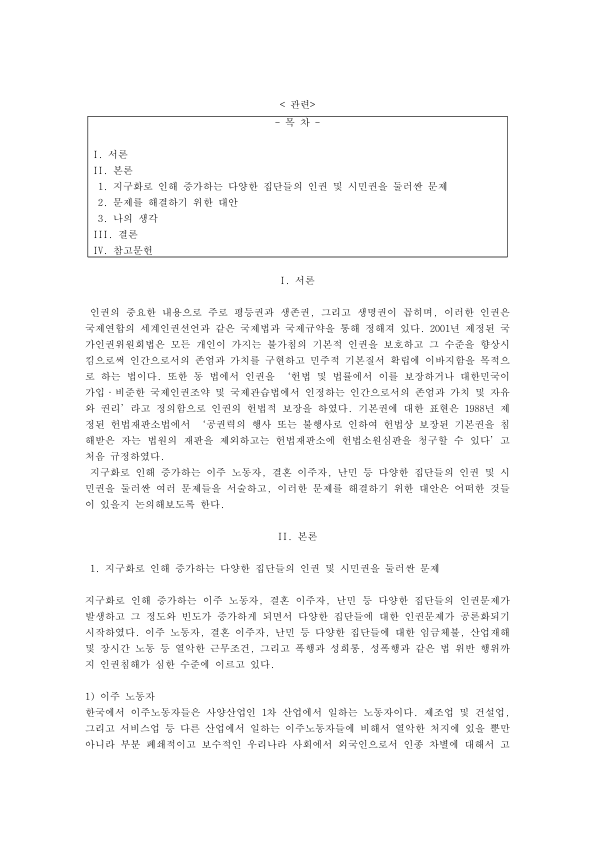
Page 1 is shown as is; from page 2 on, the preview is blurred. Buy it to download the complete original file right away (the file itself is written in Korean).
Packed with real examples and experience. Download it now and save time.
Save your valuable time
Buyer ratings
Fast, accurate and useful.
No ratings yet. Be the first to rate it.
Human Rights of Migrant Workers, Marriage Migrants and Refugees in Korea: The Employment Permit System, Refugee Recognition and Proposed Remedies
※ You can preview page 1 as is. Buy it to download the complete original file right away. The file itself is written in Korean.
■ Human Rights of Migrant Workers, Marriage Migrants and Refugees in Korea: The Employment Permit System, Refugee Recognition and Proposed Remedies — Overview
A 4-page Korean human rights paper on migrants. It starts from the definition of human rights in Korea's National Human Rights Commission Act, then describes the problems faced by migrant workers under the employment permit system, marriage migrants and their children, and refugees with very low recognition rates, and proposes remedies.
■ Human Rights of Migrant Workers, Marriage Migrants and Refugees in Korea: The Employment Permit System, Refugee Recognition and Proposed Remedies — Excerpt from the original document (English translation)
In Korea, migrant workers are workers in primary industries, a declining sector. Compared with migrant workers in other industries such as manufacturing, construction and services, they not only are in a worse position but are fully exposed as foreigners to racial discrimination in a partly closed and conservative Korean society. The various kinds of discrimination they experience, including racial discrimination, are sometimes encouraged by laws and institutions and sometimes justified by custom or culture. Because of the Labor Standards Act, which has exception clauses for these workers, and the employment permit system, which restricts changing jobs, they are discriminated against compared with other migrant workers, and amid practices that mistreat workers and a culture of deep contempt and prejudice toward foreigners they suffer forced labor, verbal abuse and assault, sexual violence and invasions of privacy.
Typical human rights violations against migrant workers include, for industrial trainees (D-3), 'minimum wage violations, unpaid wages, compulsory savings, industrial accidents, verbal abuse and assault, control of private life, confiscation of identity documents, sexual harassment, huge recruitment fees and abuses by the small business federation and post-placement management companies'; for low-skilled workers (E-9), 'unpaid wages, breach of contract, abuses by companies due to restrictions on changing employers, industrial accidents, verbal abuse and assault'; and for undocumented (overstaying) workers, 'unpaid wages, severance pay, industrial accidents, verbal abuse and assault.'
For marriage migrants, the stigma of a broken marriage after divorce continues to torment foreign spouses. If marital problems could lead to domestic violence, divorce may be seen as a solution. In interviews with migrant brides, they named language barriers and cultural differences, family relations and financial difficulties, and even petty quarrels as common factors that sour marital relations and create misunderstandings. Such misunderstandings then make family relationships hard to repair. Social integration and discrimination make a difficult and complicated path for migrant spouses. Children of Korean and migrant parents often face subtle but conscious rejection in being treated equally in Korean society.
To add: Korea joined the Refugee Convention in 1992 and began accepting refugee applications under the Immigration Act in 1994, and a stand-alone Refugee Act was enacted in 2012 and took effect in July 2013. The paper's 'Refugee Act enacted in 1994' should be corrected on this point, and its first sentence describing migrant workers as primary industry workers is best read as a description of migrant workers in agriculture and livestock. The employment permit system took effect in 2004, and the industrial trainee system was merged into it in 2007. In September 2011 the Constitutional Court held that the former limit on how many times migrant workers could change workplaces did not violate their freedom to choose a job (2007Hun-Ma1083). The paper's refugee statistics are as of 2015, and the numbers of applicants and recognized refugees have since risen sharply.
■ Human Rights of Migrant Workers, Marriage Migrants and Refugees in Korea: The Employment Permit System, Refugee Recognition and Proposed Remedies — Contents and key concepts
What rights problems do migrants face in Korea?
✦ At a glance
- Human rights of three migrant groups in Korea
- Structure: definition → group problems → remedies → conclusion
- Useful for human rights, multicultural society and social welfare courses
☰ What the paper covers
- Defining human rights
- Migrant workers by visa type
- Limits on changing jobs
- Marriage migrants
- Refugee recognition
✎ Migrant and refugee law in Korea and the U.S.
Korea ties most low-skilled migrant workers to one employer under its 2004 employment permit system and passed a stand-alone Refugee Act in 2012.
In the U.S., the Refugee Act of 1980 adopted the international refugee definition, and H-2A and H-2B temporary visas also tie workers closely to sponsoring employers.
Note: the paper itself is written in Korean and discusses Korean law. This page is general study information, not legal advice.
Related wiki: Affirmative Action
■ Human Rights of Migrant Workers, Marriage Migrants and Refugees in Korea: The Employment Permit System, Refugee Recognition and Proposed Remedies References
- 박란이. "결혼이주여성의 인권보호를 위한 기독교사회복지 역할 연구." 국내박사학위논문 서울장신대학교, 2016.
- 경기도 이봉철. "재한 인도네시아 미등록 이주 근로자 발생사유와 대처방안에 관한 연구." 국내박사학위논문 동아대학교 국제전문대학원, 2016. 부산
Take a break with a quick personality test?
Ranked by actual participation. Results in about a minute.
Loading…
Most-read content
Loading view counts…

Campusdown is a lifelong-learning community in Korea offering study materials, information on government support, student loans and scholarships, and more. Don't miss our free resources.
Go to the Campusdown home page →Refund policy
- Change of mind / refund requested after partial use / more than 7 days after purchase
◆ Exceptions
- File errors / cannot download or open the file
◆ How to request a refund: send a 1:1 inquiry via Customer Service at the top