
— Overview
Korea's multicultural family support centers are local offices created under the Multicultural Families Support Act. A volunteer report from Taebaek describes visiting teachers, a morning Korean class, and a room where people arrived with different passports and the same wish to speak. Official programs and contact points are listed so you can check today's hours and address.
— Contents and key concepts
A weekday morning in a small mountain city
On a weekday morning in a small mountain city, people who arrived in Korea with different passports sit at the same table and repeat the same sentence. A volunteer who spent two weeks at the Taebaek multicultural family support center wrote that nationality and skin color were all different, but the wish to learn Korean felt equally strong. That room is one local face of a national system, not a tourist brochure.
The report introduces the center as a non-profit body entrusted by the city, with support from the ministry that funds this work. It is worth saying the ministry's current official name is the Ministry of Gender Equality and Family (성평등가족부); older documents still say 여성가족부. If you are filling in a form, use the name on the page you are looking at today.
What the law puts in place
Article 12 of the Multicultural Families Support Act says the state and a local government may establish and operate a multicultural family support center, and may entrust that operation to a corporation or organization set by presidential decree. A private operator needs a designation from the local government. The same article lists the work: education and counseling, Korean education for marriage immigrants, information and publicity, links with other agencies, job information and referral, and interpretation and translation, plus other support the center needs to provide.
In many cities those services now sit inside a Family Center (가족센터) that also serves a wider group of families. Some standalone multicultural family support centers remain. The legal name on the door can differ from the everyday name people use, so it helps to search both on the official portal.
What the Taebaek report saw, week by week
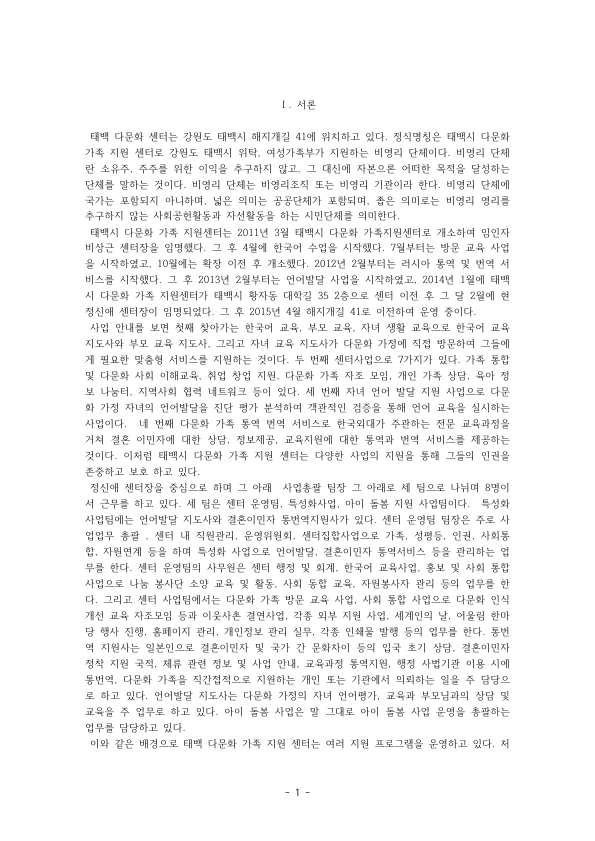
The volunteer report walks through the center's own history as the writer heard it: opening in March 2011, Korean classes from April, visiting education from July, a later move, a Russian interpretation and translation service from February 2012, a children's language-development program from 2013, and a further move in April 2015 to 41 Haejigae-gil, Taebaek, Gangwon-do. Centers do move, so if you are going in person it is worth checking familynet.or.kr, or calling 1577-9337, for the current address.
The work the writer watched falls into familiar official categories. Visiting instructors went to the home for Korean, parenting, and children's everyday life, when coming to the center was hard. At the center there were family-integration and multicultural-understanding sessions, help with employment and starting a small business, self-help groups, counseling, and a parenting-information corner. Children's language development began with an assessment, then lessons. Interpretation and translation supported counseling, information, and education for marriage immigrants.
Korean class, in this report, ran in the morning from 10 o'clock to noon, in groups by level. That is a picture of one center in one period, and it is useful because it is concrete. It is not a national timetable. If you are joining a class, ask for this term's hours.
If you already have a class like this at home
If you are in Japan, the closest everyday scene is often a local international-exchange association or a community Japanese class, sometimes in a municipal hall on a Saturday morning, plus counseling desks that help with residence paperwork. Those classes are real and welcoming, but they are not usually built on a single national statute that requires a multicultural-family center in the same way Article 12 does.
In the United States, support for immigrant and refugee families is typically a mix of city offices, school-district family liaisons, and nonprofit resettlement or community agencies. A morning language class may look similar; the legal home of the service will not. In China, help for cross-border or marriage-migrant families is more often handled through community or local civil-affairs channels, and the package of visiting teachers plus on-site interpreting is not a single nationwide brand you can look up the same way. In Gulf cities, language and family support often run through employers, embassies, or private institutes; public family-center networks of this kind are not the default, so the Korean portal is still the place to start if you are moving to Korea.
If you plan to visit
If you plan to visit, or you are writing a field report of your own, write down what the official Act and the ministry page actually list, then add only what you saw: the hours of that class, the languages that desk could offer that day, the way people practiced a sentence together. The Taebaek volunteer did that, and the warmth of the room is still the part that stays with a reader. Confirm the live address, the current class time, and whether you should book ahead.
Sources
- Multicultural Families Support Act, Article 12 (establishment and operation of support centers; duties including Korean education, counseling, job information, and interpretation and translation) — law.go.kr, current text.
- Ministry of Gender Equality and Family (성평등가족부), family and multicultural family support center programs: visiting education, children's language-development support, bilingual programs, and interpretation — https://www.mogef.go.kr/sp/fam/sp_fam_f003.do
- Family Center portal and inquiry line 1577-9337 — https://www.familynet.or.kr
- Danuri multilingual counseling and information (1577-1366) and Live in Korea information — https://www.liveinkorea.kr
- A two-week volunteer report from the Taebaek multicultural family support center, with a morning Korean class, visiting education, and interpreting.
Last updated: 14 November 2026
Refund policy
- Change of mind / refund requested after partial use / more than 7 days after purchase
◆ Exceptions
- File errors / cannot download or open the file
◆ How to request a refund: send a 1:1 inquiry via Customer Service at the top