
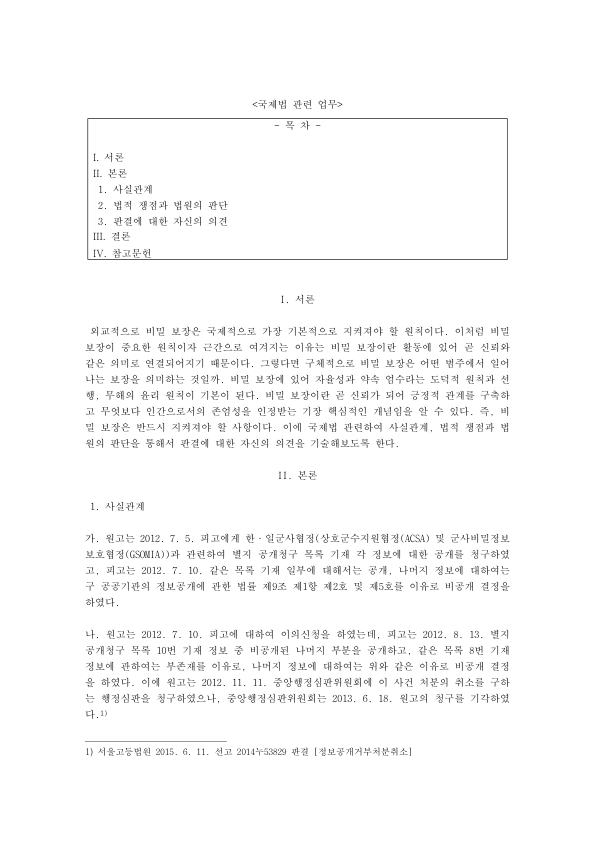
Page 1 is shown as is; from page 2 on, the preview is blurred. Buy it to download the complete original file right away (the file itself is written in Korean).
Packed with real examples and experience. Download it now and save time.
Save your valuable time
Buyer ratings
Fast, accurate and useful.
No ratings yet. Be the first to rate it.
Freedom of Information and Diplomatic Secrets in Korea: Supreme Court Decision 2015Du46512 (2019) on Withholding Korea-Japan GSOMIA Negotiation Records
※ You can preview page 1 as is. Buy it to download the complete original file right away. The file itself is written in Korean.
■ Freedom of Information and Diplomatic Secrets in Korea: Supreme Court Decision 2015Du46512 (2019) on Withholding Korea-Japan GSOMIA Negotiation Records — Overview
A 4-page Korean administrative law case note. A citizen asked the Defense Ministry for records on the Korea-Japan military intelligence and logistics agreements and was refused. The paper covers the facts, the national interest and deliberative process exemptions, why partial disclosure was denied, and the author's view supporting the ruling.
■ Freedom of Information and Diplomatic Secrets in Korea: Supreme Court Decision 2015Du46512 (2019) on Withholding Korea-Japan GSOMIA Negotiation Records — Excerpt from the original document (English translation)
This decision is a case that took a clear position on the specific disclosure of diplomatic secrets, in light of the fact that the Official Information Disclosure Act also treats information related to national interests such as diplomacy and defense specially as subject to disclosure. Information on diplomatic relations whose disclosure is deemed likely to seriously harm major national interests under Article 9(1)(2) of the former act is not secret information under statutes as in Article 9(1)(1), but it refers to confidential information and is designated as exempt from disclosure. Article 113 of the Criminal Act punishes anyone who leaks diplomatic secrets, and according to Supreme Court precedent, diplomatic secrets mean "secrets the state must keep in relation to foreign countries, that is, all information and materials whose being kept secret from or unconfirmed to foreign countries for diplomatic policy reasons is in the interest of the Republic of Korea." It cannot be determined whether the requested information reaches the level of a diplomatic secret within the scope of the Criminal Act, but as the Supreme Court found, it is clear that disclosure could seriously affect the national interest. Even if the information did not reach the level of affecting major national interests, since it concerns treaties at the initialing stage and treaties whose text was not yet finalized, it could also fall under Article 9(1)(5), information on matters in the decision-making or internal review process whose disclosure would seriously hinder the fair performance of duties. Disclosing information on negotiations during the treaty-making process not only affects the position taken in the negotiations but can also create diplomatic problems by affecting the other party's choice of negotiating strategy and position. It could also affect the positions of third countries that may hold similar diplomatic negotiations in the future, making negotiations between Korea and those countries impossible or forcing Korea to begin negotiations at a disadvantage with its strategy already exposed. In this respect, the Supreme Court's decision not to disclose the diplomatic information is judged appropriate.
To add: the Korea-Japan General Security of Military Information Agreement, whose signing was put on hold just before the ceremony in June 2012, was concluded on November 23, 2016. The government gave notice of termination in August 2019, suspended that notice in November of the same year, and withdrew it in March 2023, normalizing the agreement. A person refused disclosure can challenge the decision through an objection (Article 18 of the Official Information Disclosure Act), an administrative appeal (Article 19) or an administrative lawsuit (Article 20), and in a lawsuit the court can examine the information itself in private. The paper's reference to "Article 7(1)(5) of the former act" uses the numbering before the 2004 full revision, which corresponds to Article 9(1)(5) of the current act.
■ Freedom of Information and Diplomatic Secrets in Korea: Supreme Court Decision 2015Du46512 (2019) on Withholding Korea-Japan GSOMIA Negotiation Records — Contents and key concepts
Can the public see treaty negotiation records?
✦ At a glance
- A 2019 Korean ruling on withholding diplomatic records
- Structure: facts → exemptions → partial disclosure → author's view
- Useful for administrative law and information law courses
☰ What the paper covers
- Request and appeals
- Balancing the right to know
- National interest exemption
- Deliberative process exemption
- No partial disclosure
✎ Freedom of information in Korea and the U.S.
Korea's Official Information Disclosure Act took effect in 1998 and lets anyone request records, subject to exemptions such as national security and diplomacy.
The U.S. Freedom of Information Act of 1966 has similar exemptions, including Exemption 1 for properly classified national security information and Exemption 5 for deliberative records.
Note: the paper itself is written in Korean and discusses Korean law. This page is general study information, not legal advice.
Related wiki: Freedom of Information Act (FOIA)
■ Freedom of Information and Diplomatic Secrets in Korea: Supreme Court Decision 2015Du46512 (2019) on Withholding Korea-Japan GSOMIA Negotiation Records References
- 류병운, 2018, 국제중재에서의 투명성과 기밀성의 경계(境界), 서울시립대학교 법학연구소, 서울법학 Vol.26 No.3 안건형, 2019, 2019년 개정 ICC 중재 진행에 관한 당사자 및 중재판정부 지침의 주요내용과 시사점:ICC의 중재판정부 정보 공개 및 중재판정의발간 정책을 중심으로, 한국중재학회, 중재연구 Vol.29 No.2 대법원 2019. 1. 17.
- 선고 2015두46512 판결 [정보공개거부처분취소] 서울고등법원 2015. 6. 11.
- 선고 2014누53829 판결 [정보공개거부처분취소]
Take a break with a quick personality test?
Ranked by actual participation. Results in about a minute.
Loading…
Most-read content
Loading view counts…

Campusdown is a lifelong-learning community in Korea offering study materials, information on government support, student loans and scholarships, and more. Don't miss our free resources.
Go to the Campusdown home page →Refund policy
- Change of mind / refund requested after partial use / more than 7 days after purchase
◆ Exceptions
- File errors / cannot download or open the file
◆ How to request a refund: send a 1:1 inquiry via Customer Service at the top