
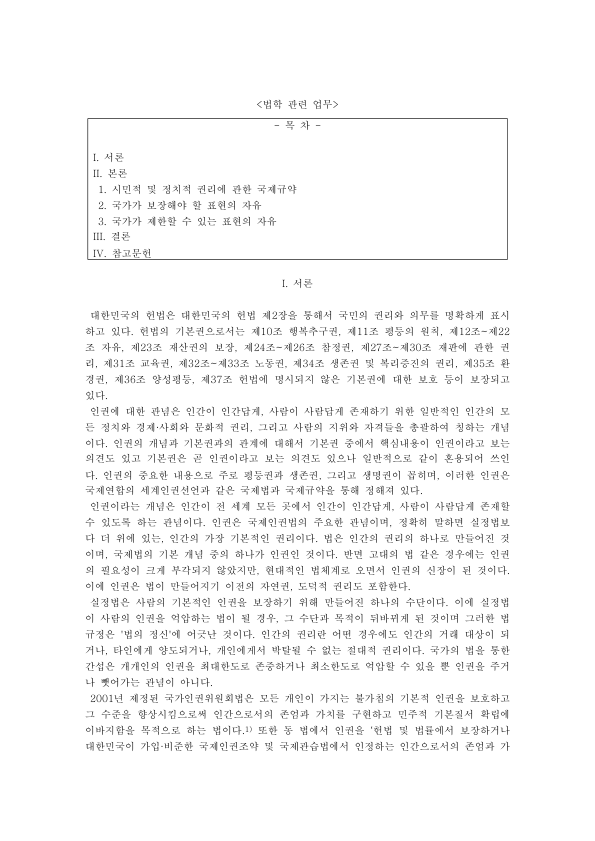
Page 1 is shown as is; from page 2 on, the preview is blurred. Buy it to download the complete original file right away (the file itself is written in Korean).
Packed with real examples and experience. Download it now and save time.
Save your valuable time
Buyer ratings
Fast, accurate and useful.
No ratings yet. Be the first to rate it.


Freedom of Expression Under the ICCPR and Korean Law: Articles 19 and 20, Hate Speech Limits, and the Rabat Plan of Action
※ You can preview page 1 as is. Buy it to download the complete original file right away. The file itself is written in Korean.
■ Freedom of Expression Under the ICCPR and Korean Law: Articles 19 and 20, Hate Speech Limits, and the Rabat Plan of Action — Overview
A 6-page Korean human rights law paper. It traces freedom of expression from the UN Charter and the Universal Declaration to the binding International Covenant on Civil and Political Rights, compares ICCPR Article 19 with Article 21 of Korea's Constitution, and explains Article 20's ban on war propaganda and advocacy of hatred that incites discrimination or violence, using the 2012 Rabat Plan of Action and its graded responses.
■ Freedom of Expression Under the ICCPR and Korean Law: Articles 19 and 20, Hate Speech Limits, and the Rabat Plan of Action — Excerpt from the original document (English translation)
So far, we have examined the freedom of expression that the state must guarantee and the freedom of expression that the state may restrict under the International Covenant on Civil and Political Rights, and we have seen that efforts to improve human rights are needed in accordance with the International Covenant on Civil and Political Rights.
If the scope of Article 20(2) of the "International Covenant on Civil and Political Rights" is interpreted too broadly, the right to freedom of expression under Article 19 of the "International Covenant on Civil and Political Rights" may be infringed, and if it is interpreted too narrowly, doubts may arise about the validity of the provisions prohibiting expression, so there is a concern that confusion will be created in each country's legislative process concerning freedom of expression.
In 2011, in its comment on Article 19, freedom of opinion and expression, the Human Rights Committee of the "International Covenant on Civil and Political Rights" stated that Articles 19 and 20 of the "International Covenant on Civil and Political Rights" are compatible with and complement each other, that the acts of expression addressed in Article 20 are subject to the restrictions set out in Article 19(3), and that the limits on prohibiting expression set out in Article 20 must satisfy the freedom-of-expression provision of Article 19(3).
The provision of Article 20 of the "International Covenant on Civil and Political Rights" can be regarded as having the status of a special law in relation to Article 19. That is, if a law is to be made for the provision of Article 20(2) of the "International Covenant on Civil and Political Rights," it must not exceed the limits of the provision restricting freedom of expression in Article 19(3). States parties to the Covenant have a legal obligation to prohibit the specific forms of expression set out in Article 20, and in any case where a state party to the Covenant restricts freedom of expression, it needs to justify the prohibition and provisions in strict conformity with Article 19 of the Covenant.
As to whether provisions of international law can be directly regarded as a standard for judging illegality, we must examine whether international law can be directly applied to legal relations between persons. Article 6(1) of the Constitution of Korea provides: "Treaties duly concluded and promulgated under the Constitution and the generally recognized rules of international law shall have the same effect as the domestic laws." However, the authority to interpret a treaty lies primarily with the parties to the treaty. Article 31 (General rule of interpretation), paragraph 1, of the Vienna Convention on the Law of Treaties provides: "A treaty shall be interpreted in good faith in accordance with the ordinary meaning to be given to the terms of the treaty in their context and in the light of its object and purpose."
International treaties have the effect of domestic law, but case law has not taken a clear position on what exactly "domestic law" means in detail, and scholarly opinions are not unanimous either. Article 6(1) can be interpreted in several ways, and the meaning of such a provision is ultimately left to the judgment of the judiciary within a scope that does not contradict the text of the law.
Case law holds that because international treaties set obligations between states under international law, they do not create specific rights of individuals against the state, such as a right to damages.
For reference, part of the material states that Article 18 of the Covenant on Civil and Political Rights is the provision establishing the Human Rights Committee, but Article 18 concerns freedom of thought, conscience, and religion, and the establishment of the Human Rights Committee is in Article 28. The Covenant consists of a preamble and 53 articles. Korea acceded in 1990, and when the United States ratified it in 1992 it attached a reservation to Article 20 on the ground that it could conflict with freedom of expression, so it would be even better to organize this together when comparing it with the scope of protection of the First Amendment to the U.S. Constitution.
■ Freedom of Expression Under the ICCPR and Korean Law: Articles 19 and 20, Hate Speech Limits, and the Rabat Plan of Action — Contents and key concepts
How does international law balance free speech and hate speech?
✦ At a glance
- Freedom of expression under the ICCPR
- Structure: sources → Article 19 → Article 20 → Rabat Plan
- Useful for human rights and media law
☰ What the paper covers
- International law and Korea's Constitution
- From the UDHR to the ICCPR
- Article 19 protections and limits
- Article 20 and hate speech
- Graded responses under the Rabat Plan
✎ Free speech under the ICCPR and the U.S. Constitution
Korea joined the ICCPR in 1990, and under its Constitution ratified treaties have the same effect as domestic statutes.
The U.S. ratified the ICCPR in 1992 with a reservation to Article 20, because the First Amendment, as applied in Brandenburg v. Ohio (1969), protects hateful speech unless it is directed to and likely to incite imminent lawless action.
Note: the paper itself is written in Korean and discusses Korean law. This page is general study information, not legal advice.
Related wiki: Hate Speech
■ Freedom of Expression Under the ICCPR and Korean Law: Articles 19 and 20, Hate Speech Limits, and the Rabat Plan of Action References
- 이숙영, 2011, 인터넷상 표현의 자유의 국제법적 고찰 : 시민적·정치적 권리에 관한 국제규약 제19조와 국내법의 이행을 중심으로, 인하대학교 대학원 최승준, 2010, 표현의 자유의 제한에 관한 연구, 호서대학교 일반대학원
Take a break with a quick personality test?
Ranked by actual participation. Results in about a minute.
Loading…
Most-read content
Loading view counts…

Campusdown is a lifelong-learning community in Korea offering study materials, information on government support, student loans and scholarships, and more. Don't miss our free resources.
Go to the Campusdown home page →Refund policy
- Change of mind / refund requested after partial use / more than 7 days after purchase
◆ Exceptions
- File errors / cannot download or open the file
◆ How to request a refund: send a 1:1 inquiry via Customer Service at the top