
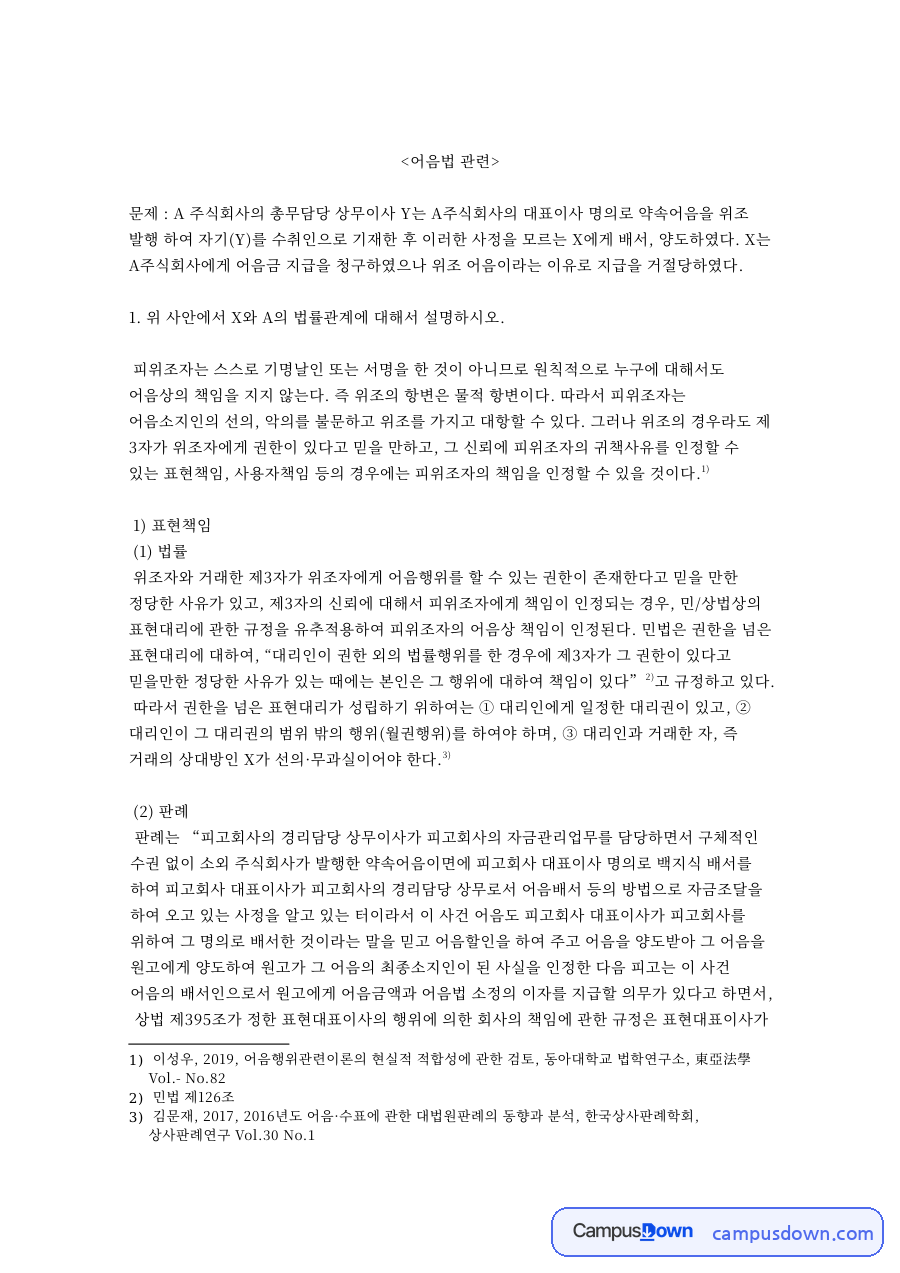
Page 1 is shown as is; from page 2 on, the preview is blurred. Buy it to download the complete original file right away (the file itself is written in Korean).
Packed with real examples and experience. Download it now and save time.
Save your valuable time
Buyer ratings
Fast, accurate and useful.
No ratings yet. Be the first to rate it.


1 / 6
좌우로 밀어서 페이지를 넘겨보세요
과제 개요
| 전체 페이지 수 | 6페이지 |
|---|---|
| 파일 형식 | 한글(HWP) |
| 등록일 | 2025.07.04 |
캠퍼스다운 도움말
해당 자료는 No AI 자료입니다. 인싸이트를 얻고 새롭게 가공해 보세요.
자료를 받아서 이용하면 품질이 확 올라갑니다.
- 어음법
- 상법
- 어음 위조
- 표현대리
- 민법 제126조
- 사용자책임
- 민법 제756조
- 어음법 제8조
- 무권대리인 책임
Forged Promissory Note Case Under Korean Law: Company Liability for a Note Forged in the CEO's Name, Apparent Authority, Employer Liability and the Forger's Own Liability
※ You can preview page 1 as is. Buy it to download the complete original file right away. The file itself is written in Korean.
■ Forged Promissory Note Case Under Korean Law: Company Liability for a Note Forged in the CEO's Name, Apparent Authority, Employer Liability and the Forger's Own Liability — Overview
A 6-page Korean bills-and-notes case study. A managing director forged a promissory note in the name of the company's representative director, named himself as payee and endorsed it to X, who did not know about the forgery. The paper explains why the company as the forged party is not normally liable on the note, when it can still be liable through apparent authority by analogy to Article 126 of the Civil Act or as an employer under Article 756, and why the forger is liable to X by analogy to Article 8 of the Korean Promissory Notes Act.
■ Forged Promissory Note Case Under Korean Law: Company Liability for a Note Forged in the CEO's Name, Apparent Authority, Employer Liability and the Forger's Own Liability — Excerpt from the original document (English translation)
So it held (see Supreme Court en banc decision 91Da43848, rendered June 23, 1992).
The case law states: "Where a bill is forged, the person whose name was forged, except in special cases such as where the Civil Act provisions on apparent agency can be applied by analogy, in principle bears no liability on the bill; but where an employee took part in a tort through the forgery of a bill and it was committed through an unlawful act related to the employer's business, the employer may bear liability for damages under Article 756 of the Civil Act. In this case, the liability the employer bears is not liability on the bill but tort liability under the Civil Act, so its requirements and scope do not coincide with those on the bill. Therefore, in discussing employer liability under Article 756 of the Civil Act, there is no need to examine the existence of rights under the Bills of Exchange and Promissory Notes Act, such as whether the holder has a right of recourse under that Act; whether the holder actually presented the bill for payment and was refused cannot be said to be a necessary requirement for claiming liability for damages due to the forgery of an endorsement; and even if the holder did not present the bill for payment within the lawful presentment period and did not take steps to preserve the right of recourse, this cannot be said to be a ground that prevents the holder from pursuing the tort liability, already incurred, of the forger's employer." Supreme Court decision 93Da21514, rendered November 8, 1994.
So it held (see Supreme Court en banc decision 93Da21514, rendered November 8, 1994).
If Y, the managing director in charge of general affairs at Company A, forged and issued a promissory note in the name of Company A's representative director, named Y as payee, and then endorsed and transferred it to X, who did not know of these circumstances, this can be regarded, judging objectively by its outward form, as related to the performance of duties. Therefore, if Y forged the promissory note in the name of Company A's representative director, Company A, as Y's employer, can be regarded as bearing tort liability for damages to X, who acquired the note believing Y's endorsement to be genuine.
2. (A separate issue from 1 above) After payment is refused by Company A, X seeks to demand that Y perform the obligation of recourse. Is Y liable to X for recourse?
The liability of an unauthorized agent under Article 8 of the Bills of Exchange and Promissory Notes Act should be regarded as grounded not in liability based on the signature, but in a warranty liability for having represented that the named principal bears liability on the bill. Furthermore, in the case of forgery of a bill, using the named principal's name without authority to represent as if the named principal bears liability on the bill is no different from unauthorized agency. Therefore, the liability of the actor who signed the bill should not depend on whether agency was indicated, and Article 8 of that Act should be applied by analogy even to a forger who fabricated the principal's signature directly without indicating agency, imposing the same warranty liability on the bill as in unauthorized agency. In this way, the person who signed the forged signature on the bill can be held directly liable on the bill, and a bona fide holder can also be protected more thoroughly because the forger is added as a debtor bearing the original liability on the bill.
In practice, electronic bills have come into wide use because of the risks of forgery and loss of paper promissory notes and the problem of chain defaults, and issuing electronic bills is mandatory for corporations above a certain size. Policy discussions on phasing out the promissory note system and replacing it with other means of payment are also continuing. Still, the independence of bill transactions, the defense of forgery, apparent liability and employer liability, and the analogical application of Article 8 of the Bills of Exchange and Promissory Notes Act are regular issues on commercial law and bills law exams, so organizing them in a framework of statute, case law and conclusion, as this material does, lets you use them right away in writing answers.
■ Forged Promissory Note Case Under Korean Law: Company Liability for a Note Forged in the CEO's Name, Apparent Authority, Employer Liability and the Forger's Own Liability — Contents and key concepts
Is a company liable for a note forged by its own executive?
✦ At a glance
- The company's and the forger's liability on a forged note
- Structure: question one (apparent authority, employer liability) → question two (forger)
- Good for commercial law exam practice
☰ What the paper covers
- The forged party is not liable in principle
- Apparent authority by analogy
- Employer liability and its limits
- Forger's liability by analogy to Article 8
- Conclusion
✎ Forgery and note liability
Only people who sign a note are liable on it, so a company whose name was forged can refuse payment against anyone.
Exceptions exist when the holder reasonably trusted the forger's authority and the company helped create that appearance, or when the company is liable in tort as the forger's employer.
Note: the paper itself is written in Korean and discusses Korean law. This page is general study information, not legal advice.
■ Forged Promissory Note Case Under Korean Law: Company Liability for a Note Forged in the CEO's Name, Apparent Authority, Employer Liability and the Forger's Own Liability References
- 정응기, 2020, 어음행위의 실질적 요건에 관한 어음항변, 사법발전재단, 사법 Vol.1 No.54 이성우, 2019, 어음행위관련이론의 현실적 적합성에 관한 검토, 동아대학교 법학연구소, 東亞法學 Vol.- No.82 김문재, 2018, 약속어음제도의 현상과 과제, 한국상사법학회, 商事法硏究 Vol.36 No.4 김문재, 2017, 2016년도 어음·수표에 관한 대법원판례의 동향과 분석, 한국상사판례학회, 상사판례연구 Vol.30 No.1 정응기, 2017, 어음이론과 어음변조의 입증책임, 대한변호사협회, 人權과 正義 : 大韓辯護士協會誌 Vol.- No.470 임재호, 2016, 2015년도 어음법 관련 주요 판결의 평석, 한국상사판례학회, 상사판례연구 Vol.29 No.1 임재호, 2015, 2014년도 어음법 관련 주요 판례의 평석, 한국상사판례학회, 상사판례연구 Vol.28 No.2 장덕조, 2015, 상법학방법론 소고, 한국비교사법학회, 比較私法 Vol.22 No.4 나민영, 2015, 사용자책임의 성립요건에 관한 연구, 숭실대학교 대학원, 국내석사 황재훈, 2013, 어음법과 민법의 무권대리 제도 비교를 통한 어음법 제8조의 새로운 해석론, 서울대학교 법학전문대학원, 국내석사 오강훈, 2013, 전자어음제도의 법적 문제점 소고, 경희대학교 대학원, 국내석사 김동춘, 2019, 기한부신용장의 매입유형에 따른 사례 및 시사점에 관한 연구, 건국대학교, 국내박사
Keyword Prompt
전문가가 만들었어요과제를 직접 쓰는 데 도움이 되는 영어 프롬프트예요.
Tip! Prompt 에 자신의 생각을 추가해서 하면 훨씬 더 ✨ 좋습니다.
캠퍼스다운에서 레포트 받고 잘 쓰는 법 3가지, AI로 참고자료 제대로 재가공하기 →Prompt 1
I'm writing a university assignment on "어음 위조 사례 풀이: 대표이사 명의 약속어음 위조와 피위조 회사의 표현책임·사용자책임, 위조자 책임". Help me build an outline (introduction, 2-3 body sections, conclusion) that covers 어음법, 상법 and 어음 위조. Don't write the paper for me - give me guiding questions for each section. My own perspective: [자신의 생각 넣는 곳] Please respond in Korean.
Prompt 2
Explain the key concepts "어음법" and "상법" in simple terms, then show how they connect to the topic "어음 위조 사례 풀이: 대표이사 명의 약속어음 위조와 피위조 회사의 표현책임·사용자책임, 위조자 책임". Point out common misunderstandings students have about them. My own perspective: [자신의 생각 넣는 곳] Please respond in Korean.
Prompt 3
Suggest 3 real-world cases or examples I could analyze in an assignment on "어음 위조 사례 풀이: 대표이사 명의 약속어음 위조와 피위조 회사의 표현책임·사용자책임, 위조자 책임", focusing on "어음 위조". For each, tell me what I should look up and verify in official or academic sources. My own perspective: [자신의 생각 넣는 곳] Please respond in Korean.
Prompt 4
Review my draft paragraph on "어음 위조 사례 풀이: 대표이사 명의 약속어음 위조와 피위조 회사의 표현책임·사용자책임, 위조자 책임" (key idea: "표현대리"). Give feedback on logic, evidence and clarity, and mark where I need a citation. My paragraph: [paste here] My own perspective: [자신의 생각 넣는 곳] Please respond in Korean.
Take a break with a quick personality test?
Ranked by actual participation. Results in about a minute.
Loading…
Most-read content
Loading view counts…

Campusdown is a lifelong-learning community in Korea offering study materials, information on government support, student loans and scholarships, and more. Don't miss our free resources.
Go to the Campusdown home page →Refund policy
- Change of mind / refund requested after partial use / more than 7 days after purchase
◆ Exceptions
- File errors / cannot download or open the file
◆ How to request a refund: send a 1:1 inquiry via Customer Service at the top