
Page 1 is shown as is; from page 2 on, the preview is blurred. Buy it to download the complete original file right away (the file itself is written in Korean).
Packed with real examples and experience. Download it now and save time.
Save your valuable time
Buyer ratings
Fast, accurate and useful.
No ratings yet. Be the first to rate it.


Foreign Sex Offense Prevention Policies and Lessons for Korea: New York's SAFE Model, Social Impact Bonds, Sentencing and Treatment Programs
※ You can preview page 1 as is. Buy it to download the complete original file right away. The file itself is written in Korean.
■ Foreign Sex Offense Prevention Policies and Lessons for Korea: New York's SAFE Model, Social Impact Bonds, Sentencing and Treatment Programs — Overview
An 11-page Korean criminal law and criminal policy paper comparing sex offense prevention abroad: New York's SAFE forensic response model, the U.K.'s social impact bond for reducing reoffending, German law on child sexual abuse, sentencing levels in several countries, and treatment programs in the U.S. and Canada. It argues that harsher punishment alone is not enough.
■ Foreign Sex Offense Prevention Policies and Lessons for Korea: New York's SAFE Model, Social Impact Bonds, Sentencing and Treatment Programs — Excerpt from the original document (English translation)
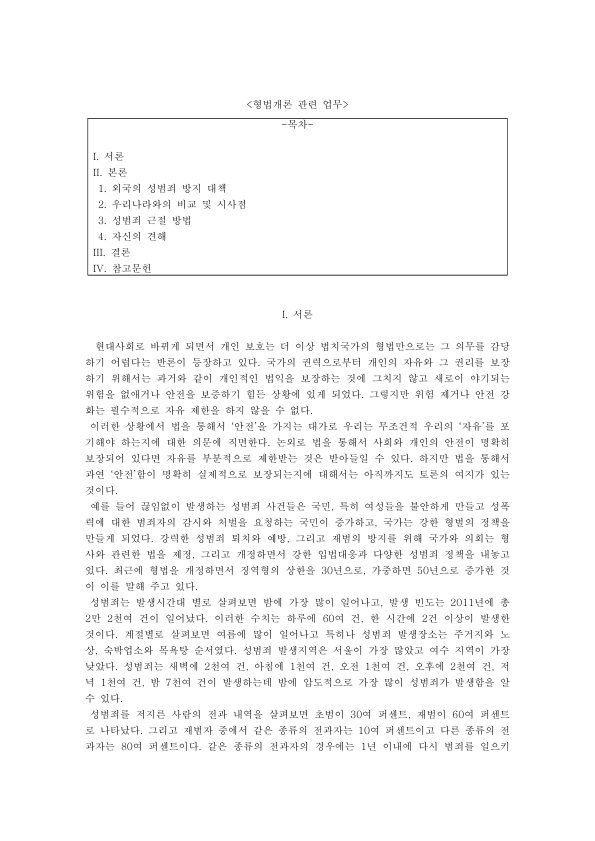
As society has modernized, some argue that the criminal law of a state governed by the rule of law can no longer fulfill its duty to protect individuals on its own. To guarantee individual freedom and rights against state power, it is no longer enough to protect individual legal interests as in the past; we now face a situation in which it is hard to remove new risks or guarantee safety. Yet removing risks or strengthening safety inevitably requires limiting freedom.
In this situation we face the question of whether we must unconditionally give up our 'freedom' in return for gaining 'safety' through law. Setting that aside, if law clearly guaranteed the safety of society and individuals, partial limits on freedom could be accepted. But whether law actually and clearly guarantees 'safety' is still open to debate.
For example, sex crimes that keep occurring make the public, especially women, anxious; more and more people demand surveillance and punishment of sex offenders, and the state has adopted harsh punishment policies. To fight and prevent serious sex crimes and stop reoffending, the government and legislature have enacted and amended criminal laws, producing strong legislative responses and a variety of sex crime policies. The recent amendment of the Criminal Act raising the maximum prison term to 30 years, or 50 years when aggravated, shows this.
By time of day, sex crimes occur most often at night, and about 22,000 occurred in 2011. That is about 60 a day, or more than 2 an hour. By season they occur most often in summer, and by place they occur most in homes, then on streets, in lodging facilities and in bathhouses. Seoul had the most sex crimes and Yeosu the fewest. About 2,000 occur at dawn, 1,000 in the early morning, 1,000 in the late morning, 2,000 in the afternoon, 1,000 in the evening and 7,000 at night, showing that by far the most occur at night.
Looking at offenders' criminal records, about 30 percent were first-time offenders and about 60 percent repeat offenders. Among repeat offenders, about 10 percent had prior convictions for the same type of crime and about 80 percent for other types. Among those with prior convictions for the same type, about 40 percent reoffended within a year. The more prior convictions, the higher the share of crimes committed alone.
About 7 percent of sexual violence offenders had accomplices, most often neighborhood friends, then school classmates and then coworkers. About 30 percent of offenders said their motive was impulsive, about 10 percent curiosity, and 6 percent claimed they had been seduced. By occupation, about 20 percent were unemployed and about 10 percent self-employed. This paper examines what effective methods could eradicate such sex crimes.
To find effective ways to eradicate sex crimes, we first look at other countries. Among the sex crime prevention measures in the United States, we examine New York's SAFE program. It is a forensic response model for sex crimes, with the advantage of offering a new perspective and possibilities for dramatically strengthening the justice system's response. New York's integrated forensic response program is a hospital-based model that supports the response to sex crimes by combining the FHP and SAE programs.
New York State law asks participating hospitals to set up contact systems with rape crisis organizations and sex crime support agencies and, to build a system for cooperation among agencies providing response services, to contact an advocate on condition that the victim consents.
Note: The Criminal Act's Article 42 was amended on April 15, 2010 to raise the maximum fixed-term imprisonment to 30 years, or 50 years when aggravated. From June 19, 2013, amendments to six sex crime laws including the Criminal Act and the Sexual Violence Punishment Act took effect, abolishing every provision that made sex crimes prosecutable only on complaint or barred prosecution against the victim's wishes, and changing the object of rape from 'a woman' to 'a person.' The crime statistics and foreign sentencing levels in the paper reflect the time it was written and may have changed by country or state, so check current sources.
■ Foreign Sex Offense Prevention Policies and Lessons for Korea: New York's SAFE Model, Social Impact Bonds, Sentencing and Treatment Programs — Contents and key concepts
Harsher punishment alone is not enough
✦ At a glance
- How other countries prevent sex crimes, and what Korea can learn
- Structure: statistics → foreign models → sentencing → treatment → proposals
- Useful for criminal law and criminology courses
☰ What the paper covers
- New York SAFE
- U.K. social impact bond
- Sentencing compared
- Treatment programs
- Reporting rates
✎ Sex offense policy in Korea and the U.S.
Korea raised maximum prison terms in 2010 and, from June 19, 2013, abolished the rule that sex crimes could be prosecuted only on the victim's complaint.
In the U.S., Megan's Law (1996) requires community notification about registered sex offenders, and states differ widely in sentencing and treatment.
Note: the paper itself is written in Korean and discusses Korean law. This page is general study information, not legal advice.
Related wiki: Electronic Monitoring and Ankle Monitors, Theories of Punishment
■ Foreign Sex Offense Prevention Policies and Lessons for Korea: New York's SAFE Model, Social Impact Bonds, Sentencing and Treatment Programs References
- 위험관리를 위한 신상공개의 정당성과 형법의 과제, 이무선, 고려대학교 대학원, 2014
- 청소년의 성에 대한 인식 실태와 성 일탈 예방을 위한 연구, 이주연, 안동대학교, 2014
Take a break with a quick personality test?
Ranked by actual participation. Results in about a minute.
Loading…
Most-read content
Loading view counts…

Campusdown is a lifelong-learning community in Korea offering study materials, information on government support, student loans and scholarships, and more. Don't miss our free resources.
Go to the Campusdown home page →Refund policy
- Change of mind / refund requested after partial use / more than 7 days after purchase
◆ Exceptions
- File errors / cannot download or open the file
◆ How to request a refund: send a 1:1 inquiry via Customer Service at the top