
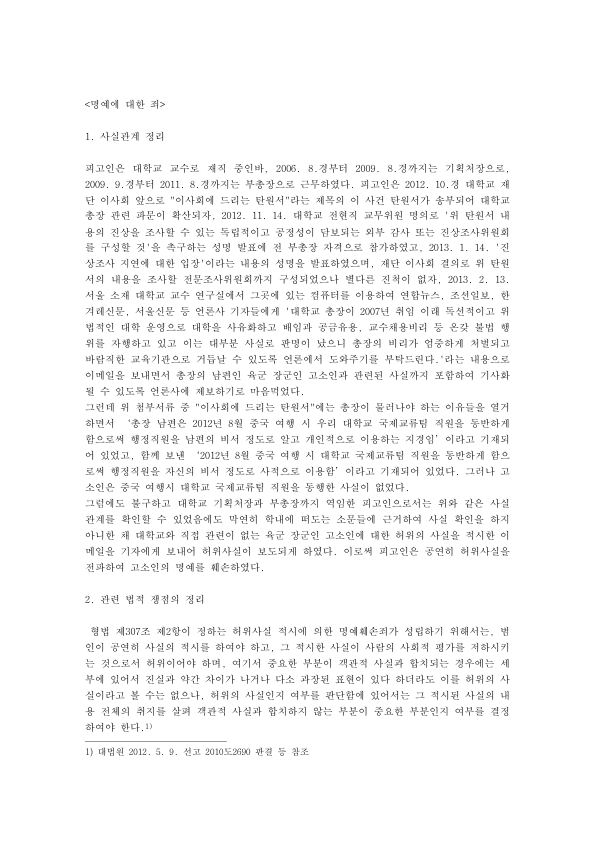
Page 1 is shown as is; from page 2 on, the preview is blurred. Buy it to download the complete original file right away (the file itself is written in Korean).
Packed with real examples and experience. Download it now and save time.
Save your valuable time
Buyer ratings
Fast, accurate and useful.
No ratings yet. Be the first to rate it.


False Statement Defamation and Insurance Fraud in Korean Criminal Law: Article 307(2), the Article 310 Public Interest Defense and Fraud Through Unneeded Hospital Stays
※ You can preview page 1 as is. Buy it to download the complete original file right away. The file itself is written in Korean.
■ False Statement Defamation and Insurance Fraud in Korean Criminal Law: Article 307(2), the Article 310 Public Interest Defense and Fraud Through Unneeded Hospital Stays — Overview
A 5-page Korean criminal law paper analyzing two Supreme Court cases. In the first, a professor tipped off reporters with an unverified rumor about a general. The paper explains when a statement counts as false and when truth and public interest excuse it. In the second, a hospital head faked long stays to collect insurance money.
■ False Statement Defamation and Insurance Fraud in Korean Criminal Law: Article 307(2), the Article 310 Public Interest Defense and Fraud Through Unneeded Hospital Stays — Excerpt from the original document (English translation)
The defendant decided to defraud insurers by falsely overbilling medical fees when claiming treatment costs for auto insurance patients from non-life insurance companies. For a patient treated at the hospital after a traffic accident from January 1 to 21, 2003, he had a medical fee claim falsely prepared as if the patient had received 12 sessions of superficial heat therapy, 13 sessions of interferential current therapy, emergency fixation, and head, chest and cervical spine X-rays, although these were not actually performed, and submitted it on the 21st to the victim insurance company. Beginning with receiving excessive treatment costs from the deceived insurer around that time, he received excessive sums as treatment costs and similar payments until around September 30, 2005, and thereby defrauded the insurers.
When a right is exercised by means of deception, the act of exercising the right and the deception used as its means are viewed as a whole, and if the deception is of a degree that cannot be tolerated as a means of exercising a right under social norms, the act of exercising the right constitutes fraud.
Also, even if there are grounds for receiving insurance money, if a person uses this as an opportunity to receive excessive insurance money through a long hospital stay with the intent to obtain more than could actually be paid, fraud is established for the entire insurance money received.
When a right is exercised by means of deception, the act of exercising it and the deception used as its means are viewed as a whole, and if the deception cannot be tolerated as a means of exercising a right under social norms, the exercise of the right constitutes fraud; even if there are grounds for receiving insurance money, if a person receives a large amount through a long stay with the intent to obtain more than could actually be paid, fraud is established for the entire amount received.
Inducing long hospital stays, such as deliberately recommending admission even to patients with little need for it and discouraging discharge, without providing care suited to their health, and requesting excessive medical care benefits from the National Health Insurance Service, cannot be accepted as a means of exercising a right under social norms, so even if inpatient treatment was actually needed for part of the period, fraud is established for the entire medical care benefits for that stay, including that part.
The act of disposition in fraud mediates and links the offender's deception, the deceived person's mistake, and the final result of the offender obtaining property or a financial benefit, and since fraud is essentially a crime of acquiring property by exploiting the acts of a victim who has been misled, the act of disposition serves to separate fraud from theft, in which the offender takes property without any act of the victim. Considering this role and function, the act of disposition in fraud is recognized whenever the offender can be seen to have obtained property or a financial benefit through some act of the deceived person based on that person's will.
To add: defamation by stating facts under Article 307(1) of the Criminal Act is punishable by up to two years in prison or a fine of up to 5 million won, and defamation by stating false facts under Article 307(2) by up to five years in prison, up to ten years' suspension of qualifications or a fine of up to 10 million won. On February 25, 2021, the Constitutional Court upheld Article 307(1) in case 2017Hun-Ma1113 and others. The 'National Health Management Corporation' mentioned in the paper refers to the National Health Insurance Service. Insurance fraud is now covered by the Special Act on Prevention of Insurance Fraud, in force since September 2016, with up to ten years in prison or a fine of up to 50 million won, while ordinary fraud under Article 347 of the Criminal Act carries up to ten years in prison or a fine of up to 20 million won.
■ False Statement Defamation and Insurance Fraud in Korean Criminal Law: Article 307(2), the Article 310 Public Interest Defense and Fraud Through Unneeded Hospital Stays — Contents and key concepts
When does a false tip become criminal defamation?
✦ At a glance
- Two Korean criminal law cases on defamation and fraud
- Structure: facts → issues → application → author's view
- Useful for criminal law and case analysis assignments
☰ What the paper covers
- Professor's tip to the press
- Substantial truth test
- Convicting without amending charges
- Truth and public interest
- Fraud by long hospital stays
✎ Criminal defamation in Korea and the U.S.
Korea punishes even true statements that harm reputation unless they are true and solely in the public interest, and the Constitutional Court upheld this rule in 2021.
In the U.S., defamation is mostly a civil matter, and since New York Times v. Sullivan (1964) public officials must prove actual malice to recover.
Note: the paper itself is written in Korean and discusses Korean law. This page is general study information, not legal advice.
Related wiki: Truth as a Defense to Defamation
■ False Statement Defamation and Insurance Fraud in Korean Criminal Law: Article 307(2), the Article 310 Public Interest Defense and Fraud Through Unneeded Hospital Stays References
- 박세민. "보험사기방지특별법상 기망행위의 적용대상과 보험사기죄 실행 착수시기에 관한 비판적 분석." 經營法律 30.3 (2020): 323-357.
- 최준혁(Choi Jun-Hyouk).
- "사기죄의 처분행위와 처분의사에 관한 대법원 2016도13362 전원합의체 판결의 의미." 法學硏究 21.3 (2018): 237-275.
Take a break with a quick personality test?
Ranked by actual participation. Results in about a minute.
Loading…
Most-read content
Loading view counts…

Campusdown is a lifelong-learning community in Korea offering study materials, information on government support, student loans and scholarships, and more. Don't miss our free resources.
Go to the Campusdown home page →Refund policy
- Change of mind / refund requested after partial use / more than 7 days after purchase
◆ Exceptions
- File errors / cannot download or open the file
◆ How to request a refund: send a 1:1 inquiry via Customer Service at the top