
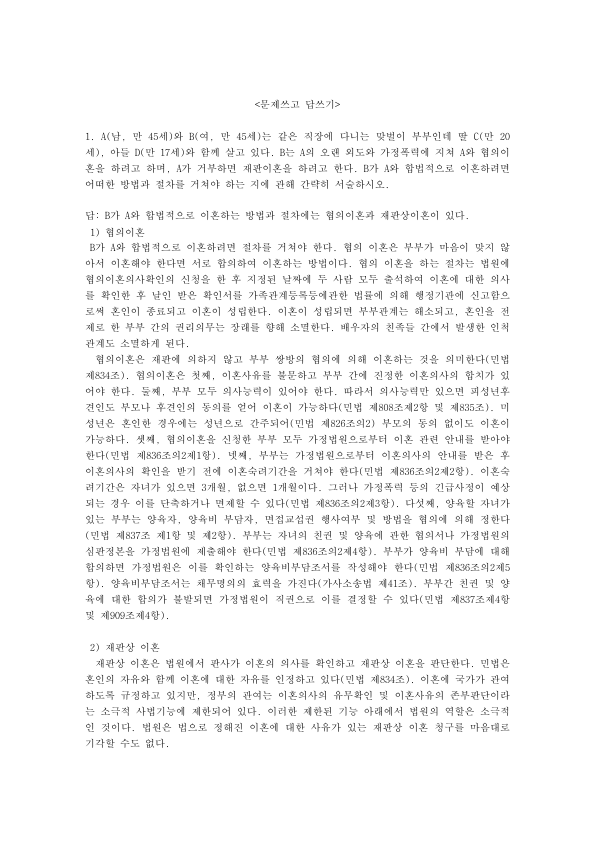
Page 1 is shown as is; from page 2 on, the preview is blurred. Buy it to download the complete original file right away (the file itself is written in Korean).
Packed with real examples and experience. Download it now and save time.
Save your valuable time
Buyer ratings
Fast, accurate and useful.
No ratings yet. Be the first to rate it.


Everyday Korean Law in Five Questions: Divorce by Agreement and by Trial, Heirs and Representation, Minimum Wage, Unfair Dismissal and Workplace Harassment
※ You can preview page 1 as is. Buy it to download the complete original file right away. The file itself is written in Korean.
■ Everyday Korean Law in Five Questions: Divorce by Agreement and by Trial, Heirs and Representation, Minimum Wage, Unfair Dismissal and Workplace Harassment — Overview
A 6-page Korean everyday-law problem set built around one family. It covers divorce by agreement and the cooling-off period, who inherits and representation by a predeceased child's spouse and children, the 2021 and 2022 hourly minimum wage, remedies for unfair dismissal through the Labor Relations Commission, and remedies for sexual harassment by an employer.
■ Everyday Korean Law in Five Questions: Divorce by Agreement and by Trial, Heirs and Representation, Minimum Wage, Unfair Dismissal and Workplace Harassment — Excerpt from the original document (English translation)
1. A (male, 45) and B (female, 45) are a dual-income couple working at the same company and live with their daughter C (20) and son D (17). Worn out by A's long affair and domestic violence, B wants a divorce by agreement, and if A refuses, a judicial divorce. Briefly describe the methods and procedures B must follow to divorce A lawfully.
Answer: The lawful ways for B to divorce A are divorce by agreement and judicial divorce.
To divorce A lawfully, B must follow a procedure. Divorce by agreement is the way a couple divorces by mutual consent when they cannot get along. The couple applies to the court for confirmation of their intent to divorce by agreement, both appear on the designated date to have that intent confirmed, and the marriage ends and the divorce is completed when the stamped confirmation is reported to the administrative office under the Act on the Registration of Family Relationships. Once the divorce is completed, the marital relationship is dissolved, the rights and duties between spouses premised on marriage end for the future, and the in-law relationships with the spouse's relatives also end.
Divorce by agreement means divorce by mutual agreement of both spouses without a trial (Civil Act Article 834). First, there must be a genuine meeting of minds to divorce, whatever the reason. Second, both spouses must have mental capacity, so an adult under guardianship may divorce with the consent of a parent or guardian as long as he or she has capacity (Articles 808(2) and 835). A minor who has married is deemed an adult (Article 826-2) and may divorce without parental consent. Third, both spouses must receive guidance on divorce from the family court (Article 836-2(1)). Fourth, after the guidance and before confirmation of intent, they must go through a cooling-off period (Article 836-2(2)), which is three months if they have children and one month if not, but it may be shortened or waived where urgent circumstances such as domestic violence are expected (Article 836-2(3)). Fifth, spouses with children to raise decide by agreement who will raise them, who will bear child support, and whether and how visitation rights will be exercised (Article 837(1) and (2)). They must submit to the family court an agreement on parental authority and custody or a copy of the court's ruling (Article 836-2(4)). If they agree on child support, the family court must prepare a child support record confirming it (Article 836-2(5)), which has the force of an enforceable title (Family Litigation Act Article 41). If they cannot agree on parental authority and custody, the family court may decide on its own authority (Articles 837(4) and 909(4)).
In a judicial divorce, a judge confirms the intent to divorce and decides on the divorce in court. The Civil Act recognizes freedom of divorce along with freedom of marriage (Article 834). The law provides for state involvement in divorce, but that involvement is limited to the passive judicial functions of confirming whether there is an intent to divorce and whether grounds for divorce exist.
Note: In question 2, because the children A and F are alive, the grandchildren C, D and H are not heirs; the heirs are A and F, plus J and K, who inherit by representation in place of the predeceased son I. As I's spouse, J receives a share increased by half, so the 450 million won estate is split 150 million won each to A and F, 90 million won to J and 60 million won to K. Failing to comply with a remedy order for unfair dismissal in question 4 leads to a non-compliance charge of up to 30 million won, not a fine, and since May 19, 2022 a victim of workplace sexual harassment can ask a Labor Relations Commission to correct an employer's failure to take protective measures.
■ Everyday Korean Law in Five Questions: Divorce by Agreement and by Trial, Heirs and Representation, Minimum Wage, Unfair Dismissal and Workplace Harassment — Contents and key concepts
Five everyday legal problems in one family
✦ At a glance
- Divorce, inheritance, wages, dismissal and harassment in one case set
- Structure: divorce → heirs → minimum wage → dismissal → harassment
- Useful for everyday law and introduction to law courses
☰ What the paper covers
- Divorce by agreement
- Heirs and representation
- Minimum wage
- Unfair dismissal
- Harassment remedies
✎ Inheritance and remedies in Korea and the U.S.
In Korea, closer descendants inherit before more distant ones, and the spouse and children of a predeceased child inherit in that child's place.
In the U.S., intestate succession is set by state law, and workers usually file harassment and dismissal claims with agencies such as the EEOC before going to court.
Note: the paper itself is written in Korean and discusses Korean law. This page is general study information, not legal advice.
Related wiki: Intestate Succession, Minimum Wage and Overtime Law
■ Everyday Korean Law in Five Questions: Divorce by Agreement and by Trial, Heirs and Representation, Minimum Wage, Unfair Dismissal and Workplace Harassment References
- 조경애. "재판상 이혼원인에서 파탄주의 도입에 관한 연구." 국내박사학위논문 이화여자대학교, 2018.
- 서울 신정균. "배우자의 상속권 강화에 관한 연구." 국내석사학위논문 한남대학교 대학원, 2019.
- 대전 이재현. "최저임금제도의 법 이론적 기초에 관한 연구." 국내박사학위논문 부산대학교 대학원, 2020.
- 부산 이관수. "부당해고 구제제도의 실효성 확보방안에 대한 연구." 국내석사학위논문 성균관대학교, 2018.
- 서울 김수영. "직장 내 성희롱에 관한 법사회학적 연구." 국내석사학위논문 서울대학교 대학원, 2020. 서울
Take a break with a quick personality test?
Ranked by actual participation. Results in about a minute.
Loading…
Most-read content
Loading view counts…

Campusdown is a lifelong-learning community in Korea offering study materials, information on government support, student loans and scholarships, and more. Don't miss our free resources.
Go to the Campusdown home page →Refund policy
- Change of mind / refund requested after partial use / more than 7 days after purchase
◆ Exceptions
- File errors / cannot download or open the file
◆ How to request a refund: send a 1:1 inquiry via Customer Service at the top