
Page 1 is shown as is; from page 2 on, the preview is blurred. Buy it to download the complete original file right away (the file itself is written in Korean).
Packed with real examples and experience. Download it now and save time.
Save your valuable time
Buyer ratings
Fast, accurate and useful.
No ratings yet. Be the first to rate it.


Electronic Monitoring of Offenders in Korea: Ankle Monitors, House Arrest vs. GPS Tracking, Recidivism and Human Rights Concerns
※ You can preview page 1 as is. Buy it to download the complete original file right away. The file itself is written in Korean.
■ Electronic Monitoring of Offenders in Korea: Ankle Monitors, House Arrest vs. GPS Tracking, Recidivism and Human Rights Concerns — Overview
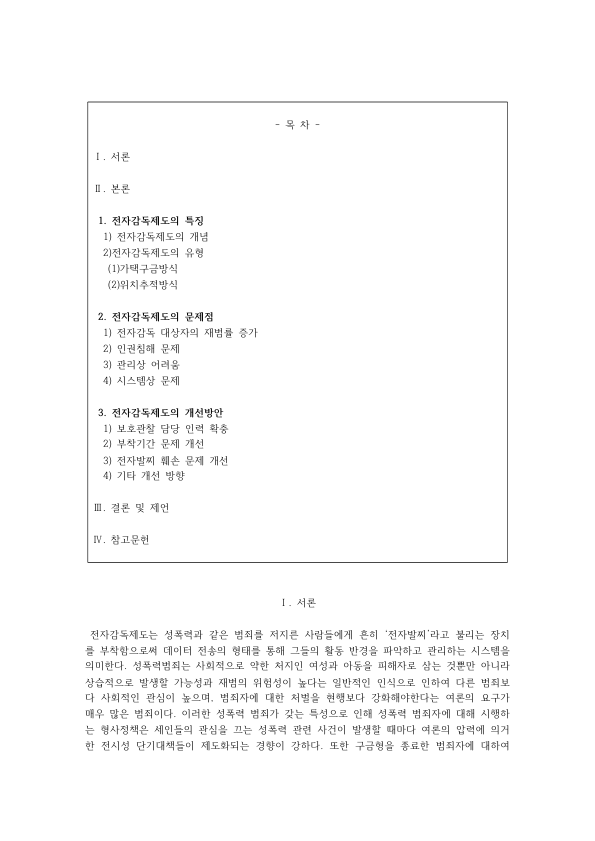
A 13-page Korean criminal policy report on electronic monitoring, the ankle-monitor system first used for sex offenders in 2008. It compares house-arrest and GPS tracking methods, reviews recidivism figures for 2011 to 2016 and the growth of average monitoring periods, discusses privacy concerns, staff shortages and device tampering, and proposes more probation officers, better monitoring periods and links to treatment programs.
■ Electronic Monitoring of Offenders in Korea: Ankle Monitors, House Arrest vs. GPS Tracking, Recidivism and Human Rights Concerns — Excerpt from the original document (English translation)
As mentioned earlier, I agree with the view that crime can be suppressed through drug treatment for the subjects. Even though most subjects of the electronic monitoring system wear electronic ankle monitors, in most cases they commit crimes because they fail to suppress a momentary sexual impulse. On this basis, I judge that, even for persons subject to ankle monitors, where a risk of reoffending exists, combining the monitor with the sexual-impulse-suppressing drug treatment currently in force, with the subject's consent or where the subject voluntarily wishes it, would be an effective means of preventing reoffending. I also think that, in Korea as an IT powerhouse, methods using mobile technology can be used. Currently, some areas offer a service that, upon application, informs parents of their child's location by SMS. Through this service, parents can check their children's location at any time. In addition, using smartphone application technology, when a person wearing an ankle monitor comes nearby, the phone could detect this and send the information to the school and the parents, making it possible to block the occurrence of crime at the source. Children would also be able to get help by going to the school security guard or the nearby local police box. Combining these methods at an appropriate level would be an opportunity to develop the electronic monitoring system in a more efficient direction, and furthermore its significance lies in responding proactively in advance rather than with "fixing the barn after losing the cow" measures that respond after a crime occurs. Attaching an ankle monitor stems from the purpose of tracking the movements of people who have committed specific crimes and preventing reoffending through the psychological pressure placed on them; it is not intended to control offenders' behavior or even the content of their conversations. Therefore, the electronic monitoring system has an inherent limitation in that it is difficult to use it to arrest, in real time, those who plan or carry out actual crimes. Accordingly, to prevent reoffending after an ankle monitor is attached, it is necessary to make probation more substantive than at present by informing the police station or police box with jurisdiction over subjects of the electronic monitoring system of their identity information so that monitored persons are managed at ordinary times as well, and to build a cooperation system among the relevant agencies so that the competent police station can be dispatched immediately when a situation arises in which there is reason to suspect a crime has actually been committed. In addition to monitoring for the purpose of preventing crime, for types that can be classified as crimes involving elements of mental illness, such as sexual crimes, it is also necessary to consider developing reoffending-prevention programs in the form of professional treatment through psychiatrists and others to fundamentally resolve the problems inherent in the offender, and, where necessary, linking them to medical treatment with specialized institutions.
In the main body, the concept and rationale of the electronic monitoring system, as well as its problems and measures for improvement, were examined from multiple angles. The world is in an uproar as heinous crimes such as murder and sexual violence occur day after day. It is said that the increase in crime is nothing new, but in recent crimes the methods are extremely cruel and the purposes of the crimes are unlimited. Moreover, in that the targets are socially vulnerable people such as children and women, or that indiscriminate attacks are made on good citizens who are complete strangers, the public's distrust of and anxiety about the social safety net are growing. If it is impossible to keep even an offender who has committed the most heinous acts confined for life, then realistically that person may someday return to our community and become a neighbor with whom we must live.
For reference, the statistics in the material are figures up to around 2016, so it is better to recheck the latest status with Ministry of Justice statistics. The name of the law was also changed in August 2020 to the Act on the Attachment of Electronic Devices, and at that time electronic monitoring was applied to all parolees and a bail system attaching an electronic device instead of detention was introduced. In 2012 the Constitutional Court viewed the attachment of an electronic device as a security measure rather than a punishment and held retroactive application constitutional, so it is good to organize this in a table together with the human rights issues and the discussion of the principle of proportionality.
■ Electronic Monitoring of Offenders in Korea: Ankle Monitors, House Arrest vs. GPS Tracking, Recidivism and Human Rights Concerns — Contents and key concepts
Do ankle monitors actually reduce reoffending in Korea?
✦ At a glance
- Korea's electronic monitoring system
- Structure: concept → types → problems → reforms
- Useful for criminology and criminal policy
☰ What the paper covers
- Concept and background
- House arrest vs. GPS tracking
- Recidivism and rights concerns
- Staffing and system problems
- Proposed reforms
✎ Electronic monitoring in Korea and the U.S.
Korea treats electronic monitoring as a security measure rather than a punishment, and since 2020 it applies to all parolees and to bail in place of detention.
In the U.S., the Supreme Court held in Grady v. North Carolina, 575 U.S. 306 (2015), that attaching a GPS monitor to a person is a Fourth Amendment search, so programs must be reasonable.
Note: the paper itself is written in Korean and discusses Korean law. This page is general study information, not legal advice.
Related wiki: Electronic Monitoring and Ankle Monitors
■ Electronic Monitoring of Offenders in Korea: Ankle Monitors, House Arrest vs. GPS Tracking, Recidivism and Human Rights Concerns References
- 법제처. ‘특정 범죄자에 대한 위치추적 전자장치 부착 등에 관한 법률’. 대한민국정부. [네이버 지식백과] 전자감독제도 (시사상식사전, 박문각) http://terms.naver.com/entry.nhn?docId=3557881&cid=43667&categoryId=43667 강호성(2014). <전자감독제도의 성과분석 및 발전방안>. 형사정제 제 26권 제 3호.
- 곽병선(2001). <사회 내 처우로서 전자감시에 의한 보호관찰 도입 방안>, 형사정책연구 제3권-2호.
- 김재중(2010). <성폭력 범죄자에 대한 전자감시제도>, 법학 연구 제8권 1호 경상대학교 법학 연구소 .
- 김혜정(2006). <성폭력범죄자 출소 후 감독제도 효율화 방안>. 형사정책연구 통권 제 74호. 147-174.
- 박선영(2010). <전자감독제도의 효과성 연구>. 한국형사정책연구원 연구총서. 15-143.
- 김지선 외(2014). <성폭력범죄자 사후관리시스템에 대한 평가연구>. 한국형사정책연구원 연구총서. 1-722.
- 심희기(2010). <성범죄자와 강력범죄자에 대한 전자감독에 수반하는 법적 쟁점들>. 한국형사 정책연구원 연구총서. 145-197.
- 연성진,유진(2015). <전자감독제도 운영성과 분석 및 효과적인 개선방안에 관한 연구>. 한국 형사정책 연구원 연구총서. 1-180.
- 송진경(2012). <위치추적 전자감시제도에 대한 비판적 검토>. 동아대학교 학위논문.
- 법률신문(2016). “전자발찌, 부착기간 늘어나자 재범률 오히려 증가” https://www.lawtimes.co.kr/Legal-News/Legal-News-View?serial=102637 사건인(2016).
- “무쓸모 전자발찌, 부착자 재범률 꾸준히 늘어” http://www.sagunin.com/sub_read.html?uid=16549
Take a break with a quick personality test?
Ranked by actual participation. Results in about a minute.
Loading…
Most-read content
Loading view counts…

Campusdown is a lifelong-learning community in Korea offering study materials, information on government support, student loans and scholarships, and more. Don't miss our free resources.
Go to the Campusdown home page →Refund policy
- Change of mind / refund requested after partial use / more than 7 days after purchase
◆ Exceptions
- File errors / cannot download or open the file
◆ How to request a refund: send a 1:1 inquiry via Customer Service at the top