
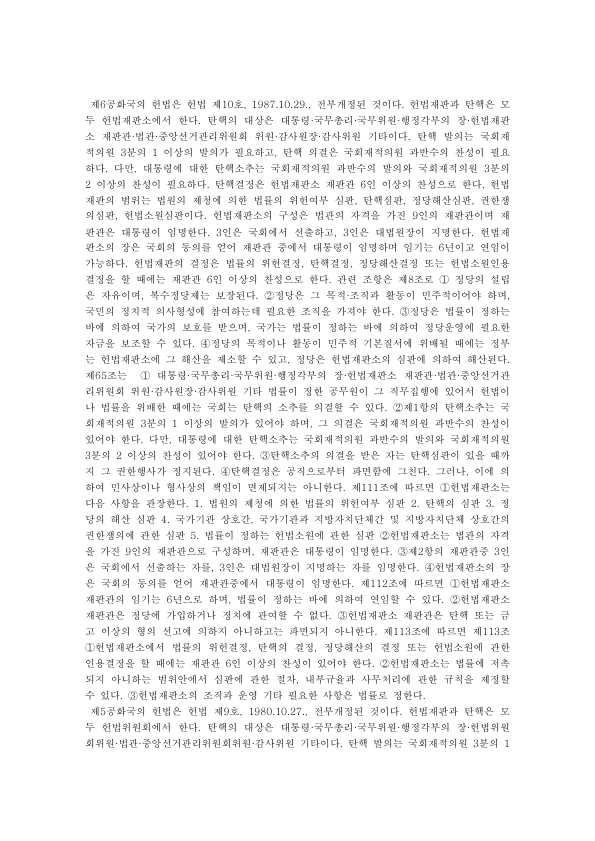
Page 1 is shown as is; from page 2 on, the preview is blurred. Buy it to download the complete original file right away (the file itself is written in Korean).
Packed with real examples and experience. Download it now and save time.
Save your valuable time
Buyer ratings
Fast, accurate and useful.
No ratings yet. Be the first to rate it.


Constitutional Adjudication and Impeachment in Korea from the First to the Sixth Republic: From the Constitutional Committee to the Constitutional Court
※ You can preview page 1 as is. Buy it to download the complete original file right away. The file itself is written in Korean.
■ Constitutional Adjudication and Impeachment in Korea from the First to the Sixth Republic: From the Constitutional Committee to the Constitutional Court — Overview
A Korean constitutional history paper comparing, republic by republic, which body handled constitutional review and impeachment, who could be impeached and what quorums applied: the Impeachment Court and Constitutional Committee of the First Republic, the Constitutional Court provided for in the Second Republic, the Impeachment Committee and Supreme Court review of the Third, the Constitutional Committee of the Fourth and Fifth, and today's Constitutional Court.
■ Constitutional Adjudication and Impeachment in Korea from the First to the Sixth Republic: From the Constitutional Committee to the Constitutional Court — Excerpt from the original document (English translation)
Let us look at the Constitution of the Second Republic, Constitution No. 4, partially amended June 15, 1960. Constitutional adjudication and impeachment are both handled by the Constitutional Court. Those subject to impeachment are the President, Constitutional Court justices, judges, members of the Central Election Commission, the Chairman of the Board of Audit, and others. A motion for impeachment requires at least 30 members of the House of Representatives, and a resolution requires the approval of a majority of the total members of each of the two houses. An impeachment decision is made with the approval of at least six Constitutional Court justices. The scope of constitutional adjudication is review of the constitutionality of statutes, final interpretation of the Constitution, competence disputes between state organs, dissolution of political parties, impeachment trials, and election lawsuits concerning the President, the Chief Justice and Supreme Court justices. The Constitutional Court consists of nine members, three each selected by the President, the Supreme Court and the House of Councillors. The term is six years, with three replaced every two years. Decisions of the Constitutional Court holding statutes unconstitutional and impeachment decisions are made with the approval of at least six justices.
The constitutions applied in the First Republic are divided into Constitution No. 3, partially amended November 29, 1954; Constitution No. 2, partially amended July 7, 1952; and Constitution No. 1, enacted July 17, 1948. First, let us look at Constitution No. 3, partially amended November 29, 1954. Constitutional adjudication is handled by the Impeachment Court and the Constitutional Committee, and impeachment by the Impeachment Court. The Impeachment Court is presided over by the Vice President, with five Supreme Court justices and five members of the House of Councillors as members, and when the President or Vice President is tried, the Chief Justice presides. Those subject to impeachment are the President, the Vice President, State Council members, the Chairman of the Board of Audit, judges, and others. A motion for impeachment requires at least 30 members of the House of Representatives, and a resolution requires the approval of a majority of the total members of each of the two houses. An impeachment decision requires the approval of at least two-thirds of the Constitutional Committee's adjudicators. The scope of constitutional adjudication is unconstitutional statutes, unconstitutional or unlawful orders, dissolution of political parties, and competence disputes. The constitutional court body consisted of the Vice President as chair, with five Supreme Court justices, three members of the House of Representatives and two members of the House of Councillors as members. Constitutional adjudication decisions require the approval of at least two-thirds of the members. The Supreme Court handles courts' requests for adjudication on the constitutionality of statutes and review of the constitutionality and legality of orders and the like.
Next, let us look at the First Republic's Constitution No. 2, partially amended July 7, 1952. Constitutional adjudication is handled by the Impeachment Court and the Constitutional Committee, and impeachment by the Impeachment Court. The Impeachment Court is presided over by the Vice President, with five Supreme Court justices and five members of the House of Councillors as members, and when the President or Vice President is tried, the Chief Justice presides. Those subject to impeachment are the President, the Vice President, the Prime Minister, State Council members, the Chairman of the Board of Audit, judges, and others. A motion for impeachment requires at least 50 members of the House of Representatives, and a resolution requires, in a joint session of both houses, the attendance of at least two-thirds of the total members of each house and the approval of at least two-thirds of the members present. An impeachment decision requires the approval of at least two-thirds of the Constitutional Committee's adjudicators. The scope of constitutional adjudication is unconstitutional statutes, unconstitutional or unlawful orders, dissolution of political parties, and competence disputes. The constitutional court body consisted of the Vice President as chair, with five Supreme Court justices, three members of the House of Representatives and two members of the House of Councillors as members. Constitutional adjudication decisions require the approval of at least two-thirds of the members. The Supreme Court handles courts' requests for adjudication on the constitutionality of statutes and review of the constitutionality and legality of orders and the like.
The evolution of the constitutional adjudication system is a topic that shows at a glance the history of constitutional amendments and changes in the power structure, so it is often covered in assignments on general constitutional theory and the structure of government. If you organize the responsible body, the quorum for impeachment motions and the quorum for decisions by republic in a table and add actual impeachment and party-dissolution cases, you can persuasively explain even the difference between periods when the system existed only on paper and periods when it actually worked. Adding a paragraph comparing how the impeachment and decision quorums under the current Constitution differ from the past lets you develop the assignment beyond a simple summary into one that explains the reasons for institutional change.
■ Constitutional Adjudication and Impeachment in Korea from the First to the Sixth Republic: From the Constitutional Committee to the Constitutional Court — Contents and key concepts
Constitutional Adjudication and Impeachment in Korea from the First to the Sixth Republic
✦ At a glance
- How constitutional review bodies changed across republics
- Structure: Sixth Republic back to the First Republic
- Useful for constitutional law and Korean political history
☰ What the paper covers
- Sixth Republic: current Constitutional Court
- Fourth and Fifth: Constitutional Committee
- Third: Supreme Court review
- First and Second Republics
✎ Background in brief
Korea's Constitutional Court began operating in 1988 and has since decided presidential impeachments.
Earlier bodies existed on paper but rarely exercised real review.
Note: the paper itself is written in Korean and discusses Korean law. This page is general study information, not legal advice.
Take a break with a quick personality test?
Ranked by actual participation. Results in about a minute.
Loading…
Most-read content
Loading view counts…

Campusdown is a lifelong-learning community in Korea offering study materials, information on government support, student loans and scholarships, and more. Don't miss our free resources.
Go to the Campusdown home page →Refund policy
- Change of mind / refund requested after partial use / more than 7 days after purchase
◆ Exceptions
- File errors / cannot download or open the file
◆ How to request a refund: send a 1:1 inquiry via Customer Service at the top