
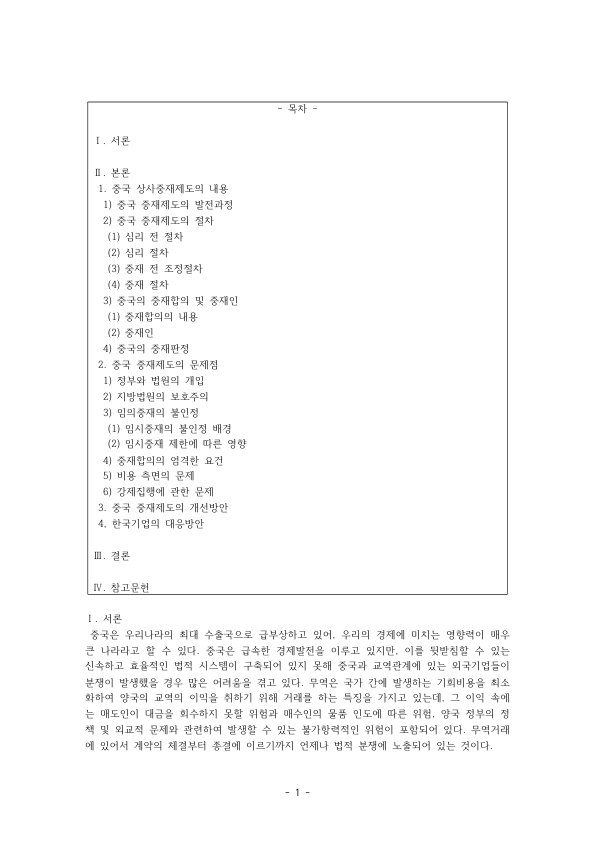
Page 1 is shown as is; from page 2 on, the preview is blurred. Buy it to download the complete original file right away (the file itself is written in Korean).
Packed with real examples and experience. Download it now and save time.
Save your valuable time
Buyer ratings
Fast, accurate and useful.
No ratings yet. Be the first to rate it.


Commercial Arbitration in China: Procedures, Arbitration Agreements and Awards, Court Intervention and the Ban on Ad Hoc Arbitration, and How Korean Companies Should Respond
※ You can preview page 1 as is. Buy it to download the complete original file right away. The file itself is written in Korean.
■ Commercial Arbitration in China: Procedures, Arbitration Agreements and Awards, Court Intervention and the Ban on Ad Hoc Arbitration, and How Korean Companies Should Respond — Overview
A 9-page Korean international trade law paper on China's commercial arbitration system. It explains how the system developed, the steps from filing to award, the strict rules for valid arbitration agreements and arbitrators, and problems such as court and government intervention, local protectionism, no ad hoc arbitration and difficult enforcement, with practical advice for Korean firms.
■ Commercial Arbitration in China: Procedures, Arbitration Agreements and Awards, Court Intervention and the Ban on Ad Hoc Arbitration, and How Korean Companies Should Respond — Excerpt from the original document (English translation)
China first introduced arbitration for political purposes, to build a socialist state. Recently, however, China's foreign-related arbitration has been developing rapidly while also carrying many problems. Many foreign parties avoid Chinese arbitration, so China's foreign-related arbitration is drifting away from internationalization. China therefore needs to make its rules on foreign-related arbitration more specialized and adopt a unified arbitration law. Many revisions and additions are needed so that arbitration is fair and equal in line with international trends.
Finally, recognizing ad hoc arbitration is essential. Ad hoc arbitration offers flexibility and speed and is the most widely used approach internationally. But so far there is little basis in China for recognizing it. For ad hoc arbitration to be recognized, not only legal amendment but also the support of the courts is essential, and guidance and supervision must be strengthened. Many institutional improvements are needed, such as expanding parties' choices and giving the party against whom an award is enforced a full opportunity to present evidence.
The problems in China's arbitration law fall within the inherent powers of China's legislature and are not yet being discussed within China. Because the shortcomings of China's commercial arbitration cannot be solved quickly, Korean companies that must deal with Chinese companies now need to prepare in advance for disputes.
First, companies should use the Korea-China Commercial Arbitration Agreement concluded in 1992. It is a private agreement in the form of a private-law contract, but because it specifies the seat, institution and applicable rules in advance, using it as the arbitration clause when drafting contracts for trade with China is recommended. Disputes between the parties are finally resolved by arbitration through civil organizations in the two countries, and the result binds both parties to the contract.
Choosing the seat of arbitration is also an important point in the parties' agreement. When an international dispute arises, it is most advantageous for a Korean party to receive an award from a Korean arbitration institution. That is partly a matter of time and cost, but above all, choosing another country as the seat can leave a party much less able to deal with that country's culture and values, putting it at a disadvantage. It is therefore advantageous to specify Korea as the seat in the contract, and if that cannot be agreed, a third-country institution should be chosen. Hong Kong and Singapore use English as the language of arbitration, which makes proceedings relatively convenient. Keeping these points in mind can prevent an arbitration agreement from being held invalid under Chinese law.
This paper examined the content and problems of China's commercial arbitration system. Influenced by its political system, China's commercial arbitration is stricter and less independent than that of other countries. Its strict procedural requirements, which leave no room for flexibility, also make it not yet fit for international use. In particular, Chinese arbitration does not recognize ad hoc arbitration and involves serious judicial interference. These features have historical and cultural roots, and the socialist system, which runs society for the interests of the collective and the state, has had a great influence. Yet trade with China grows every year, and disputes are becoming more frequent. Korean companies must understand the problems and details of China's arbitration system and prepare various alternatives to minimize harm.
To add: China's Arbitration Law was enacted in 1994 and took effect in September 1995, and it was fully revised on September 12, 2025, with the new law in force since March 1, 2026. The revised law codifies the concept of the seat of arbitration and, for the first time, allows ad hoc arbitration, but only for foreign-related maritime disputes and foreign-related disputes between companies registered in pilot free trade zones or the Hainan Free Trade Port (Article 82). China joined the New York Convention on the Recognition and Enforcement of Foreign Arbitral Awards in 1987, and Korea joined in 1973. Even after the revision, most foreign-related disputes are still handled through institutional arbitration.
■ Commercial Arbitration in China: Procedures, Arbitration Agreements and Awards, Court Intervention and the Ban on Ad Hoc Arbitration, and How Korean Companies Should Respond — Contents and key concepts
What should a Korean company know before arbitrating in China?
✦ At a glance
- China's commercial arbitration system
- Structure: development → procedure → problems → reforms → strategy
- Useful for international trade law and arbitration courses
☰ What the paper covers
- How it developed
- Procedure and awards
- Arbitration agreements
- Court intervention
- Strategy for Korean firms
✎ Arbitration in China, Korea and the U.S.
China's revised Arbitration Law, in force since March 2026, codifies the seat of arbitration and allows ad hoc arbitration in limited foreign-related cases.
In the U.S., the Federal Arbitration Act of 1925 makes arbitration agreements enforceable, and courts enforce foreign awards under the New York Convention.
Note: the paper itself is written in Korean and discusses Korean law. This page is general study information, not legal advice.
Related wiki: Arbitration
■ Commercial Arbitration in China: Procedures, Arbitration Agreements and Awards, Court Intervention and the Ban on Ad Hoc Arbitration, and How Korean Companies Should Respond References
- 담정(2014). <중국 중재제도의 문제점에 관한 연구 : CIETAC와 KCAB 국제중재규칙을 중심으로>.
- 성균관대학교 대학원 석사학위논문 이화(2012). <중국 중재제도의 현황 및 문제점에 대한 연구 : 한국중재제도와의 비교를 중심으로>.
- 경희대학교 중국법무학과 석사학위논문 이주원(2005). 중국 중재제도의 특징에 관한 소고. <중재연구> 제15권 제3호 pp.113-137 박규용, 서세걸(2015).
- 중국 중재제도의 새로운 발전과 외국중재판정 승인 및 집행에 관한 연구. <중재연구> 제25권 제2호 pp.49-70 오원석, 이경화(2014).
- 중국 중재제도의 특징과 그 역사·문화적 배경에 관한 연구. <중재연구> 제24권 제2호 pp.161-181
Take a break with a quick personality test?
Ranked by actual participation. Results in about a minute.
Loading…
Most-read content
Loading view counts…

Campusdown is a lifelong-learning community in Korea offering study materials, information on government support, student loans and scholarships, and more. Don't miss our free resources.
Go to the Campusdown home page →Refund policy
- Change of mind / refund requested after partial use / more than 7 days after purchase
◆ Exceptions
- File errors / cannot download or open the file
◆ How to request a refund: send a 1:1 inquiry via Customer Service at the top