
Page 1 is shown as is; from page 2 on, the preview is blurred. Buy it to download the complete original file right away (the file itself is written in Korean).
Packed with real examples and experience. Download it now and save time.
Save your valuable time
Buyer ratings
Fast, accurate and useful.
No ratings yet. Be the first to rate it.


1 / 5
좌우로 밀어서 페이지를 넘겨보세요
과제 개요
| 전체 페이지 수 | 5페이지 |
|---|---|
| 파일 형식 | 한글(HWP) |
| 등록일 | 2025.07.04 |
캠퍼스다운 도움말
해당 자료는 No AI 자료입니다. 인싸이트를 얻고 새롭게 가공해 보세요.
자료를 받아서 이용하면 품질이 확 올라갑니다.
- 헌법
- 국제법
- 인간의 존엄과 가치
- 주권면제
- 국가면제
- 위안부 판결
- 재판청구권
- 2006헌마788
- 국제사법재판소
- 손해배상
Comfort Women Ruling and Human Dignity: Sovereign Immunity Under Customary International Law vs. the Korean Constitution
※ You can preview page 1 as is. Buy it to download the complete original file right away. The file itself is written in Korean.
■ Comfort Women Ruling and Human Dignity: Sovereign Immunity Under Customary International Law vs. the Korean Constitution — Overview
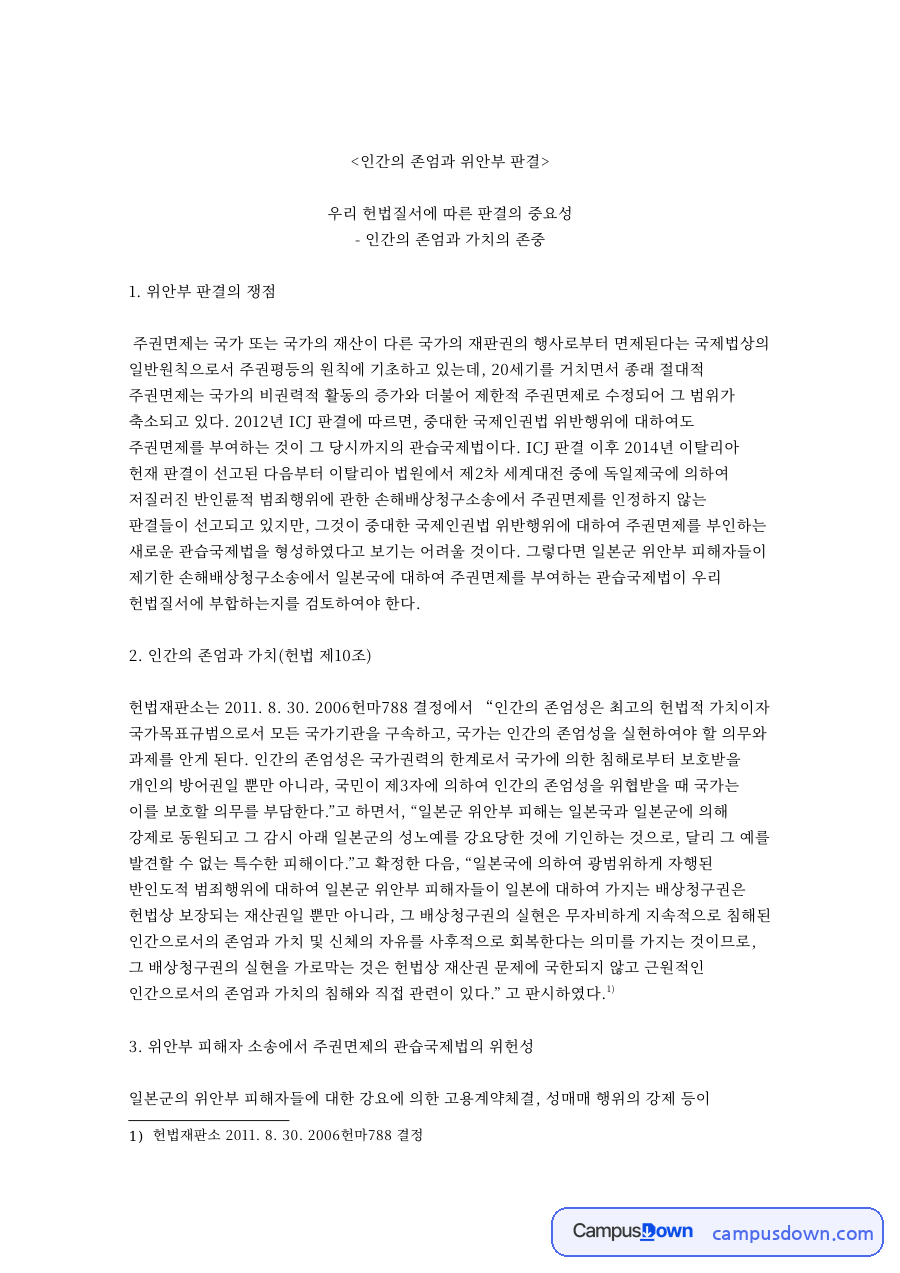
A 5-page Korean law paper on whether Korean courts may hear damages claims against Japan brought by former 'comfort women'. It traces the shift from absolute to restrictive sovereign immunity, the 2012 ICJ judgment (Germany v. Italy) and the 2014 Italian Constitutional Court decision, then applies Article 10 (human dignity) and Article 27 (right to trial) of the Korean Constitution, citing Constitutional Court decision 2006Hun-Ma788.
It reviews the Seoul Central District Court judgment of January 8, 2021 (2016Gahap505092) and argues that the exceptions to state immunity need clearer substantive and procedural limits.
■ Comfort Women Ruling and Human Dignity: Sovereign Immunity Under Customary International Law vs. the Korean Constitution — Excerpt from the original document (English translation)
Article 6(1) of our Constitution provides that "generally recognized rules of international law shall have the same effect as domestic laws," and there is no disagreement in constitutional or international law scholarship that "generally recognized rules of international law" in that provision include customary international law; our Constitutional Court has also made clear that generally recognized rules of international law are subject to constitutional review. In addition, the Constitutional Court declared: "The claims for damages of the 'comfort women' victims against Japan for crimes against humanity committed by the Japanese military are not only property rights guaranteed under the Constitution; realizing those claims also means restoring, after the fact, human dignity and worth and bodily freedom, and blocking the realization of those claims is directly related to the infringement of the fundamental human dignity and worth under the Constitution."
The Supreme Court requires, in order to apply customary law as a norm for adjudication, legitimacy and reasonableness that do not contravene the entire legal order with the Constitution as the supreme norm, that is, constitutionality. Therefore, for a domestic court to recognize "generally recognized rules of international law," that is, customary international law, and use it as a norm for adjudication, it must determine not only whether the rule is established as a general international practice and whether legal conviction is established internationally, but also whether that customary international law conforms to our constitutional order. In applying customary international law on sovereign immunity in the damages lawsuits brought by the Japanese military "comfort women" victims against Japan, our courts must likewise review whether that customary international law conforms to our constitutional order. (Oh Seung-jin, 2018, A Study on the Damages Lawsuits of Japanese Military "Comfort Women" Victims: Focusing on Judgments of Foreign Courts, Dankook University Legal Research Institute, Dankook Law Review Vol. 42 No. 1)
Applying customary international law on sovereign immunity to the damages lawsuits filed by the "comfort women" victims against Japan restricts our courts' exercise of jurisdiction, so the courts cannot even proceed to decide on the victims' substantive rights. As the Constitutional Court held earlier, this blocks the realization of the victims' claims for damages, which are property rights guaranteed by the Constitution and mean the after-the-fact restoration of human dignity and worth and bodily freedom, and therefore does not conform to our constitutional order. Accordingly, such customary international law on sovereign immunity cannot be said to have the same effect as domestic law and cannot be our norm for adjudication. (Lee Eunkyung, 2018, Discussion of Legal Issues in the Damages Lawsuits of "Comfort Women" Victims, Seoul National University BK21 Law Research Group, Center for Public Interest and Human Rights Law, Public Interest and Human Rights Vol. 18)
5. Assessment of the recent Seoul Central District Court judgment 2016Gahap505092 rendered on January 8, 2021
This is a case in which Plaintiff A and others, who were forcibly mobilized during the Japanese colonial period and forced to live as "comfort women," sought payment of consolation money from Japan.
The "comfort women" damages lawsuits continued afterward: in April 2021 a different panel of the same court recognized state immunity and dismissed the suit, but in November 2023 the Seoul High Court reversed that decision and rendered a judgment denying state immunity. Organizing even this flow of conflicting conclusions is a great help in preparing constitutional and international law assignments and debates that link, all at once, Article 10 of the Constitution (human dignity and worth), Article 27 (the right to trial), and the domestic effect of customary international law. It is even better to focus on learning the order of argument rather than the conclusion of the judgments.
■ Comfort Women Ruling and Human Dignity: Sovereign Immunity Under Customary International Law vs. the Korean Constitution — Contents and key concepts
Can a court hear a case against a foreign state when human dignity is at stake?
✦ At a glance
- The clash between state immunity and Article 10 human dignity
- Structure: issues → human dignity → unconstitutionality argument → opinion
- Useful for constitutional law, international law and human rights papers
☰ What the paper covers
- From absolute to restrictive sovereign immunity; ICJ 2012 and Italy 2014
- Human dignity and the state's duty to protect (2006Hun-Ma788)
- Japanese court history and the right to a trial
- Opinion on the 2021 Seoul Central District Court judgment
✎ Sovereign immunity in a nutshell
Sovereign immunity means one state cannot be sued in another state's courts. Most countries now follow a restrictive approach that covers sovereign acts but not commercial ones.
The hard question is grave human rights violations committed as sovereign acts. The paper argues that blocking every lawsuit leaves victims with no remedy at all, which conflicts with the constitutional duty to protect human dignity.
Note: the paper itself is written in Korean and discusses Korean law. This page is general study information, not legal advice.
■ Comfort Women Ruling and Human Dignity: Sovereign Immunity Under Customary International Law vs. the Korean Constitution References
- 홍승기(Hong, Sungkee), 2020, 『제국의 위안부』 형사 판결의 비판적 분석 -서울고등법원 2017노610 판결을 중심으로-, 인하대학교 법학연구소, 法學硏究 Vol.23 No.1 강경자, 2021, 일본군 ‘위안부' 문제에 있어서 공권력과 강제동원성 ― 일본 재판부의 판결문 속 ‘국가무답책' 법리를 중심으로 ―, 단국대학교 일본연구소, 일본학연구 Vol.62 No.- 오승진, 2018, 일본군 ‘위안부' 피해자 손해배상소송에 관한 연구- 해외 법원의 판결을 중심으로 -, 단국대학교 법학연구소, 법학논총 Vol.42 No.1 이은경 ( Lee Eunkyung ), 2018,‘위안부' 피해자 손해배상청구소송에서의 법적 쟁점 논의, 서울대학교 BK21 법학연구단 공익인권법연구센터, 공익과 인권 Vol.18 No.- 헌법재판소 2011. 8. 30. 2006헌마788 결정 서울중앙지방법원 2021. 1. 8.
- 선고 2016가합505092 판결
Keyword Prompt
전문가가 만들었어요과제를 직접 쓰는 데 도움이 되는 영어 프롬프트예요.
Tip! Prompt 에 자신의 생각을 추가해서 하면 훨씬 더 ✨ 좋습니다.
캠퍼스다운에서 레포트 받고 잘 쓰는 법 3가지, AI로 참고자료 제대로 재가공하기 →Prompt 1
I'm writing a university assignment on "위안부 판결과 인간의 존엄과 가치: 주권면제 관습국제법의 위헌성과 2016가합505092 판결 검토". Help me build an outline (introduction, 2-3 body sections, conclusion) that covers 헌법, 국제법 and 인간의 존엄과 가치. Don't write the paper for me - give me guiding questions for each section. My own perspective: [자신의 생각 넣는 곳] Please respond in Korean.
Prompt 2
Explain the key concepts "헌법" and "국제법" in simple terms, then show how they connect to the topic "위안부 판결과 인간의 존엄과 가치: 주권면제 관습국제법의 위헌성과 2016가합505092 판결 검토". Point out common misunderstandings students have about them. My own perspective: [자신의 생각 넣는 곳] Please respond in Korean.
Prompt 3
Suggest 3 real-world cases or examples I could analyze in an assignment on "위안부 판결과 인간의 존엄과 가치: 주권면제 관습국제법의 위헌성과 2016가합505092 판결 검토", focusing on "인간의 존엄과 가치". For each, tell me what I should look up and verify in official or academic sources. My own perspective: [자신의 생각 넣는 곳] Please respond in Korean.
Prompt 4
Review my draft paragraph on "위안부 판결과 인간의 존엄과 가치: 주권면제 관습국제법의 위헌성과 2016가합505092 판결 검토" (key idea: "주권면제"). Give feedback on logic, evidence and clarity, and mark where I need a citation. My paragraph: [paste here] My own perspective: [자신의 생각 넣는 곳] Please respond in Korean.
Take a break with a quick personality test?
Ranked by actual participation. Results in about a minute.
Loading…
Most-read content
Loading view counts…

Campusdown is a lifelong-learning community in Korea offering study materials, information on government support, student loans and scholarships, and more. Don't miss our free resources.
Go to the Campusdown home page →Refund policy
- Change of mind / refund requested after partial use / more than 7 days after purchase
◆ Exceptions
- File errors / cannot download or open the file
◆ How to request a refund: send a 1:1 inquiry via Customer Service at the top