
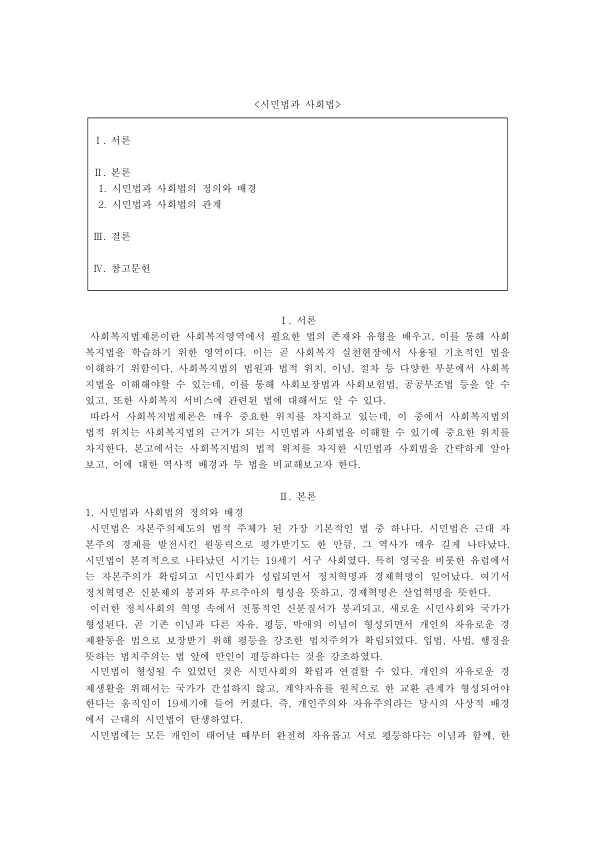
Page 1 is shown as is; from page 2 on, the preview is blurred. Buy it to download the complete original file right away (the file itself is written in Korean).
Packed with real examples and experience. Download it now and save time.
Save your valuable time
Buyer ratings
Fast, accurate and useful.
No ratings yet. Be the first to rate it.


Civil Law and Social Law in Social Welfare Legislation: Background, Modified Principles and the Place of Social Welfare Law
※ You can preview page 1 as is. Buy it to download the complete original file right away. The file itself is written in Korean.
■ Civil Law and Social Law in Social Welfare Legislation: Background, Modified Principles and the Place of Social Welfare Law — Overview
A 3-page Korean social welfare law paper written for a social welfare legislation course. It explains how classical civil law emerged with 19th-century civil society and capitalism and rested on absolute ownership, freedom of contract and fault-based liability, how social law arose in late 19th-century Germany to modify those principles through limits on ownership, regulated contracts and no-fault liability, and why social welfare law belongs to social law as a third field between public and private law.
■ Civil Law and Social Law in Social Welfare Legislation: Background, Modified Principles and the Place of Social Welfare Law — Excerpt from the original document (English translation)
So social law greatly expanded the ideals of civil law while also modifying some of them. The most representative examples are restrictions on the exercise of ownership, modification of the principle of freedom of contract, and the principle of no-fault liability. Unlike in civil law, the exercise of ownership came to be restricted by the standard of public welfare, and the principle of freedom of contract came to be limited as state intervention was allowed. In addition, the principle of no-fault liability means that damages can be paid without examining whose fault caused the harm. This is a law that modified the civil-law principle of fault liability.
Therefore, social law is sometimes called the most modern form of law, having modified and supplemented the content and principles of civil law. Such social law is not only included in the French Civil Code of 1804 but is also closely related to social welfare law.
Seen this way, social law can be said to be the supplementation and modification of civil law. Still, the concept of social law cannot be recognized merely because it criticized and modified the principles of civil law, because, just as much as the modification from civil law to social law, the social environment and historical background changed as society changed. With these changes over time, the content and meaning of labor law and economic law changed, and attitudes toward recognizing the concept of social law came to differ from state to state and society to society.
Social welfare law has its own independent legal system that is neither public law nor private law. Therefore, the fact that its legal background is drawing attention as a new administrative field is also related to the background of social welfare law. The new emergence of legal movements in the modern sense also plays a part.
There are also parts to correct as you read. The French Civil Code of 1804 (the Napoleonic Code) is not social law but the representative code of modern civil law, embodying absolute ownership and freedom of contract, and the rule of law is a concept distinct from the separation of legislative, judicial and executive powers. Correcting and understanding these two points accurately makes the contrast between civil law and social law sharper, and it becomes a solid starting point when studying individual statutes such as the Framework Act on Social Security and the Social Welfare Services Act, so it works well as the introduction to a social welfare legislation assignment. Read it together with the relevant unit of your textbook.
■ Civil Law and Social Law in Social Welfare Legislation: Background, Modified Principles and the Place of Social Welfare Law — Contents and key concepts
Why is social welfare law neither public nor private law?
✦ At a glance
- How social law modified classical civil law
- Structure: introduction → definitions and background → relationship → conclusion
- Useful for social welfare legislation and policy classes
☰ What the paper covers
- Rise of civil law in 19th-century Europe
- Three principles of civil law
- Emergence of social law in Germany
- Social welfare law as part of social law
✎ Civil law and social law in brief
Classical civil law treated everyone as equal and free to contract, which hid real power gaps between capital and labor.
Social law corrected this by limiting ownership, regulating contracts and introducing no-fault liability, laying the ground for social welfare law.
Note: the paper itself is written in Korean and discusses Korean law. This page is general study information, not legal advice.
■ Civil Law and Social Law in Social Welfare Legislation: Background, Modified Principles and the Place of Social Welfare Law References
- 김진수, 사회복지법제론, 형지사, 2015
- 이명남, 사회복지법제론, 창지사, 2015
Take a break with a quick personality test?
Ranked by actual participation. Results in about a minute.
Loading…
Most-read content
Loading view counts…

Campusdown is a lifelong-learning community in Korea offering study materials, information on government support, student loans and scholarships, and more. Don't miss our free resources.
Go to the Campusdown home page →Refund policy
- Change of mind / refund requested after partial use / more than 7 days after purchase
◆ Exceptions
- File errors / cannot download or open the file
◆ How to request a refund: send a 1:1 inquiry via Customer Service at the top