
Page 1 is shown as is; from page 2 on, the preview is blurred. Buy it to download the complete original file right away (the file itself is written in Korean).
Packed with real examples and experience. Download it now and save time.
Save your valuable time
Buyer ratings
Fast, accurate and useful.
No ratings yet. Be the first to rate it.


Child Abuse in Korea: The Jeong-in Case, a Daycare Abuse Ruling, the Child Abuse Punishment Act and Prevention Measures
※ You can preview page 1 as is. Buy it to download the complete original file right away. The file itself is written in Korean.
■ Child Abuse in Korea: The Jeong-in Case, a Daycare Abuse Ruling, the Child Abuse Punishment Act and Prevention Measures — Overview
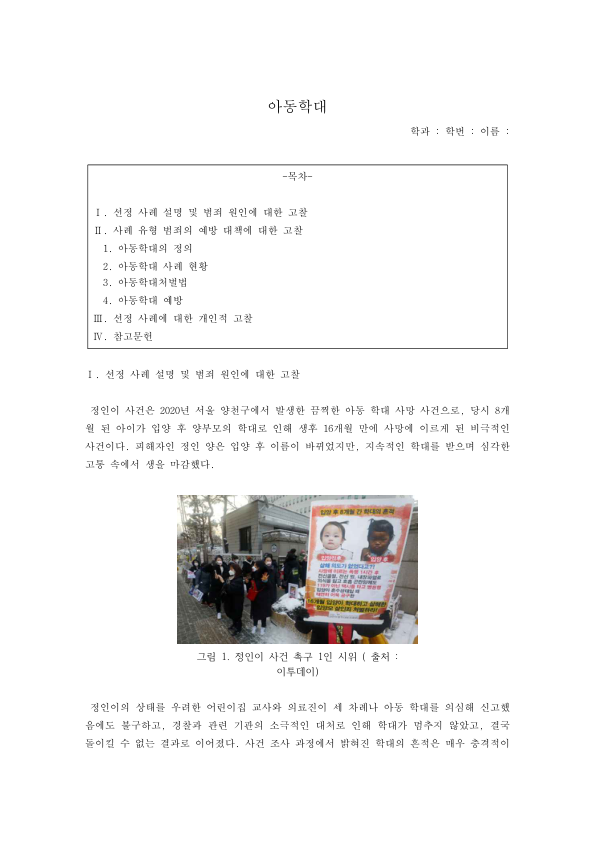
A 7-page Korean child welfare and criminology paper. It reviews the 2020 death of 16-month-old Jeong-in after repeated reports to authorities and a ruling against a daycare teacher, explains the causes and types of child abuse and the Child Abuse Punishment Act, and proposes stronger professional responders, on-site manuals and agency coordination.
■ Child Abuse in Korea: The Jeong-in Case, a Daycare Abuse Ruling, the Child Abuse Punishment Act and Prevention Measures — Excerpt from the original document (English translation)
According to one study, the causes of child abuse can be grouped into parental, child, family and social environmental factors and analyzed from psychopathological, developmental, social-psychological and ecological perspectives. The psychopathological view sees parents' pathological personalities and past abuse as the main factors, while the developmental view says traits of the child, such as disability or premature birth, can trigger abuse. The social-psychological view explains that family conflict, economic stress and cultural attitudes that accept physical punishment can underlie abuse. The ecological view analyzes how individual, family, community and cultural systems interact to produce abuse.
Looking at where abuse occurs, abuse at home accounts for by far the largest share. About 79.5% of all cases occurred at home, showing that abuse is most likely to be committed by parents and guardians. By contrast, the shares at daycare centers, kindergartens and schools were relatively low at 4.6%, 0.5% and 7.6%, but they still call for vigilance. Some cases were also reported at child welfare and other welfare facilities, so the child protection system as a whole needs review and improvement.
Child abuse is divided into physical abuse, emotional abuse, sexual abuse and neglect, and is defined as conduct that can seriously affect a child's health and development. Physical abuse includes any act that injures a child's body or harms health and development, including not only direct physical punishment but also acts such as making a child stand for long periods. Emotional abuse means any act that harms a child's mental health, and it can be abuse on its own even without physical abuse. Verbal abuse such as blame or contempt is included as well as verbal sexual harassment. Sexual abuse includes verbal sexual harassment as well as physical contact and is treated as a serious crime subject to heavy punishment. Neglect, common with infants and toddlers, includes failing to provide basic protection, care and education.
Table 1. Child abuse cases in Korea over the past three years / Source: Ministry of Health and Welfare annual child abuse report
Child abuse cases in Korea over the past three years show that it remains a serious social problem. The number of reports fluctuated slightly each year but fell somewhat from 53,932 in 2021 to 48,522 in 2023. Yet the number of cases judged to be abuse and the share occurring at home remain high, and abuse by parents reached 85.9% in 2023, making it the main threat to children's safety. Repeat abuse also exceeds 15%, a very serious problem because children who have already been abused are exposed to danger again and again.
Child abuse is defined more broadly than in the Criminal Act and is punished under the Child Abuse Punishment Act.
To add: in the Jeong-in case, the Supreme Court on April 28, 2022 upheld a 35-year prison sentence for the adoptive mother for murder and other charges (life imprisonment at first instance, reduced to 35 years on appeal), and a five-year sentence for the adoptive father. After the case, a March 2021 amendment to the Child Abuse Punishment Act created the crime of child abuse murder (punishable by death, life imprisonment or at least seven years), and early response was strengthened, for example by requiring investigations to begin without delay once a report is received. Since October 2020, child abuse investigations have moved from private child protection agencies to child abuse officials in city, county and district offices. The paper's statistics are as of the time of writing.
■ Child Abuse in Korea: The Jeong-in Case, a Daycare Abuse Ruling, the Child Abuse Punishment Act and Prevention Measures — Contents and key concepts
How one child's death changed child protection
✦ At a glance
- Child abuse cases and prevention in Korea
- Structure: cases and causes → definitions → law → prevention
- Useful for child welfare, criminology and social welfare law courses
☰ What the paper covers
- The Jeong-in case
- A daycare abuse ruling
- Four views on causes
- The punishment act
- Coordination measures
✎ Child protection in Korea and the U.S.
Korea created the crime of child abuse murder in 2021 and moved abuse investigations to local public officials in 2020.
In the U.S., every state has mandatory reporting laws, and the federal Child Abuse Prevention and Treatment Act of 1974 funds state child protective services.
Note: the paper itself is written in Korean and discusses Korean law. This page is general study information, not legal advice.
Related wiki: Theories of Punishment
■ Child Abuse in Korea: The Jeong-in Case, a Daycare Abuse Ruling, the Child Abuse Punishment Act and Prevention Measures References
- 교재 및 강의안 '2~3세 아동' 대상 신체·정서적 학대 어린이집 교사 벌금형 선고. 신아일보. 이상명 기자. 2023.09.18.
- 한소영. "보육교사의 아동권리 인식 수준에 따른 아동학대 행위, 아동학대 발생원인, 개선방안 인식 차이." 국내석사학위논문 동아대학교 교육대학원, 2022.
- 부산 차현서. "학대예방경찰관(APO)의 아동학대범죄 처리절차의 개선방안." 국내석사학위논문 동국대학교 경찰사법대학원, 2022.
- 서울 다오티미칸. "아동학대 예방법제와 아동학대 발생빈도와의 관계." 국내석사학위논문 국민대학교 일반대학원, 2021.
- 서울 이정희. "아동학대예방과 보호 네트워크에 관한 연구." 국내박사학위논문 명지대학교, 2005.
- 서울 [이창현 교수의 형사교실] 2023년~ 형법 주요 판례(5).
- 법률저널. 이창현. 2024.11.18.
- “아동학대 절대 안됩니다 관심을 가져주세요”. 동양일보. 도복희 기자. 2024.11.24.
- 검찰, '정인이 사건' 양부모에 살인죄 적용…사망 원인 재감정. 이투데이 . 김종용기자. 2021.01.13.
Take a break with a quick personality test?
Ranked by actual participation. Results in about a minute.
Loading…
Most-read content
Loading view counts…

Campusdown is a lifelong-learning community in Korea offering study materials, information on government support, student loans and scholarships, and more. Don't miss our free resources.
Go to the Campusdown home page →Refund policy
- Change of mind / refund requested after partial use / more than 7 days after purchase
◆ Exceptions
- File errors / cannot download or open the file
◆ How to request a refund: send a 1:1 inquiry via Customer Service at the top