
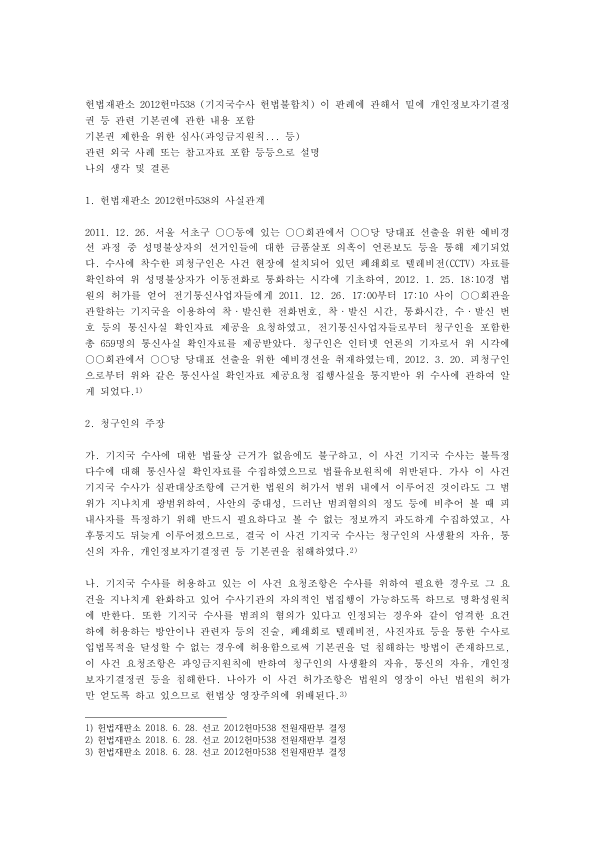
Page 1 is shown as is; from page 2 on, the preview is blurred. Buy it to download the complete original file right away (the file itself is written in Korean).
Packed with real examples and experience. Download it now and save time.
Save your valuable time
Buyer ratings
Fast, accurate and useful.
No ratings yet. Be the first to rate it.


Cell Tower Dumps Ruled Unconstitutional in Korea: Constitutional Court 2012Hun-Ma538 on Communication Records, Informational Self-Determination and Proportionality
※ You can preview page 1 as is. Buy it to download the complete original file right away. The file itself is written in Korean.
■ Cell Tower Dumps Ruled Unconstitutional in Korea: Constitutional Court 2012Hun-Ma538 on Communication Records, Informational Self-Determination and Proportionality — Overview
A 12-page Korean constitutional law paper on Constitutional Court decision 2012Hun-Ma538 (June 28, 2018). Prosecutors investigating vote-buying at a party leadership event obtained the call records of 659 people who used a nearby cell tower during a ten-minute window, including a reporter covering the event. The paper explains freedom of communication, privacy, the right to informational self-determination, statutory reservation, clarity, proportionality and the warrant requirement, walks through the Court's finding that the provision failed the least-restrictive-means test, and compares the United States, Germany and Japan.
■ Cell Tower Dumps Ruled Unconstitutional in Korea: Constitutional Court 2012Hun-Ma538 on Communication Records, Informational Self-Determination and Proportionality — Excerpt from the original document (English translation)
A. Article 12(3) of the Constitution provides that "warrants issued by a judge through due procedure upon the request of a prosecutor shall be presented in case of arrest, detention, seizure or search," and Article 16 provides that "in case of search or seizure in a residence, a warrant issued by a judge upon the request of a prosecutor shall be presented," thereby guaranteeing the warrant requirement at the constitutional level.
The warrant requirement our Constitution has adopted is the principle that, in criminal proceedings, compulsory measures of arrest, detention, seizure and search must be based on a warrant issued by a judge whose status is guaranteed by judicial independence. Therefore, the essence of the constitutional warrant requirement lies in requiring that a neutral judge make a concrete determination before compulsory measures restricting fundamental rights, such as arrest, detention, seizure and search, are taken. Meanwhile, in enacting laws on investigative agencies' compulsory measures against suspects, the legislature may, within the scope of complying with Article 12(3) of the Constitution as a special constitutional provision, comprehensively review the legal reality of our society, investigative practice, and the level of legal awareness of investigative agencies and citizens, and then make various policy choices according to specific circumstances. Constitutional Court, May 31, 2012, 2010Heonma672.
B. A request for communication confirmation data that permits base-station investigation is an investigative method that, with the court's permission, allows a request to a third party, the telecommunications business operator, to provide communication confirmation data on a subscriber without that subscriber's consent or approval; since it is a compulsory measure under the Protection of Communications Secrets Act, the constitutional warrant requirement applies. Communication confirmation data is mainly used at the initial stage of starting a criminal investigation; in particular, where a crime occurred at a specific time and place but the investigative agency has found no leads, using all phone numbers that placed calls through a specific base station during that time as investigative leads can be useful for narrowing down suspects and arresting them or collecting related evidence. In this respect, it is hard to deny that, in investigative practice, there is a real need to permit base-station investigation for crime prevention and early resolution of cases. Accordingly, the permission clause in this case, comprehensively considering the need for base-station investigation, the demands of discovering the substantive truth and investigating crimes swiftly, the characteristics of communication confirmation data, and investigative realities, allows investigative agencies, with the court's permission, to request communication confirmation data such as all phone numbers that placed calls through a specific base station during a specific time. Considering that the essence of the warrant requirement lies in requiring that a neutral judge with guaranteed personal and material independence make a concrete determination before compulsory measures are taken, the permission clause in this case, which requires the permission of the competent district court or branch court in the manner prescribed by the Protection of Communications Secrets Act, can be said to satisfy the warrant requirement in substance. Constitutional Court, full bench decision 2012Heonma538, rendered June 28, 2018.
C. Therefore, the permission clause in this case does not violate the constitutional warrant requirement.
Chapter 3 of the U.S. Electronic Communications Privacy Act governs pen registers and trap-and-trace devices. These cover records of communication use such as the phone numbers entered into a telephone to start a call, routing (the process of determining the path a sent message takes to its destination), addressing (connecting to or selecting the other party from a terminal), and location and access-point tracking, which correspond to communication confirmation data under Korea's Protection of Communications Secrets Act. The United States obtains such data using pen registers or trap-and-trace devices, and if it is determined that the purpose, "that the information likely to be obtained is relevant to an ongoing investigation," is met, an order authorizing installation of the device for a period not exceeding 60 days is issued.
After the decision of nonconformity with the Constitution, the National Assembly amended the Protection of Communications Secrets Act in December 2019, adding a supplementarity requirement so that requests for communication confirmation data on an unspecified large number of people, such as base-station investigations, and requests for real-time location-tracking data are allowed only where it is difficult by other means to prevent the commission of a crime, find or secure the offender, or collect or preserve evidence. Comparing the decision's reasoning with the amended provisions lets you persuasively describe the limits of restricting fundamental rights in constitutional law, criminal procedure and information law assignments. It is recommended to look at the provisions before and after the amendment side by side.
■ Cell Tower Dumps Ruled Unconstitutional in Korea: Constitutional Court 2012Hun-Ma538 on Communication Records, Informational Self-Determination and Proportionality — Contents and key concepts
Can police collect everyone's phone records near a crime scene?
✦ At a glance
- Why a tower dump without a necessity requirement was held unconstitutional
- Structure: facts → rights and principles → Court's reasoning → foreign comparison → opinion
- Useful for constitutional law, criminal procedure and privacy law papers
☰ What the paper covers
- Facts of 2012Hun-Ma538
- Rights at stake
- Proportionality and warrant requirement
- The Court's reasoning step by step
- US, German and Japanese practice
✎ Communication records and privacy
Communication records are metadata such as numbers called, call times and tower locations, not the content of calls.
The Court accepted the investigative purpose but found the law had no requirement that other methods be tried first, so it violated proportionality. Korea amended the Protection of Communications Secrets Act in December 2019.
Note: the paper itself is written in Korean and discusses Korean law. This page is general study information, not legal advice.
Related wiki: Freedom of Information Act (FOIA)
■ Cell Tower Dumps Ruled Unconstitutional in Korea: Constitutional Court 2012Hun-Ma538 on Communication Records, Informational Self-Determination and Proportionality References
- 박종현. "「통신비밀보호법」상 통신사실 확인자료 제공관련 조항들에 대한 헌법적 검토 – 2018. 6. 28. 2012헌마191등 결정례와 2018. 6. 28. 2012헌마538 결정례에 대한 검토를 중심으로 –." 憲法學硏究 25.2 (2019): 1-46.
- 이진구. "통신비밀의 보호범위와 한계에 관한 헌법상 연구." 국내박사학위논문 성균관대학교, 2017.
- 서울 박상철. "기본권 보장 강화를 위한 통신수사 개선방안 연구." 국내석사학위논문 성균관대학교 일반대학원, 2020.
- 서울 양훈. "인터넷 통신비밀에 관한 헌법적 보장방안 연구." 국내석사학위논문 서울시립대학교, 2020.
- 서울 권오민. "사이버 상의 위험탐지 및 대응을 위한 패킷 감청과 법적 문제." 국내박사학위논문 단국대학교 대학원, 2021.
- 경기도 이성훈. "개인정보보호 인증기준을 활용한 개인정보 감사방법 연구." 국내석사학위논문 고려대학교 정책대학원, 2022.
- 서울 김창섭. "안보 목적의 온라인 정보수집 활용을 위한 법·기술적 수행방안." 국내박사학위논문 고려대학교 정보보호대학원, 2022. 서울
Take a break with a quick personality test?
Ranked by actual participation. Results in about a minute.
Loading…
Most-read content
Loading view counts…

Campusdown is a lifelong-learning community in Korea offering study materials, information on government support, student loans and scholarships, and more. Don't miss our free resources.
Go to the Campusdown home page →Refund policy
- Change of mind / refund requested after partial use / more than 7 days after purchase
◆ Exceptions
- File errors / cannot download or open the file
◆ How to request a refund: send a 1:1 inquiry via Customer Service at the top