
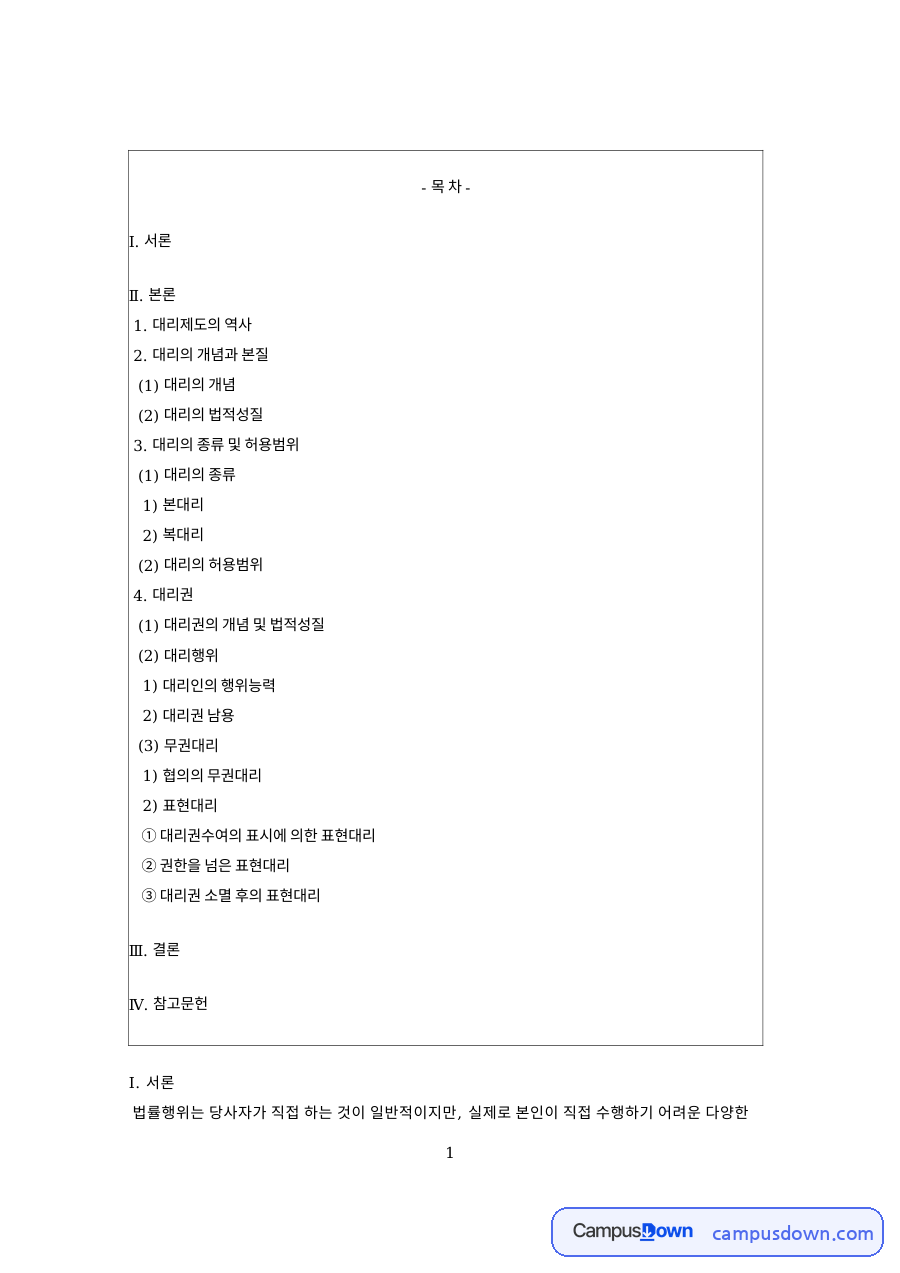
Page 1 is shown as is; from page 2 on, the preview is blurred. Buy it to download the complete original file right away (the file itself is written in Korean).
Packed with real examples and experience. Download it now and save time.
Save your valuable time
Buyer ratings
Fast, accurate and useful.
No ratings yet. Be the first to rate it.


1 / 10
좌우로 밀어서 페이지를 넘겨보세요
과제 개요
| 전체 페이지 수 | 10페이지 |
|---|---|
| 파일 형식 | 한글(HWP) |
| 등록일 | 2025.07.03 |
목차
- 1Ⅰ. 서론
- 2Ⅱ. 본론
- 2.11. 대리제도의 역사
- 2.22. 대리의 개념과 본질
- 2.3(1) 대리의 개념
- 2.4(2) 대리의 법적성질
- 2.53. 대리의 종류 및 허용범위
- 2.6(1) 대리의 종류
- 2.71) 본대리
- 2.82) 복대리
- 2.9(2) 대리의 허용범위
- 2.104. 대리권
- 2.11(1) 대리권의 개념 및 법적성질
- 2.12(2) 대리행위
- 2.131) 대리인의 행위능력
- 2.142) 대리권 남용
- 2.15(3) 무권대리
- 2.161) 협의의 무권대리
- 2.172) 표현대리
- 2.18① 대리권수여의 표시에 의한 표현대리
- 2.19② 권한을 넘은 표현대리
- 2.20③ 대리권 소멸 후의 표현대리
- 3Ⅲ. 결론
- 4Ⅳ. 참고문헌
캠퍼스다운 도움말
해당 자료는 No AI 자료입니다. 인싸이트를 얻고 새롭게 가공해 보세요.
자료를 받아서 이용하면 품질이 확 올라갑니다.
- 대리제도
- 임의대리
- 법정대리
- 복대리
- 대리권 남용
- 무권대리
- 표현대리
- 민법총칙
- 대리제도의 역사
- 본대리
Agency Under the Korean Civil Code: Voluntary and Legal Agency, Sub-Agency, Abuse of Authority, Unauthorized Agency and Three Types of Apparent Authority
※ You can preview page 1 as is. Buy it to download the complete original file right away. The file itself is written in Korean.
■ Agency Under the Korean Civil Code: Voluntary and Legal Agency, Sub-Agency, Abuse of Authority, Unauthorized Agency and Three Types of Apparent Authority — Overview
An 8-page Korean civil law paper covering agency from Articles 114 to 136 of the Civil Code. It distinguishes agents from messengers and representatives, compares theories of agency, explains voluntary, legal and sub-agency, and walks through unauthorized agency and the three forms of apparent authority.
■ Agency Under the Korean Civil Code: Voluntary and Legal Agency, Sub-Agency, Abuse of Authority, Unauthorized Agency and Three Types of Apparent Authority — Excerpt from the original document (English translation)
When the other party has good reason to believe that the agent has authority, the act of agency can be treated as valid. Good reason exists when, based on all the circumstances at the time of the unauthorized act, an ordinary person would objectively believe the agent had authority, and the other party acted in good faith and without negligence. So for apparent authority to arise, the other party must have good reason to believe the apparent agent had the authority, and whether good reason existed in the case of acts beyond authority is judged as of the time of the act. Apparent authority for acts beyond authority also applies to legal agency.
Apparent authority after the end of authority, under Article 129, is recognized to protect a good-faith, non-negligent counterparty when a person whose authority has ended still acts as an agent. Even though the authority has ended, the law gives the same effect as if it existed in relation to the other party, so the end of authority cannot be asserted against that third party. For Article 129 to apply, authority that once existed must have ended. It covers only cases where the grant was revoked or the underlying internal relationship ended; where there was never any authority, apparent authority cannot
arise. The Supreme Court recognizes as a basis of authority not only cases where the former agent deals with the other party directly after the authority ends, but also cases where the former agent appoints a sub-agent after the authority ends.
If the other party did not know that the authority had ended, believed the sub-agent had valid authority and was not negligent, apparent authority under Article 129 arises in this case too. This can be seen as the doctrine of apparent authority recognizing good reason where someone created an appearance, for the sake of secure transactions. The principal bears the burden of proving the other party's bad faith or negligence. Because whoever disputes the effect bears the burden on good faith, this applies to all types of apparent authority. Whether Article 129 also applies to legal agency is debated, and the majority view applies it to legal agency to protect the other party.
This paper reviewed the agency system in the Korean Civil Code as a whole. Messengers and representatives are similar concepts, but agency differs in that it can produce effects directly for the principal even if the agent lacks full legal capacity. And besides authorized agency, even unauthorized agency can become a valid juristic act if certain requirements are met and the principal ratifies it. In this way agency protects secure transactions, the other party and third parties, so its social meaning is very important. Voluntary agency extends private autonomy, and legal agency supplements the rules on persons lacking capacity, letting legal effects belong to someone other than the person who made the declaration, which makes it even more important. And because some forms of apparent authority are recognized for unauthorized agency, a juristic act can be validated retroactively by the principal's ratification.
However, ratification can also be excluded by agreement between the principal and the other party, and where rights acquired by the other party and by a third party both have exclusive effect, ratification cannot harm the third party's rights. Unless the principal ratifies, unauthorized agency has no effect on the principal, and the principal may actively refuse ratification. Against these rights of the principal, the other party has only the right to demand an answer and the right to withdraw, and depending on the outcome, the unauthorized agent bears no-fault liability to the other party and must, at the other party's choice, either perform the act or pay damages.
To add: the last sentence of the conclusion needs correcting. In unauthorized agency that the principal has not ratified, the person liable to perform or pay damages at the other party's choice is the unauthorized agent, not the principal (Civil Code Article 135(1)), and there is no such liability if the other party knew or could have known the lack of authority, or if the unauthorized agent has limited capacity (Article 135(2)). The term persons without capacity used in the paper was replaced by persons with limited capacity through the Civil Code revision that took effect in July 2013. The courts apply the proviso of Article 107(1) by analogy to abuse of authority.
■ Agency Under the Korean Civil Code: Voluntary and Legal Agency, Sub-Agency, Abuse of Authority, Unauthorized Agency and Three Types of Apparent Authority — Contents and key concepts
When is a principal bound by an agent's deal?
✦ At a glance
- Agency under Korean civil law
- Structure: concept → types → authority → unauthorized agency
- Useful for civil law general provisions courses
☰ What the paper covers
- History of agency
- Agent vs. messenger
- Types of agency
- Abuse of authority
- Apparent authority
✎ Agency in Korea and the U.S.
Korea's Civil Code sets out three forms of apparent authority: a stated grant, acts beyond authority, and acts after authority ends.
U.S. agency law, summarized in the Restatement (Third) of Agency, also binds a principal under apparent authority when a third party reasonably believes the agent had authority based on the principal's conduct.
Note: the paper itself is written in Korean and discusses Korean law. This page is general study information, not legal advice.
■ Agency Under the Korean Civil Code: Voluntary and Legal Agency, Sub-Agency, Abuse of Authority, Unauthorized Agency and Three Types of Apparent Authority References
- 진봉영(2013). <한국과 중국의 대리제도 비교연구>.
- 영남대학교 사법학과 민사법전공 박사학위논문 이양(2015). <한중 표현대리제도의 비교 연구>. 경북대학교 법학과 민사법전공 석사학위논문
Keyword Prompt
전문가가 만들었어요과제를 직접 쓰는 데 도움이 되는 영어 프롬프트예요.
Tip! Prompt 에 자신의 생각을 추가해서 하면 훨씬 더 ✨ 좋습니다.
캠퍼스다운에서 레포트 받고 잘 쓰는 법 3가지, AI로 참고자료 제대로 재가공하기 →Prompt 1
I'm writing a university assignment on "민법상 대리제도 총정리: 임의대리와 법정대리, 복대리, 대리권 남용, 무권대리와 표현대리 3유형(제125조·제126조·제129조)". Help me build an outline (introduction, 2-3 body sections, conclusion) that covers 대리제도, 임의대리 and 법정대리. Don't write the paper for me - give me guiding questions for each section. My own perspective: [자신의 생각 넣는 곳] Please respond in Korean.
Prompt 2
Explain the key concepts "대리제도" and "임의대리" in simple terms, then show how they connect to the topic "민법상 대리제도 총정리: 임의대리와 법정대리, 복대리, 대리권 남용, 무권대리와 표현대리 3유형(제125조·제126조·제129조)". Point out common misunderstandings students have about them. My own perspective: [자신의 생각 넣는 곳] Please respond in Korean.
Prompt 3
Suggest 3 real-world cases or examples I could analyze in an assignment on "민법상 대리제도 총정리: 임의대리와 법정대리, 복대리, 대리권 남용, 무권대리와 표현대리 3유형(제125조·제126조·제129조)", focusing on "법정대리". For each, tell me what I should look up and verify in official or academic sources. My own perspective: [자신의 생각 넣는 곳] Please respond in Korean.
Prompt 4
Review my draft paragraph on "민법상 대리제도 총정리: 임의대리와 법정대리, 복대리, 대리권 남용, 무권대리와 표현대리 3유형(제125조·제126조·제129조)" (key idea: "복대리"). Give feedback on logic, evidence and clarity, and mark where I need a citation. My paragraph: [paste here] My own perspective: [자신의 생각 넣는 곳] Please respond in Korean.
Take a break with a quick personality test?
Ranked by actual participation. Results in about a minute.
Loading…
Most-read content
Loading view counts…

Campusdown is a lifelong-learning community in Korea offering study materials, information on government support, student loans and scholarships, and more. Don't miss our free resources.
Go to the Campusdown home page →Refund policy
- Change of mind / refund requested after partial use / more than 7 days after purchase
◆ Exceptions
- File errors / cannot download or open the file
◆ How to request a refund: send a 1:1 inquiry via Customer Service at the top