
Page 1 is shown as is; from page 2 on, the preview is blurred. Buy it to download the complete original file right away (the file itself is written in Korean).
Packed with real examples and experience. Download it now and save time.
Save your valuable time
Buyer ratings
Fast, accurate and useful.
No ratings yet. Be the first to rate it.


Admissibility of a Deceased Accomplice's Police Interrogation Record in Korea: Articles 312 and 314 of the Criminal Procedure Act
※ You can preview page 1 as is. Buy it to download the complete original file right away. The file itself is written in Korean.
■ Admissibility of a Deceased Accomplice's Police Interrogation Record in Korea: Articles 312 and 314 of the Criminal Procedure Act — Overview
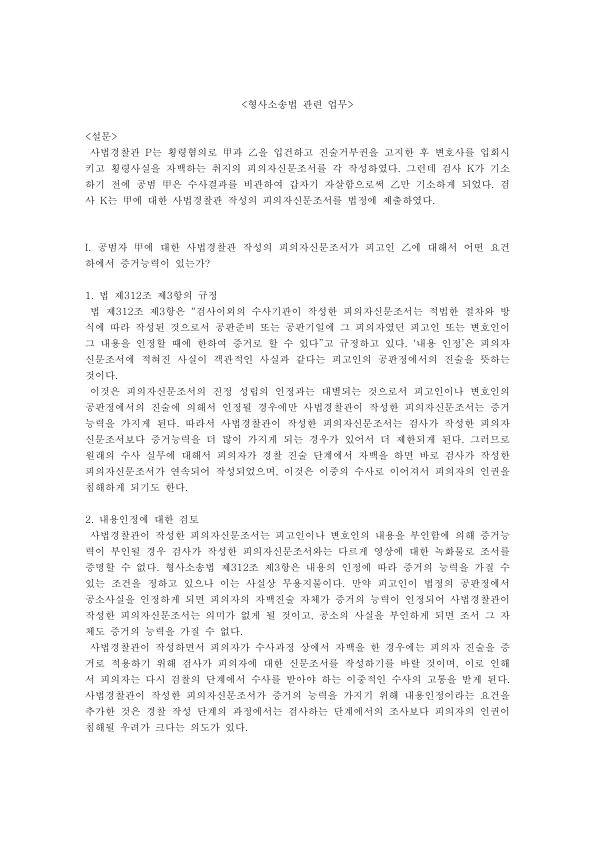
A Korean criminal procedure case answer. When one embezzlement accomplice dies and only the other is indicted, can the police interrogation record of the deceased be used? The paper analyses Article 312(3) and the requirement that the defendant admit its contents, whether Article 314 (necessity and special reliability) can apply, and how the answer would differ if a prosecutor had prepared the record.
■ Admissibility of a Deceased Accomplice's Police Interrogation Record in Korea: Articles 312 and 314 of the Criminal Procedure Act — Excerpt from the original document (English translation)
Article 314 applies to Article 312(3): where a person whose statement is required at a preparatory hearing or trial date cannot make a statement due to death, illness, residence abroad or other reasons, the statement or document may be admitted as evidence only if the statement or preparation was made under particularly reliable circumstances. Since Gap has died, necessity is recognized, and Article 314 can be applied to the suspect interrogation record of Gap prepared by a judicial police officer.
III. If the suspect interrogation record of the accomplice Gap had been prepared by a prosecutor, under what requirements would it be admissible against the defendant Eul?
Article 312(1) provides that "a record prepared by a prosecutor containing the statement of a suspect who has become a defendant may be admitted as evidence only where it is recognized, by the defendant's statement at a preparatory hearing or trial date, that it was prepared according to lawful procedures and methods and is recorded identically to what the defendant stated, and it is proven that the statement recorded in the record was made under particularly reliable circumstances," and Article 312(2) provides that "notwithstanding paragraph (1), where the defendant denies the authenticity of the record, it may be admitted as evidence only where it is proven by video recordings or other objective methods that the statement recorded in the record is recorded identically to what the defendant stated, and it is proven that the statement recorded in the record was made under particularly reliable circumstances."
This is a statutory provision that admissibility is recognized where certain requirements set in Article 312(1) are satisfied. The requirements here are formal authenticity, substantive authenticity, and the state of special guarantee of credibility, and Articles 312(3) and (4), among others, also require the same. Notwithstanding these requirements, under Article 312(2), if the defendant denies the evidence in court, there are conditions such that admissibility is recognized only where it is proven using video recordings and a state of special guarantee of credibility is recognized.
The admissibility of suspect interrogation records is the issue that appears most often in case-type questions on criminal procedure, so organizing the relationship between Articles 312 and 314 question by question lets you quickly build the skeleton of an answer. If you also note the amendment to Article 312(1) that took effect in 2022 and the case law's position on accomplices' records, you can develop it into a higher-level answer that reviews the soundness of the conclusion by comparing before and after the amendment. The part dividing the specific cases in which the necessity requirement is recognized into unknown whereabouts, residence abroad, failure to respond to summons and so on is also good for organizing in connection with case examples.
■ Admissibility of a Deceased Accomplice's Police Interrogation Record in Korea: Articles 312 and 314 of the Criminal Procedure Act — Contents and key concepts
Admissibility of a Deceased Accomplice's Police Interrogation Record in Korea
✦ At a glance
- Can a dead accomplice's police record be used against the other?
- Structure: facts → police record → Article 314 → prosecutor's record
- Useful for evidence law problem answers
☰ What the paper covers
- Article 312(3) and admission of contents
- Death of the declarant and Article 314
- Records prepared by prosecutors
- Effect of the 2022 amendment
✎ Background in brief
Since 2022, records prepared by prosecutors also require the defendant to admit their contents, narrowing the gap with police records.
Courts hold that a co-defendant's police record cannot be rescued by Article 314 when the defendant denies its contents.
Note: the paper itself is written in Korean and discusses Korean law. This page is general study information, not legal advice.
Related wiki: Criminal Complaint Process
Take a break with a quick personality test?
Ranked by actual participation. Results in about a minute.
Loading…
Most-read content
Loading view counts…

Campusdown is a lifelong-learning community in Korea offering study materials, information on government support, student loans and scholarships, and more. Don't miss our free resources.
Go to the Campusdown home page →Refund policy
- Change of mind / refund requested after partial use / more than 7 days after purchase
◆ Exceptions
- File errors / cannot download or open the file
◆ How to request a refund: send a 1:1 inquiry via Customer Service at the top