
Page 1 is shown as is; from page 2 on, the preview is blurred. Buy it to download the complete original file right away (the file itself is written in Korean).
Packed with real examples and experience. Download it now and save time.
Save your valuable time
Buyer ratings
Fast, accurate and useful.
No ratings yet. Be the first to rate it.


Abortion Law and Ethics in Korea: The Criminal Act and Maternal and Child Health Act, the 2019 Ruling, Pro-Life and Pro-Choice Views and Thomson's Violinist
※ You can preview page 1 as is. Buy it to download the complete original file right away. The file itself is written in Korean.
■ Abortion Law and Ethics in Korea: The Criminal Act and Maternal and Child Health Act, the 2019 Ruling, Pro-Life and Pro-Choice Views and Thomson's Violinist — Overview
A 13-page Korean bioethics paper on abortion. It sets out the former Criminal Act provisions and the exceptions in the Mother and Child Health Act, explains the Constitutional Court's 2019 decision of nonconformity, and compares pro-life, pro-choice, utilitarian, personalist, bioethical and feminist views, including a step-by-step reconstruction of Judith Thomson's violinist argument.
■ Abortion Law and Ethics in Korea: The Criminal Act and Maternal and Child Health Act, the 2019 Ruling, Pro-Life and Pro-Choice Views and Thomson's Violinist — Excerpt from the original document (English translation)
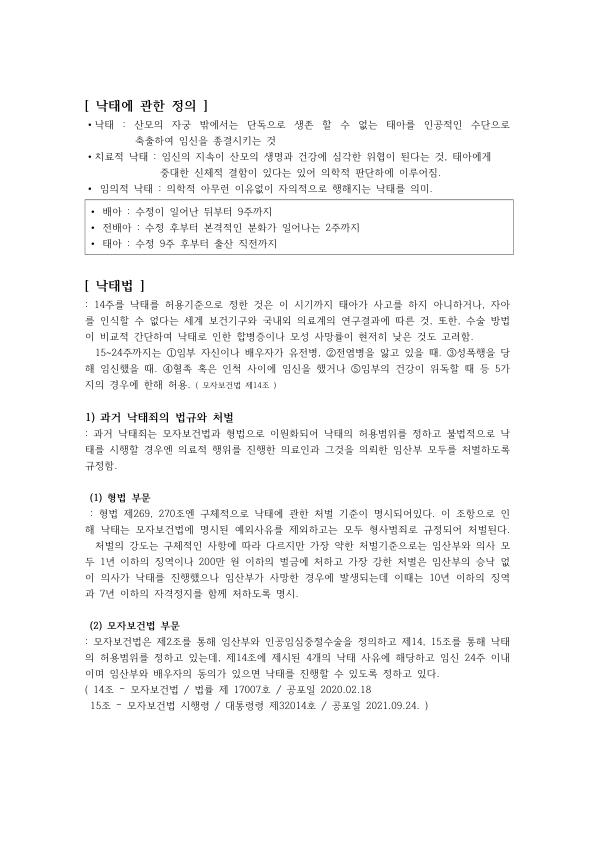
Abortion: ending a pregnancy by artificially removing a fetus that cannot survive on its own outside the mother's womb.
Therapeutic abortion: carried out on medical judgment where continuing the pregnancy seriously threatens the mother's life or health, or the fetus has
a serious physical defect.
Elective abortion: an abortion performed at will without any medical reason.
: Setting 14 weeks as the threshold for allowing abortion follows research by the World Health Organization and medical communities at home and abroad finding that the fetus does not think or recognize itself until then, and also reflects that the procedure is relatively simple, so complications and maternal mortality are markedly low.
From 15 to 24 weeks, abortion is allowed only in five cases: (1) the pregnant woman or her spouse has a hereditary disease, (2) an infectious disease, (3) the pregnancy results from rape, (4) the pregnancy is between blood relatives or in-laws, or (5) the pregnant woman's health is in serious danger. (Mother and Child Health Act Article 14)
: The former abortion crime set the permitted scope of abortion through two laws, the Mother and Child Health Act and the Criminal Act, and punished both the medical professional who performed an unlawful abortion and the pregnant woman who requested it.
: Articles 269 and 270 of the Criminal Act set out specific penalties for abortion. Under these provisions, every abortion except the exceptions in the Mother and Child Health Act was defined as a crime and punished. The severity depended on the circumstances: the lightest penalty was imprisonment of up to one year or a fine of up to 2 million won for both the pregnant woman and the doctor, and the heaviest applied where a doctor performed an abortion without the woman's consent and she died, with imprisonment of up to 10 years together with suspension of qualifications for up to 7 years.
: The Mother and Child Health Act defines a pregnant woman and induced abortion surgery in Article 2 and sets the permitted scope of abortion in Articles 14 and 15, allowing abortion where one of the four grounds in Article 14 applies, the pregnancy is within 24 weeks, and the pregnant woman and her spouse consent.
Article 15 - Enforcement Decree of the Mother and Child Health Act / Presidential Decree No. 32014 / promulgated 2021.09.24. )
Article 14 (Limits on Permitted Induced Abortion Surgery) (1) A doctor may perform induced abortion surgery with the consent of the woman and her spouse (including a de facto spouse; the same applies below) only in any of the following cases:
1. The woman or her spouse has a eugenic or genetic mental disability or physical disease prescribed by Presidential Decree;
5. Continuing the pregnancy seriously harms or is likely to seriously harm the mother's health for health or medical reasons.
(2) In the case of paragraph (1), if the spouse's consent cannot be obtained because of death, disappearance, unknown whereabouts or other unavoidable reasons, the surgery may be performed with the woman's consent alone.
(3) In the case of paragraph (1), if the woman or her spouse cannot express intent because of mental disability, the consent of the person with parental authority or the guardian, or if there is none, the consent of the person obliged to support them, may substitute for it.
: On April 11, 2019, the Constitutional Court ruled the abortion crime nonconforming to the Constitution (2017Hun-Ba127), on two main grounds.
First, it found that Article 269 of the Criminal Act, which makes abortion a crime and sets its punishment, restricted the pregnant woman's right to self-determination in violation of the principle of least restriction. Second, by punishing even women who decide on abortion for social and economic reasons, it heavily restricted their self-determination while contributing relatively little to the public interest in protecting fetal life, so the balance of interests was not met.
Note: In case 2017Hun-Ba127 on April 11, 2019, the Constitutional Court held Article 269(1) of the Criminal Act and the part of Article 270(1) concerning doctors nonconforming to the Constitution and ordered the legislature to amend them by December 31, 2020. Because the National Assembly did not amend them by the deadline, the provisions lost effect on January 1, 2021. As of October 2026, no replacement legislation amending the Criminal Act or the Mother and Child Health Act has been passed, and bills including amendments to the Mother and Child Health Act are pending. The '14 weeks' threshold at the start of the paper comes from the government's 2020 amendment bill, which did not pass the National Assembly.
■ Abortion Law and Ethics in Korea: The Criminal Act and Maternal and Child Health Act, the 2019 Ruling, Pro-Life and Pro-Choice Views and Thomson's Violinist — Contents and key concepts
Where should the law draw the line between life and choice?
✦ At a glance
- Korean abortion law and the ethical debate in one paper
- Structure: concepts → statutes → 2019 ruling → ethical views → opinion
- Useful for bioethics, constitutional law and criminal law courses
☰ What the paper covers
- Criminal Act provisions
- Statutory exceptions
- The 2019 ruling
- Thomson's violinist
- Singer's view
✎ Abortion law in Korea and the U.S.
Korea's abortion crime lost effect on January 1, 2021 after the 2019 ruling, but no replacement law had been passed as of October 2026.
In the U.S., Roe v. Wade (1973) recognized a constitutional right to abortion, and Dobbs v. Jackson (2022) overruled it and returned the issue to the states.
Note: the paper itself is written in Korean and discusses Korean law. This page is general study information, not legal advice.
Related wiki: Roe v. Wade and Dobbs: 50 Years of Abortion Law in the U.S., The Right to Privacy
Take a break with a quick personality test?
Ranked by actual participation. Results in about a minute.
Loading…
Most-read content
Loading view counts…

Campusdown is a lifelong-learning community in Korea offering study materials, information on government support, student loans and scholarships, and more. Don't miss our free resources.
Go to the Campusdown home page →Refund policy
- Change of mind / refund requested after partial use / more than 7 days after purchase
◆ Exceptions
- File errors / cannot download or open the file
◆ How to request a refund: send a 1:1 inquiry via Customer Service at the top