
Page 1 is shown as is; from page 2 on, the preview is blurred. Buy it to download the complete original file right away (the file itself is written in Korean).
Packed with real examples and experience. Download it now and save time.
Save your valuable time
Buyer ratings
Fast, accurate and useful.
No ratings yet. Be the first to rate it.


Abortion and the Right to Health after Korea's 2019 Constitutional Ruling: Decriminalization, Ethics, Foreign Laws and Nursing Care
※ You can preview page 1 as is. Buy it to download the complete original file right away. The file itself is written in Korean.
■ Abortion and the Right to Health after Korea's 2019 Constitutional Ruling: Decriminalization, Ethics, Foreign Laws and Nursing Care — Overview
A 10-page Korean health and nursing paper on abortion after the Constitutional Court's April 2019 ruling that the abortion ban was incompatible with the Constitution. It traces Korea's dual regulation under the Criminal Act and the Mother and Child Health Act, the legislative gap since 2021, ethical arguments on both sides, international legal models and health systems, and nursing strategies.
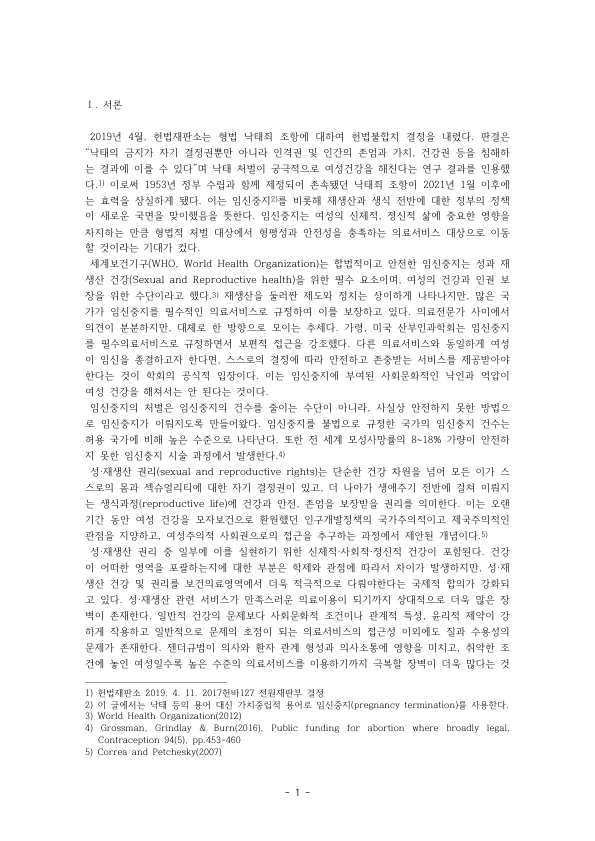
■ Abortion and the Right to Health after Korea's 2019 Constitutional Ruling: Decriminalization, Ethics, Foreign Laws and Nursing Care — Excerpt from the original document (English translation)
Until now, abortion in Korea was illegal under the Criminal Act. Article 259 of the Criminal Act enacted in 1953 provided that a woman who procures her own miscarriage by drugs or other means shall be punished by up to one year in prison or a fine of up to two million won, and Article 270 provided that a doctor, herbal doctor, midwife, pharmacist or druggist who procures a miscarriage at a woman's request or with her consent shall be punished by up to two years in prison. In principle, therefore, any abortion was punishable. In practice, however, abortion in Korea was not strictly restricted equally at all times. When family planning became national policy in the 1960s, it was impossible to stop abortion entirely and a legal basis was needed, so the Mother and Child Health Act was enacted in 1973. Article 14 of that Act, on the permitted limits of induced abortion, allows it for rape, incest, serious threats to health and eugenic reasons, and Article 28 exempted such cases from the Criminal Act. For about fifty years, then, abortion law in Korea was split between the Mother and Child Health Act and the Criminal Act. Formally this could be seen as partial legalization, but more than 80 percent of abortions actually performed in Korea were reported to be illegal.
Yet very few cases were ever prosecuted for abortion, and some said the crime had become a dead letter. In 2005 Korea's total fertility rate was 1.08, among the lowest in the world. A discourse of low-fertility crisis emerged, and various policies to raise the number of births were created along with the Framework Act on Low Birth Rate in an Aging Society. Against this demographic background, the government in 2005 adopted a comprehensive plan to prevent illegal abortion in order to raise the birth rate. In 2009 a pro-life doctors' group filed complaints against clinics performing illegal abortions, which severely limited access and led more women to pay high prices for unsafe abortions. In 2016 an amendment to the rules on administrative sanctions in medicine was announced that would classify abortion as unethical medical conduct and strengthen penalties for doctors, including twelve-month suspensions. This in the end discouraged providers of abortion services.
Two constitutional complaints were filed against the abortion crime. The Court upheld it in 2012 and found it nonconforming to the Constitution in 2019. Many factors were involved in the change, but the most important was that the debate moved away from framing abortion as a clash between self-determination and the right to life. In 2012 the Court saw abortion as a conflict between the woman's right to self-determination and the fetus's right to life, so it handled the issue by banning abortion to protect the fetus's life while protecting the woman's self-determination through exceptions. In 2019, however, the Court recognized that framing the issue as a clash of abstract legal interests could not deal with the complex realities of abortion and could protect neither the pregnant woman's self-determination nor the fetus's life.
This shift is linked to the rise of abortion discourse in the reproductive rights movement of civil society after 2016. A central claim of that movement was that abortion, like other areas of medicine, should be discussed not as legal or illegal but as safe or unsafe, and that regulation and restriction only increase unsafe abortion by preventing abortion early in pregnancy.
As a result, following the 2019 ruling of constitutional nonconformity, the abortion provisions of the Criminal Act lost their effect.
Note: On April 11, 2019, the Constitutional Court held the provisions punishing self-induced abortion and abortion by doctors nonconforming to the Constitution, with four justices for nonconformity, three for simple unconstitutionality and two finding them constitutional, and ordered revision by December 31, 2020 (2017Hun-Ba127); no revision was made, so they lost effect on January 1, 2021. In 2012 the Court had upheld the ban on a 4-4 vote. The Criminal Act was enacted on September 18, 1953, while the government was founded in 1948, and the paper's 'Article 259' is a mistake for Article 269. In a 2024 case involving an abortion at 36 weeks, the doctors were convicted of murder, upheld on appeal in July 2026, while the woman was acquitted on appeal.
■ Abortion and the Right to Health after Korea's 2019 Constitutional Ruling: Decriminalization, Ethics, Foreign Laws and Nursing Care — Contents and key concepts
Punishment is gone; is health care ready?
✦ At a glance
- What changed and what did not after Korea's abortion ruling
- Structure: legal change → ethics → foreign laws → health systems → nursing
- Useful for nursing, health policy and bioethics courses
☰ What the paper covers
- Dual regulation
- From 2012 to 2019
- The legislative gap
- Ethical debate
- Health systems and nursing
✎ Abortion law in Korea and the U.S.
Korea's abortion ban lost effect on January 1, 2021 after the 2019 ruling, but the legislature has not yet passed replacement rules.
In the U.S., the Supreme Court's 2022 Dobbs decision overturned Roe v. Wade and returned abortion regulation to the states.
Note: the paper itself is written in Korean and discusses Korean law. This page is general study information, not legal advice.
Related wiki: Roe v. Wade and Dobbs, The Right to Privacy
■ Abortion and the Right to Health after Korea's 2019 Constitutional Ruling: Decriminalization, Ethics, Foreign Laws and Nursing Care References
- World Health Organization(2012) Grossman, Grindlay & Burn(2016), Public funding for abortion where broadly legal, Contraception 94(5), pp.453-460 Correa and Petchesky(2007), Reproductive and sexual rights: A feminist perspective, Culture, Society and Sexuality, pp.1-19 김새롬(2021), 포괄적 성·재생산 건강보장을 위한 보건의료체계의 과제: 임신중지를 중심으로, 여성연구 109(2), pp.5-36 김선혜(2020), 모성의 의무에서 재생산 권리로: 모자보건법의 비판적 검투 및 개정방향 모색, 이화젠더법학 12(2), pp.1-44 김선혜 외(2022), 임신중지와 건강권: 아르헨티나, 아일랜드의 임신중지 보건의로체계 구축과정과 시사점, 여성연구 115(4), pp.5-36 변수정(2022), 인공임신중절 실태조사, 보건복지부 한국보건사회연구원 이소영 외(2018), 인공임신중절 실태조사, 보건복지부 한국보건사회연구원 최현정(2016), 낙태죄의 문제점 및 개선방향, 이화젠더법학 8(3), pp.225-258 하정옥(2017), 낙태에 대한 형사처벌의 시대착오: 건강권-사회권-인권 실천의 국제적 합의를 중심으로, 의료와사회 제8호, pp.74-75
Take a break with a quick personality test?
Ranked by actual participation. Results in about a minute.
Loading…
Most-read content
Loading view counts…

Campusdown is a lifelong-learning community in Korea offering study materials, information on government support, student loans and scholarships, and more. Don't miss our free resources.
Go to the Campusdown home page →Refund policy
- Change of mind / refund requested after partial use / more than 7 days after purchase
◆ Exceptions
- File errors / cannot download or open the file
◆ How to request a refund: send a 1:1 inquiry via Customer Service at the top