
Why Do Trade Unions Exist? From the Webbs to Perlman, Union Theory and the Rights to Organise, Bargain and Strike
- A trade union is a lasting association of wage earners formed to protect and improve their working conditions.
- The Webbs named three union methods: mutual insurance, collective bargaining and legal enactment, while Perlman argued that workers care most about guarding sca
- Most democracies protect three linked freedoms: to organise, to bargain collectively and to take industrial action.
Contents
A trade union is a lasting association of employees who join forces so that pay, hours and safety are negotiated by a group rather than by one worker standing alone in front of the boss. This guide follows how unions began, how the classic theorists explained their purpose, what the law protects in the UK and the US, and how bargaining actually works, with a nod to the Korean text that inspired it.
Picture a farm labourer in 1830s Dorset asking his employer for more than seven shillings a week. On his own, he can simply be replaced. With every labourer in the village behind him, the conversation changes. That shift from one voice to many is the whole idea.
How did trade unions begin?
As factory work spread during the Industrial Revolution, people who had left the land became wage earners facing long hours, low pay and dangerous machines. They formed friendly societies and trade clubs to help one another, but the law treated them as conspirators. Britain's Combination Acts of 1799 and 1800 banned workers from combining, and although they were repealed in 1824, organising stayed risky.
Student money tip from CampusDown Repair UpRenters insurance water claim denied? What to do next — get the reason in writing, match it to your policy wording, gather proof and ask for a review.
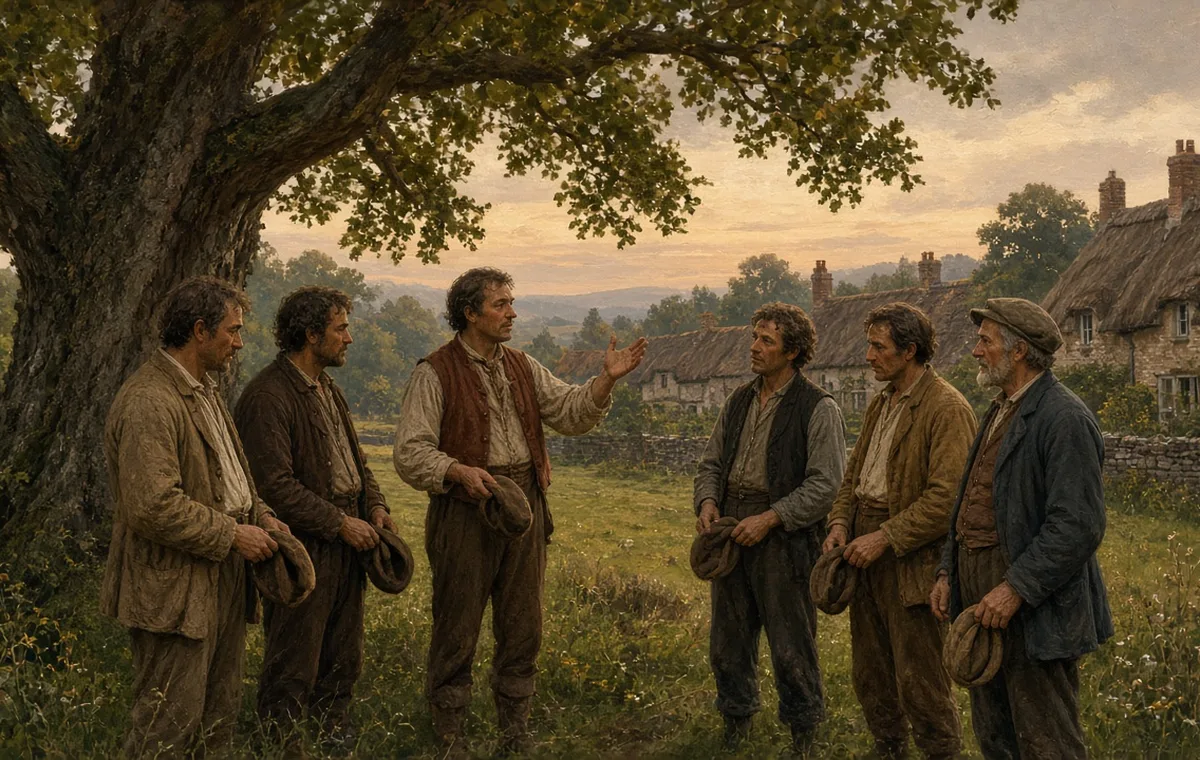
The best-known case is the Tolpuddle Martyrs. In 1834, six Dorset farm labourers who had formed a society to resist wage cuts were sentenced to transportation to Australia for swearing a secret oath. Mass protests followed, and they were pardoned in 1836. The Trade Union Act 1871 finally gave unions legal standing in Britain, so the story of unions is also the story of labour rights moving into law.

How did the Webbs explain trade unions?
Sidney and Beatrice Webb, founders of the London School of Economics, defined a union in The History of Trade Unionism (1894) as "a continuous association of wage-earners for the purpose of maintaining or improving the conditions of their working lives". In Industrial Democracy (1897) they described three methods:
- Mutual insurance: members pay into a common fund that supports anyone who is sick, injured or out of work.
- Collective bargaining: the union negotiates pay and conditions with the employer on behalf of everyone.
- Legal enactment: the union campaigns for laws that fix minimum standards, such as limits on working hours.
For the Webbs, unions were a way of bringing democracy into the economy, giving workers a say in rules that shaped their daily lives.
Skimming the section headings first makes a long guide much easier to map out. Try writing down one question of your own as you read.
How did other theorists see unions?
Marxist writers saw unions as schools of class consciousness. Wage bargaining was only the starting point; the real purpose was to build the strength of the working class to change the structure of society.
The American economist Selig Perlman disagreed. In A Theory of the Labor Movement (1928), drawing on the experience of the American Federation of Labor, he argued that manual workers feel a scarcity of opportunity and want above all to control and share out the jobs available. His job consciousness theory explains why many unions focus on seniority rules and job protection rather than revolution.
| View | Main purpose | Key text |
|---|---|---|
| The Webbs | Improve working conditions through insurance, bargaining and law | Industrial Democracy (1897) |
| Marxist | Raise class consciousness and change society | Marx and Engels' writings |
| Perlman | Protect and ration a limited number of jobs | A Theory of the Labor Movement (1928) |
How do unions fit into the labour market?
Peter Doeringer and Michael Piore's dual labour market theory splits jobs into a primary sector of stable, well-paid posts and a secondary sector of insecure, low-paid work. Unions have traditionally been strongest in the primary sector. The wiki entry on dual labour market theory explains the model in more detail.
That pattern creates today's big challenge: how to represent agency staff, zero-hours workers and app-based couriers who sit outside traditional unions. In Uber BV v Aslam (2021), the UK Supreme Court held that Uber drivers were workers entitled to the minimum wage and holiday pay, in a case backed by the GMB union.

For more on how app-based jobs are organised, see the wiki page on platform work.
What does the law protect?
The Korean text behind this guide starts from Article 33 of Korea's Constitution, which guarantees the right to organise, to bargain collectively and to take collective action. English-speaking countries protect the same three freedoms, mostly through ordinary legislation:
- United States: the National Labor Relations Act 1935, often called the Wagner Act, protects private-sector employees' rights to organise and bargain, and lists unfair labor practices that the National Labor Relations Board can remedy.
- United Kingdom: the Trade Union and Labour Relations (Consolidation) Act 1992 sets the rules on recognition, collective agreements and industrial action, which must be backed by a ballot of members.
- International: ILO Conventions No. 87 (1948) on freedom of association and No. 98 (1949) on the right to organise and bargain set the global benchmark. The UK has ratified both; the US has ratified neither.
Membership has fallen a long way from its post-war peak. US Bureau of Labor Statistics data put the union membership rate at 9.9% of wage and salary workers in 2024, while UK government figures show 22.4% of employees in a union in 2023.
Unions are also classified by how they organise: craft unions for one trade, industrial unions for one sector, general unions open to anyone, and enterprise unions inside a single company, the dominant form in Korea and Japan.
What changes when you join a union?
The first thing members notice is that they no longer have to raise problems alone. A union can bargain for everyone, help with grievances and disciplinary hearings, and support members after an accident or bullying at work. The result of bargaining is a collective agreement, and in many systems terms in individual contracts cannot fall below it.
If you are thinking of joining, a few questions are worth asking:
- Is the union recognised by your employer for bargaining?
- How much are the subscriptions, and how are they paid?
- What does the current collective agreement cover?
- Who is the workplace rep you can talk to?
The key idea to learn is the unfair labour practice: firing or disadvantaging someone for union membership, making non-membership a condition of a job, or refusing to bargain in good faith.
How does collective bargaining work?

Bargaining usually starts when the union submits a claim. Both sides meet over several rounds to discuss pay, benefits and working patterns. If they agree, they sign a collective agreement. If they cannot, conciliation services such as Acas in the UK or the Federal Mediation and Conciliation Service in the US may help. Strikes come at the very end of this long process, which makes news reports much easier to read once you know the steps.
Two points are often misunderstood. Workers on strike are not paid for the days they do not work, and lawful industrial action is protected, so employers cannot simply dismiss strikers for taking part.
| Term | Meaning |
|---|---|
| Collective bargaining | Negotiation between a union and an employer over terms and conditions |
| Collective agreement | The written result of bargaining |
| Trade dispute | A disagreement about terms and conditions that may lead to action |
| Industrial action | Strikes or action short of a strike, such as an overtime ban |
How should you write it up?
When comparing theories, write one line on what each thinker saw as the purpose of unions and put it in the first column of your table. Then add one practical step, such as how a worker would challenge unpaid wages or unfair dismissal, so the theory connects to real life. CampusDown's social policy and labour economics notes include worked comparisons if you want to check your structure.
Student money tip on CampusDown Repair Up: Renters insurance water claim denied? What to do next.
Reviewed by the CampusDown editorial team, November 2026. References: Webb, S. & Webb, B. (1897). Industrial Democracy; Perlman, S. (1928). A Theory of the Labor Movement; Doeringer, P. & Piore, M. (1971). Internal Labor Markets and Manpower Analysis; National Labor Relations Act (1935); Constitution of the Republic of Korea, Article 33.
FAQ
What are the three methods of trade unionism according to the Webbs?
Mutual insurance, collective bargaining and legal enactment, set out in Sidney and Beatrice Webb's Industrial Democracy (1897).
What is Perlman's theory called?
The theory of job consciousness. In A Theory of the Labor Movement (1928), Selig Perlman argued that manual workers mainly want to control and share out a limited supply of jobs rather than overthrow capitalism.
Which US law protects the right to join a union?
The National Labor Relations Act of 1935. Its Section 7 protects private-sector employees' rights to organise, bargain collectively and take part in concerted activity, and the National Labor Relations Board enforces it.
Can an employer sack someone for joining a union?
Not lawfully in the UK or the US. Dismissing or penalising a worker for union membership or activity is treated as an unfair labour practice in the US and as automatically unfair dismissal in the UK.