
Why Was Peking Duck Born in Beijing? Comparing Beijing, Shanghai, Sichuan and Cantonese Cuisine
- Beijing cuisine grew from a cold climate, wheat-based pancakes and buns, and centuries of imperial court cooking.
- Shanghai cooking is sweet and rich with soy sauce and sugar, while Sichuan food combines chilli and numbing Sichuan peppercorn.
- Cantonese cuisine prizes fresh, varied ingredients and shaped most Chinatowns in Britain and America.
Contents
Peking duck took root in Beijing because the city combined a cold northern climate, a wheat-based diet of pancakes and buns, and centuries as the imperial capital with refined court cooking. Comparing the "four great cuisines" often taught abroad, Beijing, Shanghai, Sichuan and Cantonese, shows the same pattern everywhere: climate, rivers, coastline and history decide what ends up on the plate. Crisp duck skin, spring onion and sweet bean sauce folded into a paper-thin pancake: why did this dish settle in Beijing of all places? This guide, adapted from a Korean Chinese culture assignment, compares the four styles in one framework and adds how they reached British and American tables.
What does food mean in Chinese culture?
The Chinese phrase for the basics of life is 衣食住行, "clothing, food, shelter and transport", but another saying shows where food really sits: 民以食为天, "for the people, food is heaven". Food is placed close to the centre of everyday life and social relationships.
Student money tip from CampusDown Repair UpActual cash value vs replacement cost: what a renters policy really pays — how each values your belongings, what to check in your policy and which receipts to keep.
China is vast, so ingredients, techniques and seasonings vary enormously, and even a small restaurant's menu can run to the length of a slim book. Grouping that variety into a few regional styles is a way of making it manageable.
One correction is worth making at the start. The Korean source, like many guides in Korea and Japan, uses Beijing, Shanghai, Sichuan and Cantonese as the "four great cuisines". In China itself, the classic four are usually Shandong, Sichuan, Cantonese and Huaiyang (Jiangsu), expanded to the "eight great cuisines" by adding Fujian, Zhejiang, Hunan and Anhui. Both groupings are useful, but an essay should say which one it is using.

Beijing cuisine: imperial dining and wheat
Beijing cuisine, also called jingcai, represents the region north of the Yellow River. It absorbed Shandong cooking, rich in seafood, along with techniques from northern peoples, and developed hearty dishes for a cold climate. As the capital for most of the last 700 years, Beijing gathered elaborate court-style dishes, and because the north grows wheat rather than rice, dumplings, noodles and pancakes are everywhere.
- Peking roast duck: slices of lacquered duck wrapped in thin pancakes with spring onion, cucumber and sauce
- Hotpot: thin slices of meat dipped briefly in boiling broth, a Beijing winter favourite in copper pots
The source says roast duck has "over 1,000 years" of history. That is generous: Beijing-style roast duck is usually traced to the imperial kitchens of the Yuan and Ming dynasties, several centuries ago, and famous duck restaurants in the city date from the Ming and Qing eras. The broader point stands, though: pancake culture and palace cooking together explain why the dish flourished in Beijing.
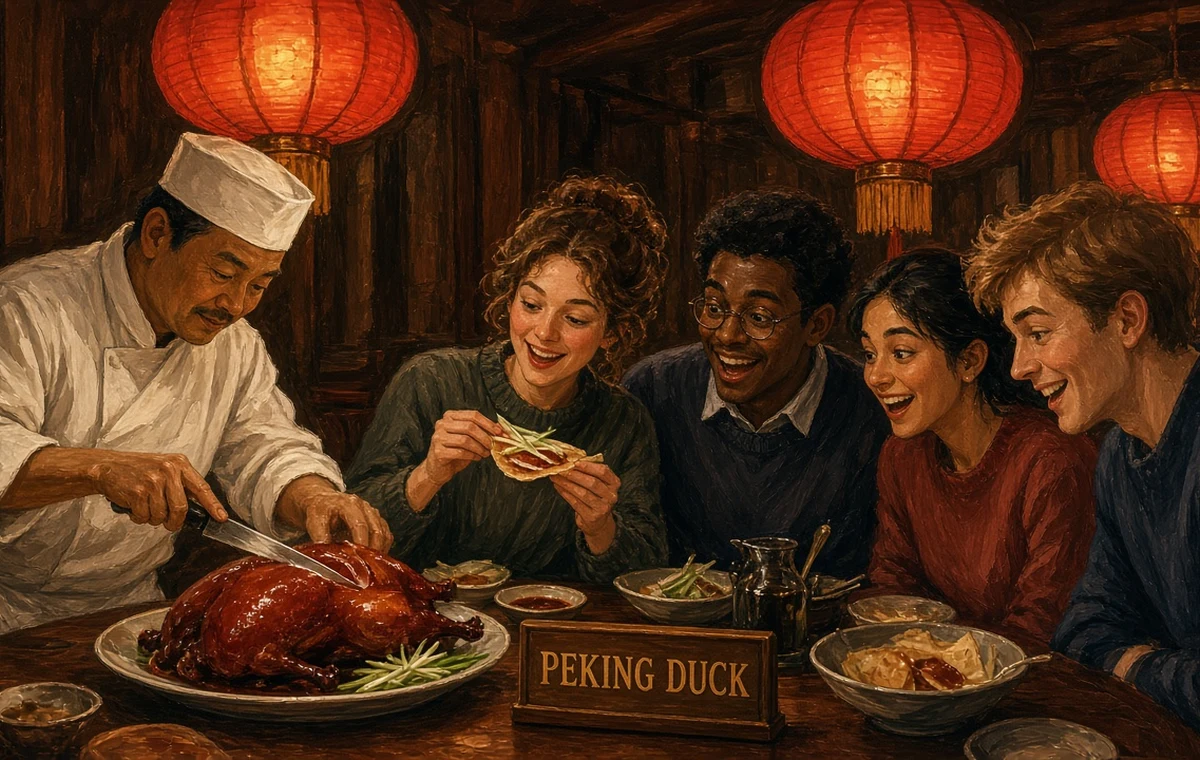
In Britain and America, Peking duck is often the centrepiece of a celebration meal, and many restaurants ask diners to order it in advance because the roasting takes so long.
Skimming the section headings first makes a long guide much easier to map out. Try writing down one question of your own as you read.
Shanghai cuisine: sweet, rich and portside
Shanghai sits near the mouth of the Yangtze, a port linking the sea and the interior, so seafood and freshwater fish feature heavily, and Western cooking left traces too. Generous use of soy sauce and sugar gives dishes a dark colour and a sweet, rich taste, described in Chinese as "thick oil and red sauce". How foreign techniques mixed in can be explained with ideas from globalisation and cultural diffusion.
- Braised sea cucumber with shrimp roe
- "Concubine chicken": chicken cooked with wine
- Diced fish with pine nuts
- Hairy crab: best from autumn into early winter
A mild climate and plentiful seafood shaped both the ingredients and the flavour of Shanghai cooking. Many visitors to the UK know Shanghai food mainly through soup dumplings, which have become a fixture of London's dumpling bars.
How do Sichuan and Cantonese cuisine differ?
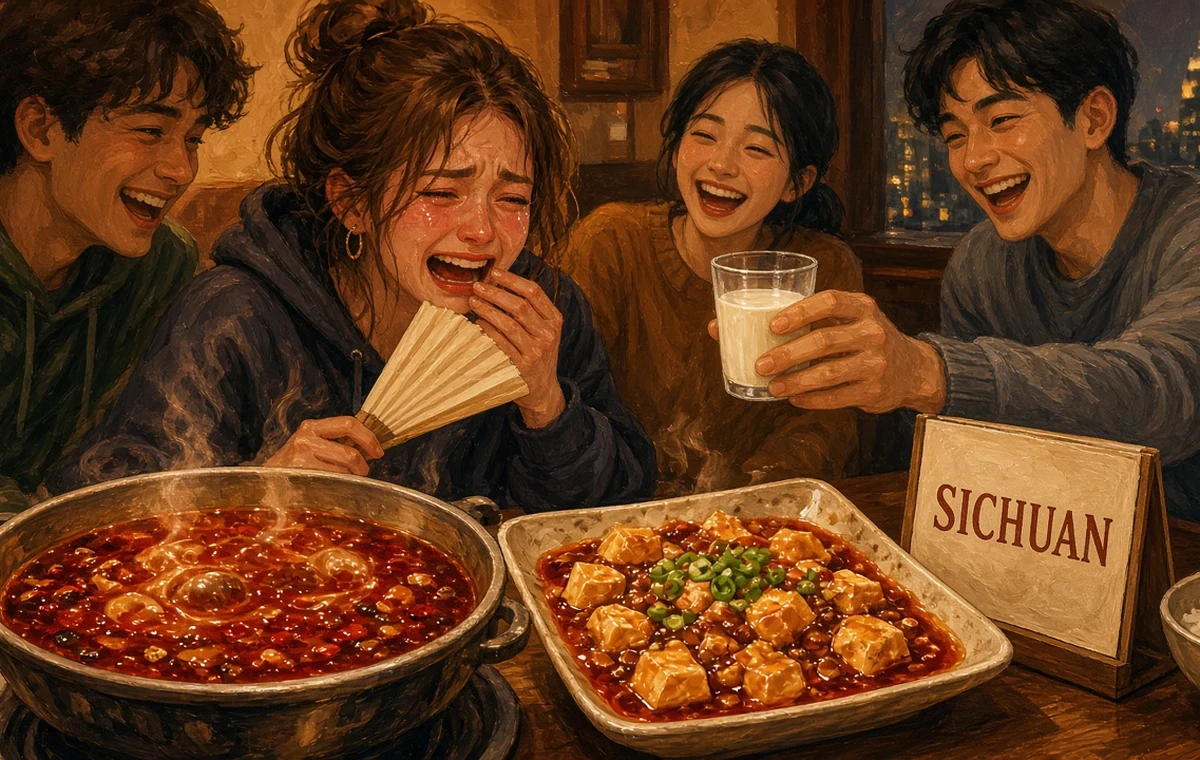
Sichuan cuisine, or chuancai, comes from the upper and middle Yangtze, around Chengdu, Zigong and Chongqing. It is famous for heat and runs to hundreds of dishes. The source lists chilli, pepper and ginger; the key "pepper" is actually Sichuan peppercorn, which is not related to black pepper and creates a tingling, numbing sensation. Together with chilli, which reached China from the Americas only a few centuries ago, it produces the signature mala, "numbing and hot".
Cantonese cuisine represents the south. It uses an exceptionally wide range of ingredients and prizes freshness, with light steaming, roast meats and the dim sum of morning tea. For English speakers this is the most familiar style, because emigration from Guangdong and Hong Kong shaped Chinatowns in London, Manchester, San Francisco and New York, and many British takeaway dishes grew out of Cantonese cooking.
| Dish | Origin | Note |
|---|---|---|
| Dim sum | Cantonese morning tea | Brought by Cantonese and Hong Kong migrants |
| Kung pao chicken | Sichuan | Western versions are often sweeter and less numbing |
| General Tso's chicken | Hunan-style dish developed in Taiwan | Became famous in the US in the 1970s |
| Chop suey | Chinese American cooking | Developed in the US rather than in China |
All four regions share one thing: climate and geography set the direction of flavour. That link is the strongest central argument for an assignment.
The four cuisines at a glance
| Cuisine | Name and region | Environment | Flavour and signature dishes |
|---|---|---|---|
| Beijing | Jingcai, north of the Yellow River | Cold climate, wheat-growing | Dumplings, noodles, pancakes; Peking duck |
| Shanghai | Lower Yangtze | Mild, port city, seafood | Sweet and rich; concubine chicken |
| Sichuan | Chuancai, upper and middle Yangtze | Inland basin | Numbing heat from chilli and Sichuan peppercorn |
| Cantonese | South China | Subtropical, coastal, many ingredients | Fresh, light; dim sum and roast meats |
Student money tip on CampusDown Repair Up: Actual cash value vs replacement cost: what a renters policy really pays.
For a presentation, fill in geography and climate, history, signature dishes and flavour in the same order for each region, and the contrasts become obvious. Food is culture that carries a region's nature and history.
Compiled by the CampusDown editorial team from a Korean Chinese culture assignment, adapted with public information on China's traditional four and eight great cuisines, the history of Peking duck, Sichuan peppercorn and chilli, and the role of Cantonese migration in British and American Chinese food. Reference: Chang, K. C. (Ed.). (1977). Food in Chinese Culture: Anthropological and Historical Perspectives. Yale University Press. Reviewed November 2026.
FAQ
What are jingcai and chuancai?
Jingcai is Beijing cuisine and chuancai is Sichuan cuisine.
Why does Beijing cuisine have so many elaborate dishes?
Because Beijing served as China's capital for most of the last 700 years, gathering court-style cooking.
Why is Shanghai food dark and sweet?
It uses generous amounts of soy sauce and sugar, a style known as 'thick oil and red sauce'.
Are these the 'four great cuisines' in China?
In China the classic four are usually Shandong, Sichuan, Cantonese and Huaiyang; the Beijing-Shanghai-Sichuan-Cantonese set is common in Korea and Japan.
Why is Cantonese food so common in the UK and US?
Emigration from Guangdong and Hong Kong shaped the first Chinatowns and many takeaway menus.