
Why Does Play Therapy Work for Children? What Play Means, Who It Helps, the Playroom and the Myths TV Creates
- Children cannot yet put complex feelings into words, so play becomes their language in therapy.
- Play therapy helps children with emotional, language, social and attention difficulties, tailored to each child.
- Real change usually builds slowly over many sessions with parents involved, unlike the quick fixes shown on TV.
Contents
Play therapy works because children cannot yet put complex feelings into words, so play becomes their language: in a safe playroom, a trained therapist watches how a child uses toys and responds in ways that help the child express, understand and manage those feelings. Can a child who is angry with a parent explain that feeling in words? Most cannot. Instead they throw a doll or make toy soldiers fight. This guide, adapted from a Korean child psychology study note, explains why play can be therapy, what play means for development, who play therapy is for, what is in a playroom, how sessions and parent work run in the US and UK, and the myths that TV shows create.
Why can play be therapy for children?
Adult psychotherapy explores the mind mostly through conversation, but children, because of their stage of development, have limited ability to describe their wishes, feelings and thoughts in words. Play takes over the role of language, and it is often compared with free association in adult psychoanalysis, where a person says whatever comes to mind.
Related on CampusDown Repair UpMy Floating Shelf Started Tilting and Pulling Out of the Wall — Floating shelf pulling out of drywall in your apartment?
For example, a child who cannot say that they feel hostile towards a new baby brother may act out the feeling with dolls, and the therapist can understand the child's inner world through that scene.
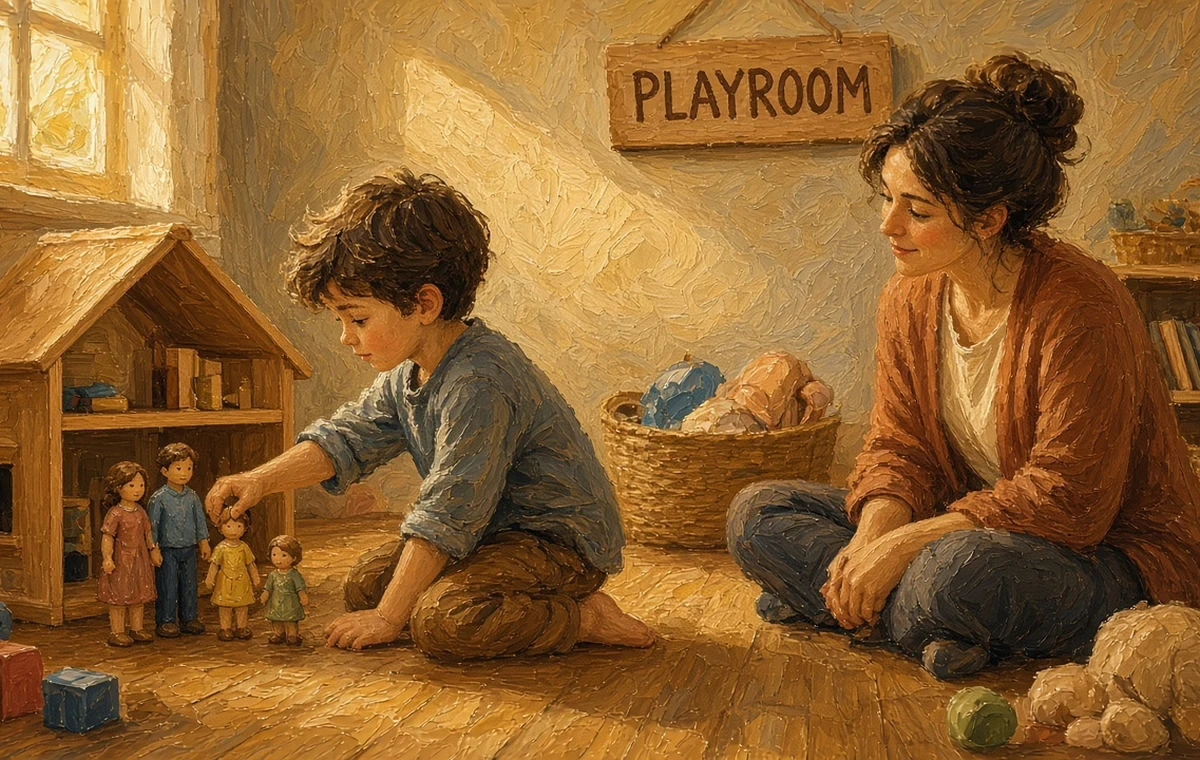
Play therapy has roots in the work of child analysts such as Anna Freud and Melanie Klein in the early twentieth century. Our overview of child development theories compares the psychoanalytic, learning and cognitive traditions that later shaped it. In 1947 Virginia Axline published Play Therapy, which set out a non directive, child centred approach, and Garry Landreth later developed child centred play therapy into a widely taught model.
The key idea is that the therapist follows the child's lead rather than directing the play, so the child experiences being accepted and understood without having to explain themselves.
That simple shift, from asking a child to talk to letting a child show, is what makes play therapy different from ordinary conversation with a worried adult.

What does play mean for development?
- Exploring new information and satisfying natural curiosity
- Gaining a sense of achievement and motivation to learn through taking part
- Strengthening learning by repeating play actions
- A safe outlet for tension, aggression and fear
Play is not just a way to pass the time; it has educational value and emotional healing power at the same time. The theories of play development, from Parten's stages of social play to Piaget's stages, show how play itself grows more complex as children develop.
That is why play therapists wait for the child to lead. Rather than giving the right answer, the adult respects the process of the child choosing and expressing things in their own way.
Skimming the section headings first makes a long guide much easier to map out. Try writing down one question of your own as you read.
Who is play therapy for?
Play therapy is mainly used with children who find it hard to adjust psychologically or emotionally, typically between about three and twelve years old. Common reasons include emotional difficulties such as anxiety or low mood, delays in language development, social difficulties that make it hard to get along with peers, attention deficit hyperactivity disorder (ADHD), and reactions to stressful events such as divorce, loss or trauma.
| Area | Examples |
|---|---|
| Emotions | Anxiety, sadness, anger outbursts |
| Development | Language delay, difficulty expressing needs |
| Social | Trouble making friends, withdrawal |
| Life events | Divorce, bereavement, moving, illness |
Stepping in early, before emotional difficulties harden into longer lasting problems, is one of the main benefits. Because the children are so varied, goals and session plans are tailored to each child.
What is in a playroom?
| Type of play | Examples |
|---|---|
| Role and symbolic play | Dolls, dollhouse furniture, toy animals |
| Construction play | Blocks |
| Expressive activities | Art materials, sand tray |
| Social play | Trucks, toy telephones, games |
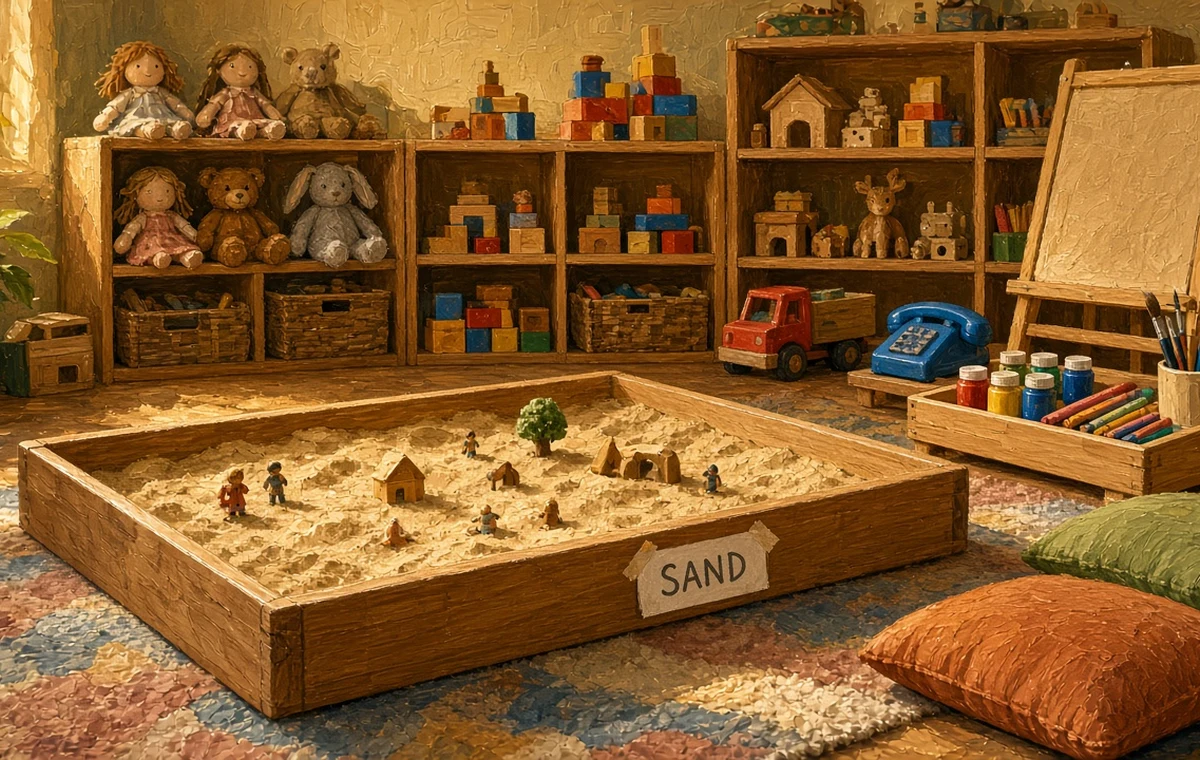
The wide range of toys is there so that children can choose and express things for themselves, and which toys a child picks and how they use them gives the therapist important clues. Toys that allow both caring and aggressive play, such as dolls and toy animals, help children show a full range of feelings safely.
A well chosen playroom is not about having the most toys but about having toys that invite expression rather than simply keeping a child busy.
How do sessions work and what do parents do?
Sessions are usually held weekly and last under an hour, after an initial meeting with parents to understand the child's history and concerns. The therapist meets the parents regularly to share progress in general terms while protecting the child's trust. In filial therapy, developed by Bernard and Louise Guerney in the 1960s, parents are trained to hold special play sessions with their own child at home.
| Country | Where to look | Tip |
|---|---|---|
| US | Association for Play Therapy directory, school counsellors, paediatricians | Ask about Registered Play Therapist (RPT) credentials and insurance coverage |
| UK | British Association of Play Therapists, school or GP referral, NHS child and adolescent mental health services | Check that the therapist is registered with a professional body |
A cooperative attitude from parents strongly affects whether a child keeps attending and how much they benefit. If you are worried about a child's safety, contact your local children's services, or call 911 in the US or 999 in the UK in an emergency.
What myths do TV shows create?
TV parenting programmes, in which experts diagnose a family's problems and the child seems transformed a few months later, have raised public trust in child therapy and changed the attitudes of some reluctant parents.
Also on CampusDown Repair Up: My Floating Shelf Started Tilting and Pulling Out of the Wall.
But broadcasts cut much of the middle of the process because of time limits and edit for drama. This makes it easy to see play therapy as quick and easy, when in reality it is a long process that the child, the therapist and the family work through together over many sessions.
In an assignment, introducing a TV case and then pointing out its limits makes for a balanced and more convincing piece. Quoting research that records children's own voices, such as studies of school based play therapy, is another good approach.
Parents can also help by keeping expectations realistic, attending review meetings and noticing small changes at home, such as a child naming a feeling for the first time or recovering from a tantrum a little faster than before.
Reference: Landreth, G. L. (2012). Play therapy: The art of the relationship (3rd ed.). Routledge. Respecting a child's play is the first step to opening their heart.
FAQ
How is play therapy different from just playing with a child?
The therapist observes the feelings and behaviour that appear in play and responds in ways that serve clear therapeutic goals.
Do parents have a role?
Yes. A cooperative attitude from parents strongly affects attendance and results, and in filial therapy parents learn to run play sessions themselves.
How quickly does it work?
Change usually builds gradually over many sessions rather than appearing dramatically as on TV.
What age is play therapy for?
It is mostly used with children of roughly three to twelve years old, though methods are adapted for older children and teenagers.
Who started play therapy?
Child analysts such as Anna Freud and Melanie Klein used play in the early twentieth century, and Virginia Axline set out a child centred approach in 1947.