
What Are Suchman's Five Stages of Illness? From Symptoms to Recovery and Care-Seeking on Low and Middle Incomes
- Suchman described illness as five stages, each with its own decision.
- Social relationships, work and money shape what happens at each stage.
- Income can change when people first seek care and whether they keep up treatment.
Contents
Suchman's illness process model, published in 1965, describes five stages people pass through when they fall ill: symptom experience, assumption of the sick role, medical care contact, the dependent patient role and recovery or rehabilitation, with a decision at each stage that family, money and work can shape. From the moment you notice something is wrong to the moment you see a clinician, what goes through your mind? Some people book an appointment at once, others wait for months. This guide, adapted from a Korean nursing study note, explains the five stages, how people on low and middle incomes with long-term conditions seek care differently, how the model compares with the Andersen model, how nurses can use it in the US and UK, and which wider ideas make an assignment stronger.
What is Suchman's illness process model?
The medical sociologist Edward Suchman set out the model in a 1965 paper. He divided the experience of illness and medical care into five stages. At each one a person decides how to interpret the symptoms, who to talk to and whether to accept treatment, and he stressed that family and friends strongly influence these decisions.
Student money tip from CampusDown Law UpSurprise out-of-network ER bill? How to check and challenge it — the No Surprises rules, itemized bills, insurance appeals and where to complain.

The model treats illness not only as a biological event but as a social process. That is why it is widely taught in health and nursing courses as a way to understand why patients come late, stop treatment or never return for follow-up.
Seeing illness as a chain of decisions also reminds clinicians that a delay is rarely random. There is usually a reason at a particular step, and finding it is the first part of helping.

What happens at each of the five stages?
| Stage | What happens | Key decision |
|---|---|---|
| 1. Symptom experience | The person notices and interprets a change in the body | Is something wrong? |
| 2. Assumption of the sick role | They tell others and are accepted as ill | Should I step back from my usual duties? |
| 3. Medical care contact | They seek a professional for diagnosis and legitimacy | Should I get professional help? |
| 4. Dependent patient role | They hand control of treatment to clinicians | Will I accept the treatment plan? |
| 5. Recovery or rehabilitation | They give up the sick role and return to daily life | Will I go back to my normal roles? |
The second stage builds on Parsons' sick role, the idea that ill people are excused from normal duties if they try to get well and seek competent help. Suchman also stressed that at any stage a person may deny the symptoms, turn to home remedies or refuse treatment, so the process can stall or go backwards.
Exam questions often ask you to match each stage with its decision, so it helps to remember the last column of the table as a set of questions. In the UK, the sick role also has a practical form: people can self-certify for the first seven days off work, after which a fit note from a clinician is usually needed.
Skimming the section headings first makes a long guide much easier to map out. Try writing down one question of your own as you read.
How do people on low and middle incomes with long-term conditions differ?
- Lower income: harder to take time off, so symptoms are endured and contact comes late
- Lower income: more reliance on advice from people nearby and on self-treatment
- Lower income: higher risk of stopping treatment because of cost or lost wages
- Middle income: problems are more often found early through check-ups, and contact is quicker
- Middle income: more active searching for information, sometimes moving between several providers
In the US there is no federal law guaranteeing paid sick leave. The Family and Medical Leave Act protects some workers' jobs for up to 12 weeks, but that leave is unpaid. Insurance deductibles and co-payments can also push people to delay care. In the UK, care is free at the point of use, but people on low incomes or zero-hours contracts may still struggle to attend daytime appointments.
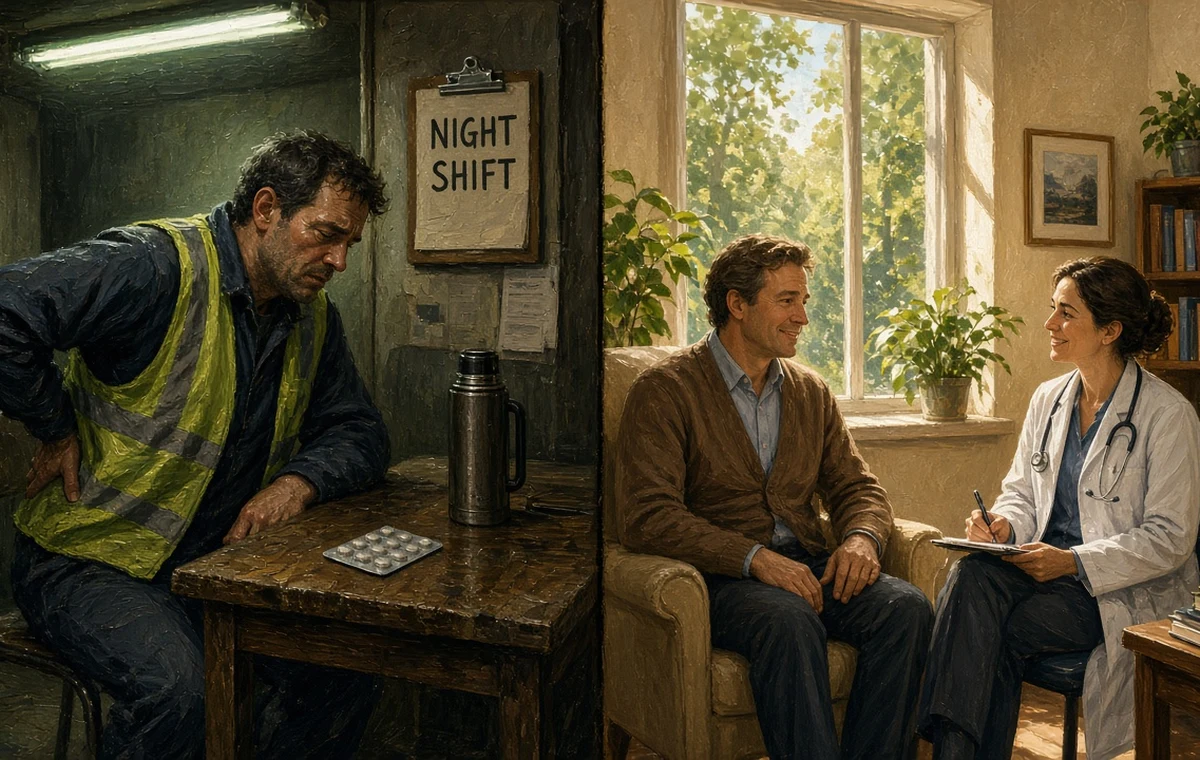
The important point is that these differences come less from personal willpower than from conditions such as time, money, information and support. A strong comparison identifies the stage where each group hesitates and links it to the social and economic conditions behind it.
Framing the analysis this way avoids blaming patients and leads to more useful recommendations.
How is it different from the Andersen model?
The Andersen model is a structural model. It explains whether people use services through predisposing, enabling and need factors. Suchman's model is a process model that follows the order of events and decisions as a person becomes ill and recovers.
| Model | Focus | Best for |
|---|---|---|
| Suchman | Stages and decisions over time | Finding where delays happen |
| Andersen | Personal traits, resources and need | Explaining who uses services |
| Health belief model | Perceived threat, benefits and barriers | Explaining preventive behaviour |
The health belief model is a useful third comparison because it focuses on how people weigh the threat of a disease against the benefits and barriers of acting. Using two models together lets you show which conditions block care and at which point in the illness process those barriers appear.
That combination often adds real depth to an analysis and is worth mentioning in the discussion section.
How can nurses use it?
Nurses can assess which stage a person has reached and tailor care to it. At the symptom stage, education about warning signs and when to seek help matters most. In the dependent patient role, the focus is on supporting adherence. At recovery, nurses help with self-management and the return to work and family life.
| Stage | Nursing focus |
|---|---|
| Symptom experience | Teach warning signs, such as chest pain or stroke signs that need 911 or 999 |
| Sick role and contact | Explain routes into care, such as NHS 111 or a primary care clinic |
| Dependent patient role | Support understanding of treatment and adherence |
| Recovery | Self-management, rehabilitation and return to work |
People with long-term conditions often move back and forth between stages as symptoms flare and settle. Regular follow-up and links to support networks keep treatment going far better than one-off education.
Reference: Suchman, E. A. (1965). Stages of illness and medical care. Journal of Health and Human Behavior, 6(3), 114 to 128.
Which wider ideas strengthen an assignment?
Once you know the five stages, natural questions follow. What does society expect from sick people? Why are some experiences now treated as medical problems? Do cultures read the same symptom differently? Who do we ask before we see a professional? Why do people delay? These five ideas connect the stages to the social forces behind them.
Student money tip on CampusDown Law Up: Surprise out-of-network ER bill? How to check and challenge it.
| Concept | Key idea | Use in an assignment |
|---|---|---|
| The sick role | Social expectations of people who are ill | Explaining stage 2 |
| Medicalisation | Life experiences such as ageing, birth, sleep and grief become medical issues | Context for stage 1 |
| Cultural reading of symptoms | The same pain may be endured in one culture and treated at once in another | Caring for diverse patients |
| Lay referral system | Family and friends consulted before a professional, described by Eliot Freidson | Comparing social networks |
| Delay in seeking care | Cost, fear, busy lives and playing down symptoms | Proposing interventions |
The lay referral system is especially useful. Before most people see a doctor, they ask a partner, a parent or a friend. Today that circle often includes online searches. In conditions where time matters, such as heart attack, stroke or cancer, delay can change the outcome, so suggesting a nursing intervention for each stage makes an assignment concrete.
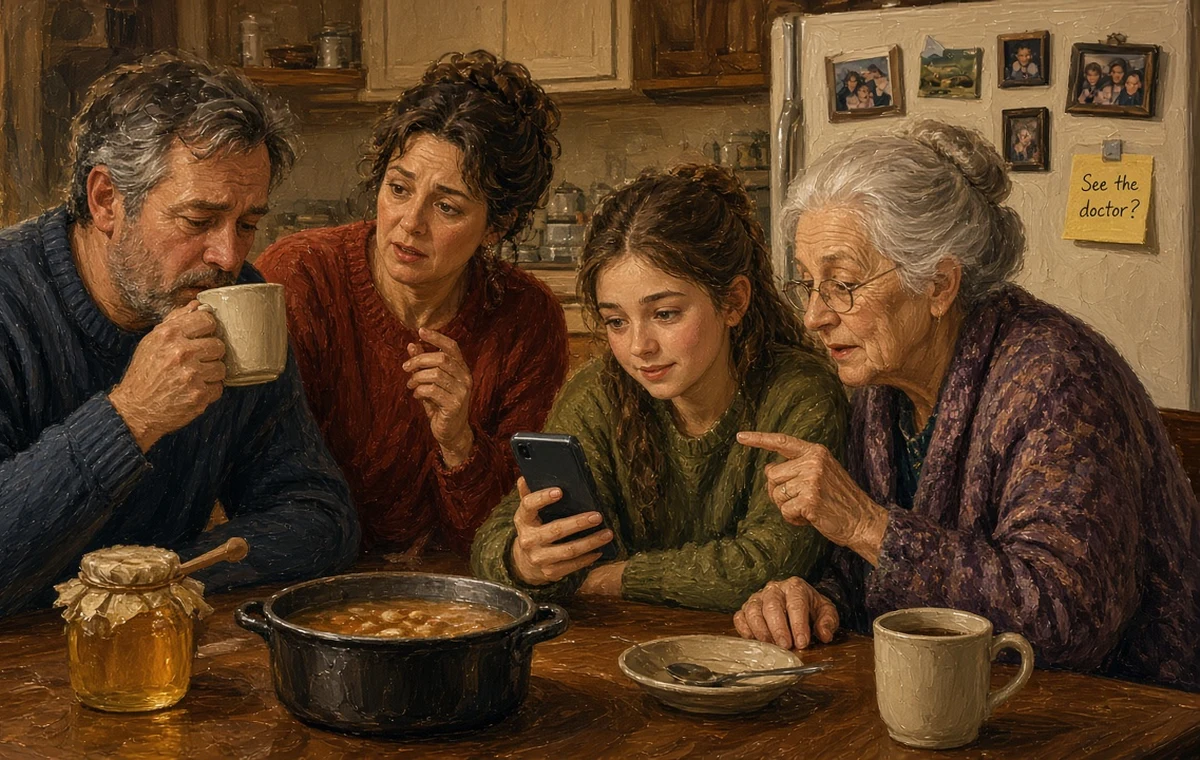
Linking these five ideas to the five stages through role, era, culture, network and time turns a description of the model into an analysis of how people really travel through illness.
FAQ
What are the limits of Suchman's model?
It was built around acute illness, so it fits long-term conditions, which cycle through stages, and preventive behaviour less well.
Who first described the sick role?
Talcott Parsons. Suchman built on the idea in his process model.
What is care-seeking behaviour?
The series of actions a person takes after noticing symptoms to get help and treatment.
Does the model still matter today?
Yes. It helps explain delays in seeking care and why people stop treatment, which remain key problems.
How does it differ from the Andersen model?
Andersen explains who uses services through factors, while Suchman follows the stages and decisions over time.