
Tai Chi Explained: Origins, the Five Major Styles, "Softness Overcomes Hardness" and What Harvard and the NIH Say About Balance
- Tai chi is an internal Chinese martial art grouped with xingyi and bagua, the opposite pole to external Shaolin boxing.
- It developed into five family styles, Chen, Yang, Wu (Hao), Wu and Sun, and joined UNESCO's heritage list in 2020.
- Its yielding principle now powers evidence-based balance and fall-prevention programs in US and UK hospitals and community centers.
Contents
- How did Chinese martial arts split into "internal" and "external" schools?
- What are the five major styles of tai chi?
- What does "softness overcomes hardness" mean in practice?
- What does the science say about tai chi for health?
- Why did tai chi move from martial lineage into Western wellness programs?
- FAQ
Tai chi (taijiquan) is a Chinese internal martial art that wins by yielding rather than by force, and it comes down to us through five major family styles: Chen, Yang, Wu (Hao), Wu and Sun. That is why a slow routine you might see at a YMCA or a hospital wellness room in Boston is, underneath, a fighting system built on one idea: softness overcomes hardness. In the US and UK, the same art is now one of the best-studied mind-body exercises for balance, fall prevention and stress.
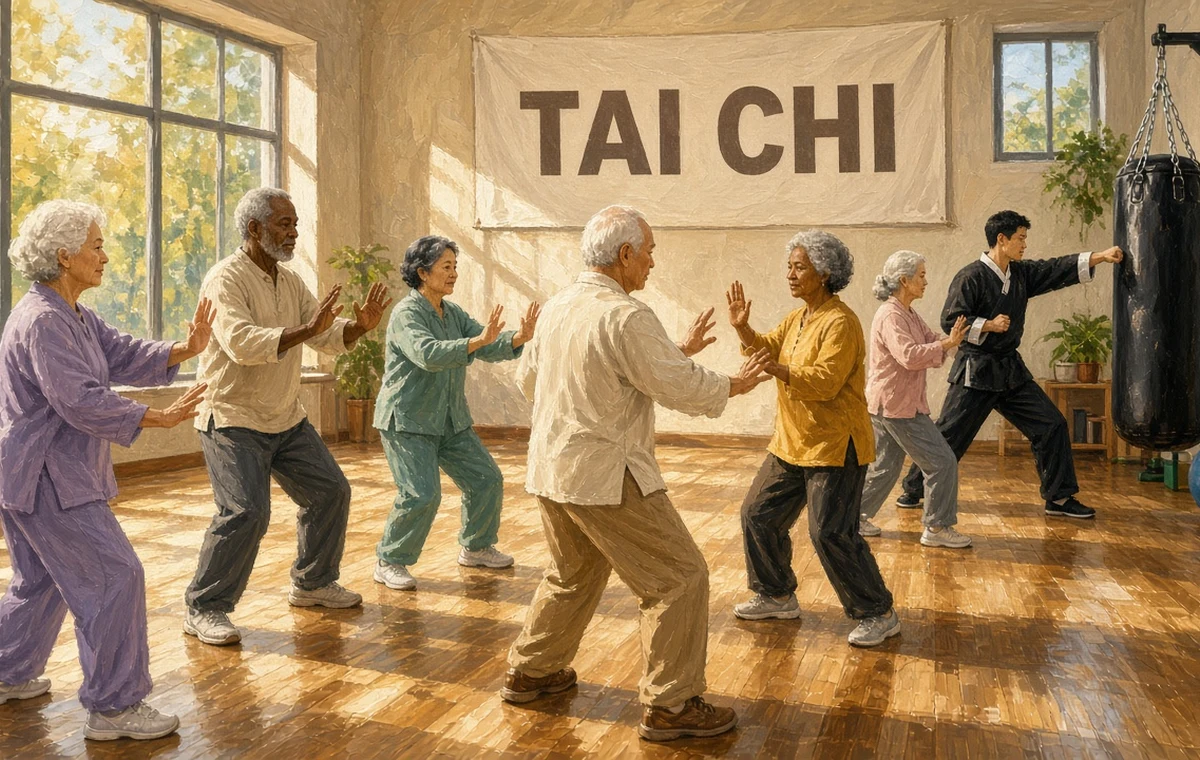
This guide explains where tai chi sits among Chinese martial arts, what separates the five styles, how the yielding principle actually works when someone pushes you, and what Harvard and the NIH say about the health claims, so you can tell the solid evidence from the wellness hype.
How did Chinese martial arts split into "internal" and "external" schools?
Chinese tradition likes a tidy origin story: martial arts began around 520 CE when the Indian monk Bodhidharma arrived at the Shaolin Temple. Historians treat that as legend, but the categories that grew out of later centuries are real and still useful. Martial arts are often sorted geographically, with the Yangtze River as the rough line between northern and southern styles, and conceptually into external (waijia) and internal (neijia) families.
Student money tip from CampusDown Life UpHow to make a simple monthly budget with the free CFPB worksheet — take-home pay, bills by due date, three spending buckets and a weekly check-in.
| Family | Typical examples | Main source of power | Training feel |
|---|---|---|---|
| External (waijia) | Shaolin boxing, long fist, hong quan | Muscle strength, speed, conditioning | Explosive, athletic, visibly hard |
| Internal (neijia) | Tai chi, xingyiquan, baguazhang | Structure, timing, breath and "internal energy" (qi) | Slow, relaxed, rooted, continuous |
Tai chi, xingyi and bagua are grouped together as the "three internal arts". The famous rival is Shaolin boxing, the archetype of the external school. Think of it this way: Shaolin trains the engine, tai chi trains the steering. Both matter, but they start from opposite ends.
Sorting by family is not a ranking. Many teachers practiced both, and modern historians point out that the internal/external label became popular in the late Qing dynasty partly as a cultural marketing story. Still, it explains why tai chi looks the way it does.

What are the five major styles of tai chi?
Tai chi is the most widely practiced martial art in China and, together with Shaolin, one of the two styles most people there would name first. From the Qing dynasty onward it branched into five family lineages, each keeping the same principles but changing stance height, speed and flavor. In 2020 UNESCO added taijiquan to its Representative List of the Intangible Cultural Heritage of Humanity.
| Style | Founding figure | Signature feel | Where English speakers meet it |
|---|---|---|---|
| Chen | Chen family of Chenjiagou, Henan | Oldest line, spiral power, sudden bursts (fajin) | Martial-focused clubs |
| Yang | Yang Luchan, who taught in Beijing | Large, even, flowing frames | Most US/UK community classes, the 24-form |
| Wu (Hao) | Wu Yuxiang | Compact, precise, upright | Rare, specialist schools |
| Wu | Wu Jianquan | Slight forward lean, small circles | Toronto and Hong Kong lineages |
| Sun | Sun Lutang | Agile "follow steps", mixes xingyi and bagua | Many arthritis-friendly programs |
If you join a class at a community center in Ohio or a leisure centre in Leeds, odds are you are learning a simplified Yang form. The Sun style is the base of the widely used "Tai Chi for Arthritis" program because its high stances and follow-steps are gentle on knees. Chen classes feel the most like martial arts, with stamps and explosive releases that surprise people who expected only slow motion.
Whichever style you meet, the shared core is the same: stay relaxed, keep the spine upright, move from the waist, and never fight force with force.
Skimming the section headings first makes a long guide much easier to map out. Try writing down one question of your own as you read.
What does "softness overcomes hardness" mean in practice?
The signature theory of tai chi is often written in English as "softness overcomes hardness" or "four ounces deflect a thousand pounds". Instead of building muscle quickly to overpower an opponent, the tai chi fighter tries to make an attack land on nothing, or to borrow its momentum and return it with interest.
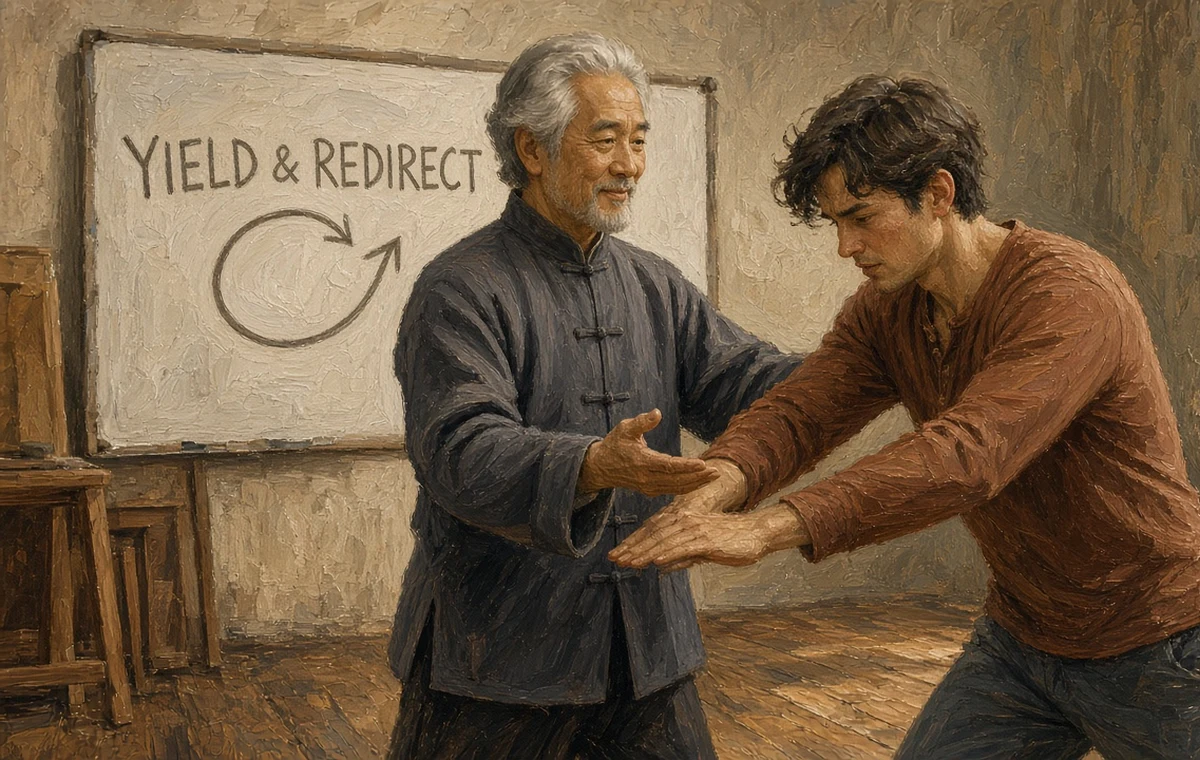
You can feel this in push hands, a two-person drill most schools teach. Your partner pushes; you neither collapse nor shove back. You stick lightly to their arms, turn your waist, and guide the force past your center. Physically it is simple mechanics: a straight push redirected along a circle loses its target, and the pusher's own momentum pulls them off balance.
- Listen (ting jin): feel the direction of the incoming force through light contact.
- Yield: give way just enough that the force finds no wall.
- Redirect: rotate the waist so the force slides past your center line.
- Issue: when the attacker is overextended, a small push finishes the job.
The name itself carries a philosophy. "Taiji" refers to the source from which yin and yang divide, and the routine keeps alternating empty and full, soft and firm. For the wider idea behind that pairing, see yin and yang and the five phases. The point for students is that the slowness is training, not the goal: you rehearse perfect structure slowly so it holds up when things get fast.
That is also why tai chi feels so different from a gym session. You are not trying to get stronger in six weeks; you are learning not to waste the strength you have.
What does the science say about tai chi for health?
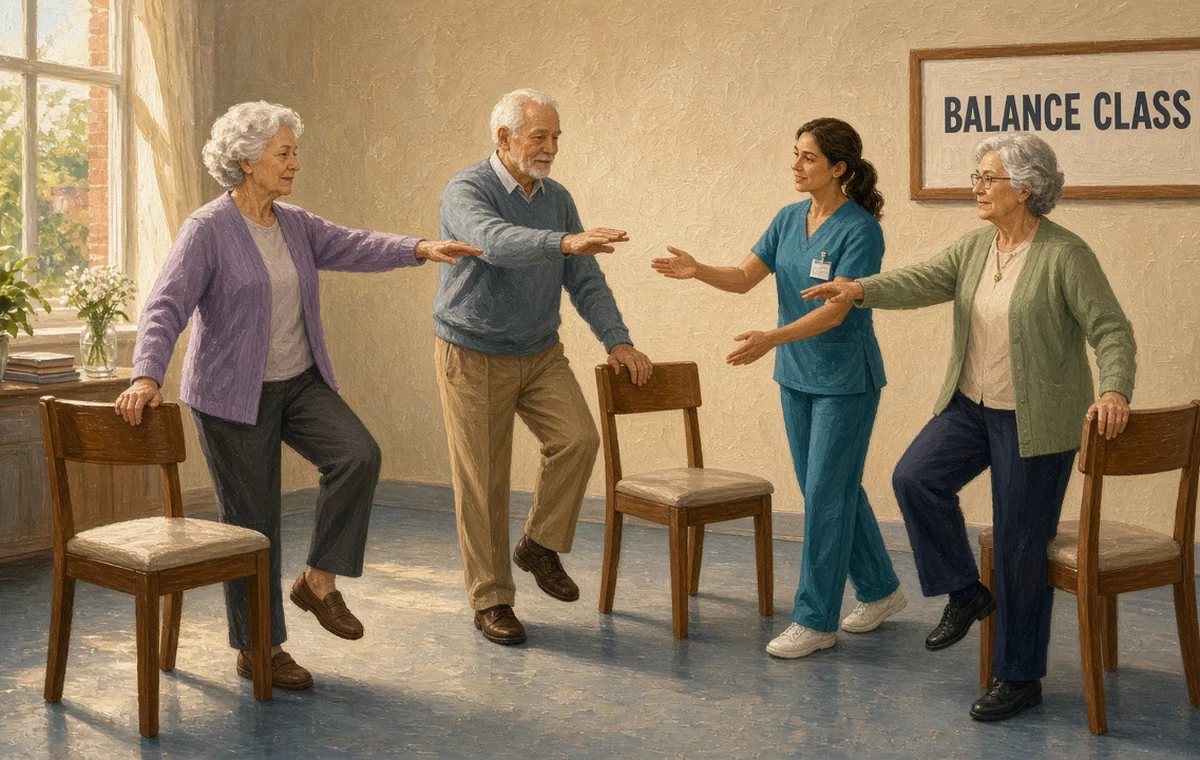
This is where tai chi made its leap from martial lineage to Western hospitals. Since the 1990s, randomized trials in the US have tested tai chi for older adults, and the findings were strong enough that hospitals, YMCAs and senior centers adopted it as a standard program.
| Claim | What studies found | Strength of evidence |
|---|---|---|
| Balance and fall prevention in older adults | A 2019 Cochrane review linked tai chi with roughly 19% fewer falls; the CDC's STEADI initiative lists "Tai Ji Quan: Moving for Better Balance" as an evidence-based program | Strong |
| Parkinson's disease | A 2012 New England Journal of Medicine trial (Li et al.) found better postural stability and walking than stretching | Good, mild-to-moderate cases |
| Shingles immunity | A UCLA trial (Irwin et al., 2007) found higher varicella-zoster immunity in older adults after 16 weeks of tai chi | Promising, small studies |
| Stress, mood, sleep | NIH NCCIH summarizes modest benefits for stress, anxiety and sleep quality | Moderate |
| Knee osteoarthritis, fibromyalgia | Tufts trials showed less pain and better function | Moderate |
The Parkinson's result is especially interesting because tai chi works on exactly what the disease erodes: shifting weight, turning and stepping in control. Read more about the condition in Parkinson's disease. The Harvard Medical School Guide to Tai Chi by Peter Wayne (2013) popularised the research for general readers and remains a good starting point.
In the UK, the NHS physical activity guidance for adults over 65 names activities such as tai chi for improving balance, and many councils fund falls-prevention classes in libraries and leisure centres. Keep claims honest: tai chi is not a cure, results vary, and anyone with a heart condition, recent surgery or severe osteoporosis should check with a clinician before starting.
Why did tai chi move from martial lineage into Western wellness programs?
Three things made the jump possible. First, the art is low-impact and needs no equipment, so it suits a church hall, a hospital conference room or a park. Second, the Yang family and later teachers simplified long routines; the 24-form created in China in 1956 fits in about six minutes and can be taught in weeks. Third, the research above gave doctors something they could prescribe.
Student money tip on CampusDown Life Up: How to make a simple monthly budget with the free CFPB worksheet.
| Setting | Typical format | Cost |
|---|---|---|
| Hospital or health-system wellness program | 8 to 12-week balance course, chair-supported | Often free or insurer-covered (some Medicare Advantage plans) |
| YMCA, senior or community center | Weekly drop-in Yang or Sun style | Low |
| UK council or NHS-referred falls class | Strength and balance course including tai chi moves | Free or subsidised |
| Martial arts school | Chen or traditional Yang, forms plus push hands | Monthly membership |
The flip side is that some classes keep the choreography and drop the martial meaning. That is fine for health, but if you are curious why each move exists, ask your teacher to show the application. It usually makes the posture click.
How does tai chi relate to qigong, Wudang and modern wushu?
Qigong is the umbrella term for breathing-and-posture exercises aimed mainly at health; tai chi shares its relaxed breathing but keeps a martial structure. Wudang Mountain in Hubei, a Taoist sacred site and UNESCO World Heritage property, is linked by legend to the monk Zhang Sanfeng as the birthplace of the internal arts, much as Shaolin symbolises the external school. Wuqinxi, the "Five Animal Frolics" credited to the Han dynasty physician Hua Tuo, is an older animal-based health routine often taught alongside tai chi. And in modern competitive wushu, tai chi appears as a scored taolu (forms) event, including at the Asian Games.
Seen together, these show tai chi as a crossroads of martial art, Taoist philosophy, health practice and modern sport, which is why it fits so comfortably into a student essay as well as a Tuesday morning class.
Common mistakes
- Locking the knees or letting them drift past the toes.
- Holding the breath during slow moves instead of breathing naturally.
- Treating it as "just stretching" and losing the weight shifts that train balance.
- Promising cures from small studies.
Quick self-check
- Can you name the five styles and the one most US/UK classes teach?
- Can you explain yield and redirect without saying "magic energy"?
- Do you know which health claims have strong evidence?
Compiled by the CampusDown editorial team from the Harvard Medical School Guide to Tai Chi (Wayne and Fuerst, 2013), NIH NCCIH summaries, CDC STEADI materials, NHS activity guidance and published trials cited above. Reviewed November 2026.
FAQ
Which tai chi style do most US and UK classes teach?
Mostly a simplified Yang style, often the 24-form. Arthritis-focused programs frequently use Sun style because of its high, gentle stances.
Is tai chi really a martial art?
Yes. It is an internal martial art based on yielding and redirecting force, practiced slowly to perfect structure. Push hands drills show the martial side.
Does tai chi prevent falls?
Strong evidence says it reduces falls in older adults; a 2019 Cochrane review linked it with about 19% fewer falls, and the CDC lists a tai chi program as evidence-based.
How is tai chi different from qigong?
Qigong is a broad family of breathing and posture exercises focused on health. Tai chi shares the relaxed breathing but keeps a martial structure and applications.
Is tai chi safe for people with Parkinson's disease?
Trials such as Li et al. (2012) found benefits in mild to moderate cases, but people should start with a qualified instructor and check with their clinician first.