
Strategic Planning vs Long-Range Planning: Stages, SWOT and the BCG Matrix
- Long-range planning projects past trends forward, while strategic planning starts from a changing environment.
- Strategic planning runs in a cycle of environmental analysis, strategy choice, implementation and evaluation.
- SWOT turns analysis into cross strategies, and the BCG matrix helps set priorities across units.
Contents
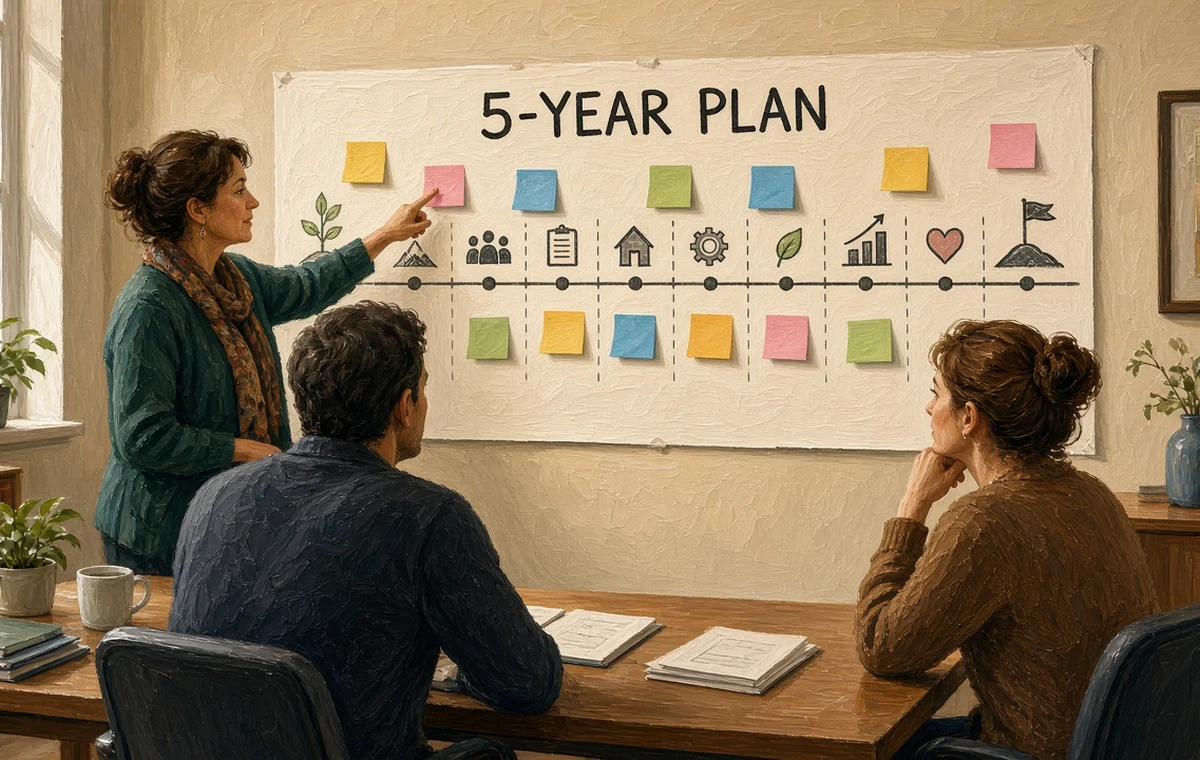
Strategic planning is a way of setting an organisation's direction and priorities by analysing its changing external environment and its internal capabilities, then revising the plan whenever the environment shifts. Long-range planning, by contrast, mainly projects past trends forward to fix goals and budgets several years ahead. The key difference is the question each asks: long-range planning asks "what will we achieve in five years?", while strategic planning asks "if the world changes, what should we do?". Both appear constantly in public administration, social work management and business courses, so this guide compares them, walks through the stages and shows where SWOT and the BCG matrix fit.
How is strategic planning different from long-range planning?
Long-range planning usually sets goals, programmes and budgets for five years or more in advance. It works well when the environment is fairly stable and the future can be predicted as an extension of the past.
Student money tip from CampusDown Law UpComplaint letter templates for hidden charges, billing errors and refunds — copy-ready letters plus where to escalate, from the company to small claims.
Strategic planning gained ground in the 1970s and 1980s, when oil shocks, inflation and fast-changing markets showed that forecasting alone was not enough. John Bryson's work on strategic planning for public and nonprofit organisations, first published in 1988, helped carry the approach from business into government and charities.
| Aspect | Long-range planning | Strategic planning |
|---|---|---|
| Core question | What will we achieve in a few years? | If the environment changes, what should we do? |
| View of the future | Predicted by extending past trends | Uncertain; several possibilities considered |
| Focus of analysis | Internal goals and resource allocation | Fit between external environment and internal capabilities |
| Nature of the plan | Closer to a fixed blueprint | Reviewed and revised regularly |
| Best suited to | Stable, predictable conditions | Fast-changing, competitive conditions |
The two are not enemies. Many organisations use strategic planning to choose direction and priorities, then build yearly targets and budgets within that direction. In an essay, make the difference clear but also note that the two complement each other.

What do public bodies in the UK and US actually do?
Real public-sector plans often blend both approaches, which makes them useful examples for coursework and shows that the textbook contrast is a spectrum rather than a strict divide.
In the United States, the Government Performance and Results Act of 1993 required federal agencies to publish strategic plans with goals and performance measures, and the GPRA Modernization Act of 2010 tied those plans to a four-year cycle with regular progress reviews. In the UK, the NHS Long Term Plan published in 2019 set out a ten-year vision, while councils and charities typically publish multi-year corporate or strategy documents that are refreshed as funding and local needs change.
| Example | Time frame | Long-range features | Strategic features |
|---|---|---|---|
| US federal agency strategic plans (GPRA) | Four-year cycle | Fixed goals and performance targets | Regular reviews and updates |
| NHS Long Term Plan (2019) | Ten years | Long-term commitments and investment | Priorities adjusted as pressures change |
| Council or charity strategy | Usually three to five years | Multi-year budget and service targets | Annual review against local needs and funding |
When you analyse such a document, ask whether it simply extends current activity forward or whether it scans the environment, names strategic issues and builds in a review cycle.
Skimming the section headings first makes a long guide much easier to map out. Try writing down one question of your own as you read.
What are the stages of strategic planning?
Textbooks name the stages slightly differently, but the flow is broadly the same and can be summarised in five steps.
- Confirm mission and vision: clarify why the organisation exists and what it wants to become.
- Analyse the environment: look at political, economic, social and technological factors outside and at people, finances and services inside.
- Identify strategic issues: pick out the core issues the organisation must respond to.
- Develop and choose strategies: create options for each issue and compare feasibility and impact.
- Implement and evaluate: set an action plan, check results and feed them into the next round.

The stages that most clearly separate strategic planning from long-range planning are environmental analysis and evaluation after implementation. Treating outside change as the starting point, and revising the plan based on evaluation, creates the cycle that defines strategic planning.
Where do SWOT and the BCG matrix fit?
The most common tool at the environmental analysis stage is SWOT analysis, which sets internal strengths and weaknesses against external opportunities and threats. Its origins are often credited to 1960s research at the Stanford Research Institute, though the history is disputed.
From the grid you derive four cross strategies: SO strategies use strengths to seize opportunities, WO strategies fix weaknesses to capture opportunities, ST strategies use strengths to counter threats and WT strategies reduce weaknesses and threats together.
An organisation running several services or business units may also use the BCG matrix, devised by Bruce Henderson of the Boston Consulting Group around 1970. Units are placed by market growth rate and relative market share into Stars, Cash Cows, Question Marks and Dogs, which helps decide where to invest. Public and nonprofit bodies adapt it carefully, because "market share" may mean reach or demand rather than sales.
| Stage | Common tool | Output |
|---|---|---|
| External environment analysis | PEST analysis | List of macro-level opportunities and threats |
| Combining internal and external | SWOT analysis | Cross-strategy options |
| Portfolio decisions | BCG matrix | Resource priorities by unit |
| Implementation planning | Gantt chart | Tasks, schedule and owners |
Pick tools to match the stage. Rather than cramming every tool into one assignment, choose two or three that suit the organisation you are analysing and make sure each result flows into the next stage.
Where do assignments usually lose marks?
Marks are lost less on defining the concepts than on applying them to a case. Three mistakes are especially common.
- Calling long-range planning "strategic planning that takes longer". The dividing line is how each views the environment, not the time span.
- Stopping at the SWOT table. Listing strengths and weaknesses gives analysis without strategy; carry it through to cross strategies and an action plan.
- Leaving out evaluation and revision. Without the feedback loop, your answer becomes indistinguishable from long-range planning.
Suppose a social policy student is analysing a three-year plan for a community centre for older people. A long-range approach would extend the last three years' growth in users to decide how many programmes to run. A strategic approach would set changes in the local older population, new services at nearby providers and the centre's staffing into a SWOT grid, choose priority programmes and review the plan every year. This is a made-up example to illustrate the difference.
- Have you explained the difference by view of the environment rather than time span?
- Have you set out the stages in order?
- Have you turned SWOT results into cross strategies?
- Have you included the cycle of evaluation and revision?
Answering yes to all four is usually what moves an essay from description to genuine analysis.
How should you wrap up a strategic planning report?
A clear order helps: the meaning and types of planning, the difference between long-range and strategic planning, the stages of strategic planning, a SWOT and cross strategies for your chosen organisation, the implementation and evaluation plan, and a conclusion.
Student money tip on CampusDown Law Up: Complaint letter templates for hidden charges, billing errors and refunds.

In the conclusion, stress that strategic planning is not a document written once and filed away but a process rewritten as the environment changes, and that public and nonprofit organisations must weigh public value and participation alongside efficiency. If you want a more systematic look at the outside world first, start with a PEST analysis of political, economic, social and technological factors before building the SWOT.
Compiled by the CampusDown editorial team from a Korean article comparing strategic and long-range planning, adapted with public information on the Government Performance and Results Act 1993, the GPRA Modernization Act 2010 and the NHS Long Term Plan (2019). Sources: John Bryson's work on strategic planning for public and nonprofit organisations; the Boston Consulting Group's growth-share matrix; standard public administration and management textbooks. Reviewed November 2026. Stage names vary between textbooks, so follow the terms used in your course.
FAQ
Is long-range planning just strategic planning over a longer period?
No. The difference lies in how each views the environment: long-range planning extends past trends, while strategic planning assumes uncertainty and revises the plan as conditions change.
What are SWOT cross strategies?
SO uses strengths to seize opportunities, WO fixes weaknesses to capture opportunities, ST uses strengths against threats, and WT reduces weaknesses and threats together.
What are the four quadrants of the BCG matrix?
Stars, Cash Cows, Question Marks and Dogs, placed by market growth rate and relative market share.
Do US federal agencies have to write strategic plans?
Yes. The Government Performance and Results Act of 1993, updated in 2010, requires agencies to publish strategic plans with goals and regular progress reviews.
Which stage most distinguishes strategic planning?
Environmental analysis at the start and evaluation with revision at the end, which together create a continuous cycle.